

Third-party property management is defined as the practice of contracting an independent firm to handle the day-to-day operations of a rental property on behalf of the owner. These firms act as intermediaries between owners and tenants, coordinating maintenance, financial management, rule enforcement, and vendor oversight under a formal agreement. The owner retains ultimate legal and financial responsibility, but the firm executes the operational work. For real estate investors managing multiple units or properties across different markets, this arrangement separates ownership from operations in a way that in-house staffing rarely achieves at the same cost or scale.
What is third-party property management and what does it cover?
Third-party property management services include tenant screening, leasing, rent collection, maintenance coordination, property inspections, and regulatory compliance. These are the core operational responsibilities that owners commonly delegate to an outside firm. The industry term for this arrangement is "contracted property management," though "third-party management" is the phrase most owners and investors use in practice.
Here is what a full-service third-party management agreement typically covers:
- Tenant screening and leasing. The firm advertises vacancies, screens applicants against Fair Housing Act standards, executes lease agreements, and handles move-in coordination.
- Rent collection and financial reporting. The manager collects rent, tracks income and expenses, and delivers owner statements on a regular cadence. You can read more about what good owner reporting looks like and what to expect from your firm.
- Maintenance and repair coordination. The firm receives tenant requests, dispatches vendors, tracks work orders, and handles emergency responses. This is often the highest-volume operational task.
- Property inspections and turnover management. Move-out inspections, unit turnovers, and periodic condition checks fall under the firm's scope.
- Legal compliance. The manager monitors adherence to local landlord-tenant laws, habitability standards, eviction procedures, and anti-discrimination regulations. Property management compliance is a distinct discipline that high-performing firms treat as a core competency, not an afterthought.
Not every agreement covers all of these areas. Leasing-only agreements, for example, limit the firm's role to finding and placing tenants, with the owner handling everything after lease execution. Full-service agreements delegate the entire operational scope listed above.
Pro Tip: Before signing any management agreement, ask the firm to walk you through a sample owner statement and a sample maintenance work order. How they present financial data and track repairs tells you more about their operational discipline than any sales conversation will.

How does third-party management differ from in-house management?
The core structural difference is employment status. In-house property managers are employees or volunteers of the ownership entity. Third-party firms are independent contractors operating under a service agreement. That distinction carries real consequences for cost, liability, and operational capacity.
| Factor | Third-party management | In-house management |
|---|---|---|
| Employment relationship | Independent contractor | Employee or volunteer |
| Vendor network access | Established, multi-client networks | Limited to owner's direct relationships |
| Technology platforms | Firm provides AppFolio, Buildium, or Yardi | Owner must license and maintain separately |
| HR and training costs | Absorbed by the firm | Borne entirely by the owner |
| Compliance expertise | Firm specializes in local regulations | Depends on individual employee knowledge |
| Continuity risk | Firm absorbs staff turnover internally | Owner loses institutional knowledge if manager leaves |
Third-party firms often have access to vendor networks and technology platforms that provide efficiencies individual owners cannot replicate easily. A firm managing 500 units across a market negotiates better rates with plumbers, electricians, and landscapers than a single-property owner ever will. That purchasing power alone frequently offsets the management fee.
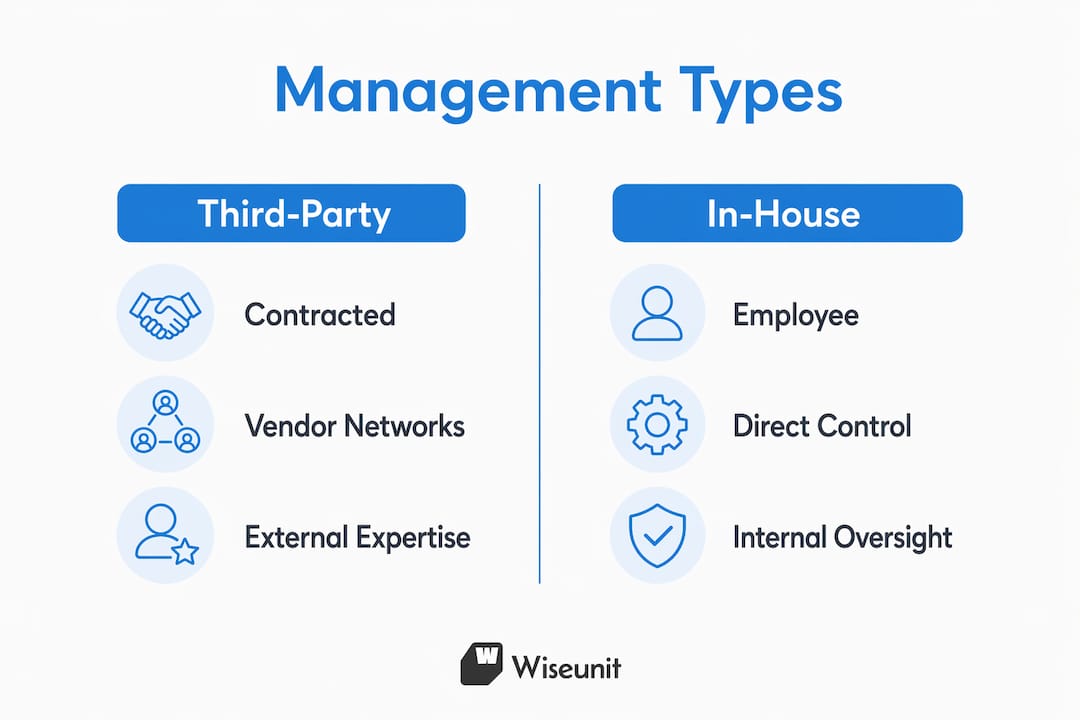
In-house management offers tighter daily control, which some owners genuinely value. But the hidden costs are real: recruiting, onboarding, benefits, training, and the operational disruption when a key employee leaves. Third-party management transfers those risks to the firm, which has a structural incentive to maintain continuity because its own revenue depends on it.
What should owners know about the property management agreement?
The management agreement is the operating system for the entire owner-manager relationship. Management agreements control the authority of property managers, including approval limits, rent collection methods, and dispute handling. Every operational expectation you have must be written into this document, because verbal understandings do not hold up when disagreements arise.
Key clauses every owner should review before signing:
- Spending authority limits. The agreement should specify the dollar threshold above which the manager must seek owner approval before authorizing repairs or expenses. A common threshold is $500 per incident, though this varies by portfolio size.
- Rent collection and disbursement schedule. The contract should define when rent is collected, when late fees apply, and when the owner receives their net proceeds each month.
- Indemnification and liability allocation. Owners remain legally responsible for landlord duties despite delegating operational tasks. The agreement should clarify which party bears liability for specific failure scenarios, such as a missed habitability repair or a Fair Housing violation.
- Termination clauses. Understand the notice period required to exit the agreement and whether there are penalties for early termination.
- Reporting cadence. The contract should specify how often you receive financial statements, inspection reports, and maintenance summaries.
Property management company liability is a nuanced area where many owners underestimate their own exposure. Delegating operations does not transfer legal accountability. If a tenant is injured due to a deferred repair, the owner is typically named in any resulting claim alongside the management firm.
Pro Tip: Negotiate a 30-day termination clause with no penalty if the firm fails to meet specific performance benchmarks, such as response time to maintenance requests or monthly reporting deadlines. Most reputable firms will accept this because they are confident in their service quality.
What are the benefits and common challenges of third-party property management?
The primary third-party management benefit is the reduction of owner workload without sacrificing professional oversight. High-performing firms deliver operational excellence, appropriate risk management, and market-savvy service that most self-managing owners cannot match at scale. But the advantages come with trade-offs that owners need to anticipate.
Benefits owners consistently report:
- Reduced day-to-day stress from tenant calls, maintenance emergencies, and lease renewals
- Access to professional leasing expertise that reduces vacancy periods
- Systematic rent collection with lower delinquency rates than self-managed portfolios
- Vendor relationships that lower per-unit maintenance costs over time
- Compliance monitoring that reduces exposure to Fair Housing and habitability violations
Common challenges to plan for:
- Communication gaps when the firm does not proactively update owners on significant issues
- Decision-making friction when spending authority limits are set too low, causing delays on routine repairs
- Financial risk if the firm does not maintain segregated trust accounts for tenant deposits and collected rents. Commingling funds is a regulatory violation in most states and a red flag for any firm you are evaluating.
- Performance variability across firms, which means the selection process matters as much as the decision to outsource
Phased outsourcing reduces initial friction by delegating specific tasks first, such as maintenance coordination or accounting, before handing over full operational control. Experienced investors often start with the highest-volume, most time-consuming tasks and expand the firm's scope once trust is established. This approach also gives you a clear view of how the firm operates before you are fully dependent on them.
When evaluating firms, ask for references from owners with portfolios similar to yours in size and property type. A firm that excels at managing large multifamily communities may not be the right fit for a scattered-site single-family portfolio, and vice versa. You can also review selection criteria for property managers to build a structured evaluation framework before you start interviewing firms.
Key takeaways
Third-party property management works best when owners treat it as a structured partnership, not a complete handoff. The management agreement, firm selection, and ongoing communication determine whether the arrangement delivers its full value.
| Point | Details |
|---|---|
| Core definition | A third-party firm handles daily operations under contract while the owner retains legal responsibility. |
| Agreement is foundational | Spending limits, reporting cadence, and liability allocation must all be written into the management contract. |
| Vendor and tech advantages | Third-party firms offer access to vendor networks and platforms like AppFolio or Buildium that reduce per-unit costs. |
| Financial controls matter | Segregated trust accounts for deposits and rents are non-negotiable and a key evaluation criterion. |
| Phased outsourcing works | Starting with maintenance or accounting tasks reduces disruption and builds trust before full delegation. |
Why "hands-off" is the wrong frame for third-party management
Most owners I have worked with come into third-party management expecting to disappear from operations entirely. That expectation is the single most common source of disappointment I have seen. The firms that deliver the best results are the ones where the owner stays engaged on financial decisions, reviews monthly statements with genuine attention, and communicates clearly when priorities shift.
The management agreement is not a release of responsibility. It is a delegation of execution. Owners who treat it as the former end up surprised when a deferred repair becomes a liability claim or when vacancy rates climb because the firm did not know the owner's income targets had changed.
What I have found actually works is treating the firm as a specialized operational partner, not a substitute for ownership judgment. Set spending authority limits that give the firm room to act on routine repairs without constant approval requests, but require notification on anything above a defined threshold. Review financial statements monthly, not quarterly. Ask for a maintenance summary at least once a month so you can see response times and open work orders.
Not all third-party management firms are alike. Selecting a high-performing firm requires evaluating their operational sophistication, local market knowledge, and compliance practices before you sign. The firms worth working with will welcome that scrutiny. The ones that resist detailed questions about their processes are telling you something important.
— Laur
How Wiseunit helps property managers deliver on their service commitments
Property managers who take on third-party management contracts face real operational pressure to deliver fast, consistent maintenance responses across every unit they manage. That is exactly where Wiseunit operates.
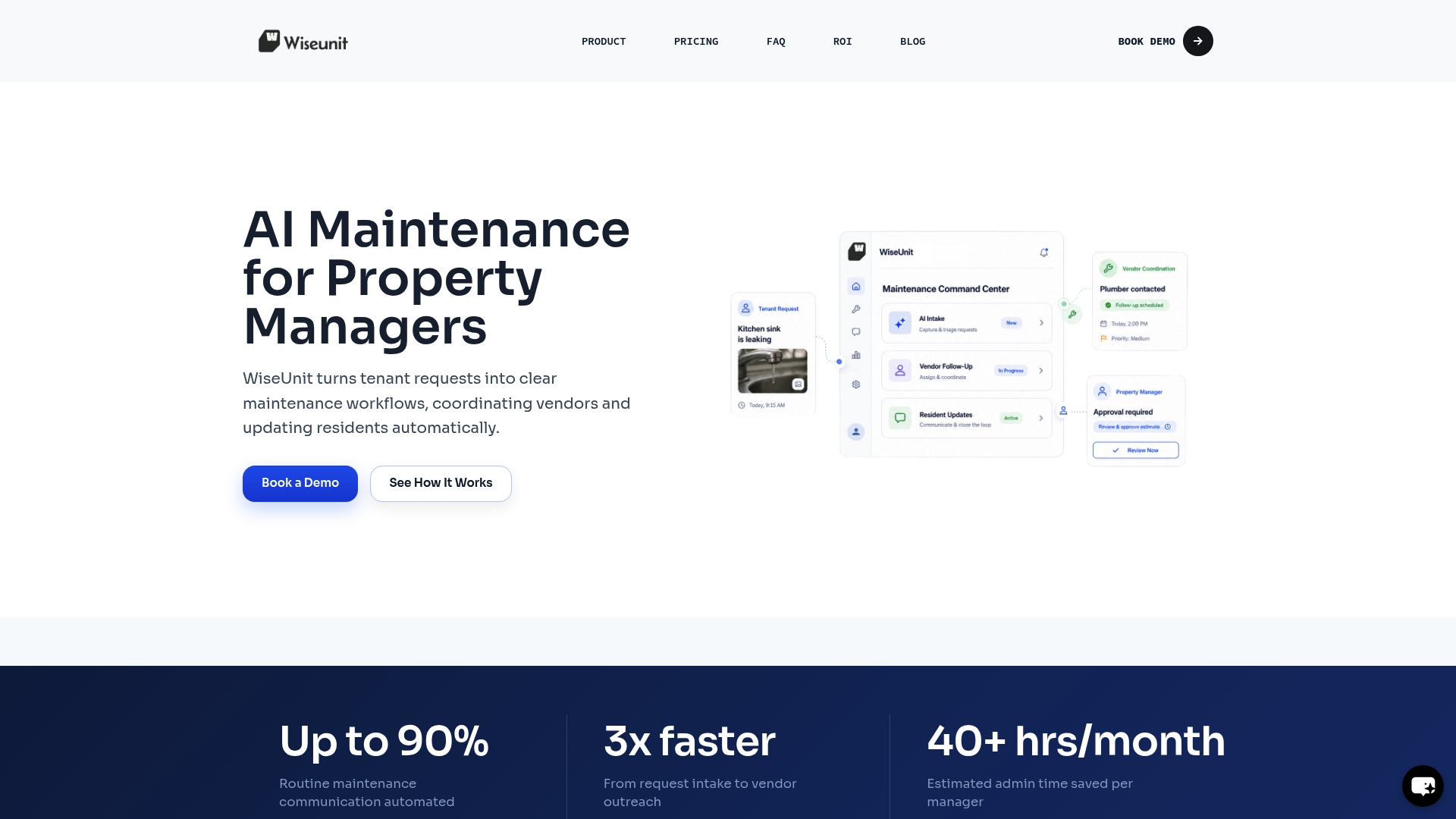
Wiseunit is an AI-powered maintenance execution platform built for property management companies managing multifamily, single-family rental, and HOA portfolios. Instead of tracking tickets, Wiseunit executes the full maintenance workflow: tenant intake via call, SMS, or online form; issue triage; vendor coordination; scheduling; and status updates inside systems like AppFolio, Buildium, or Yardi. Property managers using Wiseunit handle higher unit volumes without adding maintenance coordinators. If you want to see what that looks like for your portfolio, explore AI maintenance coordination from Wiseunit or run your numbers through the ROI calculator.
FAQ
What is third-party property management in simple terms?
Third-party property management is when a property owner hires an independent company to handle the day-to-day operations of their rental property, including tenant communication, rent collection, and maintenance coordination, under a formal management agreement.
Does hiring a third-party manager remove the owner's legal liability?
No. Owners remain legally responsible for landlord duties such as habitability, security deposit handling, and Fair Housing compliance even when a third-party firm manages daily operations. The management agreement allocates specific responsibilities but does not transfer the owner's underlying legal obligations.
What should a property management agreement include?
A management agreement should define the firm's spending authority limits, rent collection and disbursement schedule, reporting cadence, indemnification terms, and termination conditions. Every operational expectation should be written into the contract before signing.
How do third-party firms handle tenant security deposits?
Reputable firms maintain segregated trust accounts that keep tenant deposits separate from operating funds. Commingling deposits with other accounts is a regulatory violation in most U.S. states and a clear warning sign during the evaluation process.
What is phased outsourcing in property management?
Phased outsourcing means delegating specific tasks, such as maintenance coordination or accounting, to a third-party firm before transferring full operational control. This approach reduces disruption and allows owners to evaluate the firm's performance before full dependence.