

If you own rental property and work with a management company, understanding what is property management company liability could be the most important thing you do to protect your investment. Many owners assume that handing off management duties means handing off legal risk too. That assumption is wrong, and courts have made it expensive for those who learned the hard way. Liability in this space is shaped by contracts, degrees of control, and legal compliance. This guide breaks down exactly how it works, where the real risks hide, and what you can do about them.
Table of Contents
- Key takeaways
- What is property management company liability
- How courts determine legal liability
- Hidden liability risks most owners miss
- Practical steps to reduce your exposure
- My take on liability most owners still get wrong
- How Wiseunit helps reduce maintenance liability risk
- FAQ
Key takeaways
| Point | Details |
|---|---|
| Liability depends on control | Courts assign responsibility based on who controls the property and what the management contract defines. |
| Insurance has specific gaps | General and professional liability policies are required but do not cover every exposure, especially environmental and cyber risks. |
| Contracts define risk allocation | Vague or outdated management agreements are the leading cause of costly legal disputes for both owners and managers. |
| Documentation is your defense | Inspection records, repair logs, and written communications are the most effective tools against negligence claims. |
| Both parties can be liable | Owners and managers can face joint liability when control and responsibility overlap without clear contractual boundaries. |
What is property management company liability
Property management company liability refers to the legal and financial responsibility a management firm carries when something goes wrong on a property it operates. This includes physical injuries, maintenance failures, wrongful evictions, and professional errors. The challenge is that liability does not fall neatly on one party. It is distributed based on who controlled what, when, and under what contractual terms.
There are three primary liability categories every property owner should understand.
- General liability: Covers bodily injury and property damage claims from third parties, such as a visitor who slips in a poorly maintained parking lot. Standard coverage is typically $1 million per occurrence.
- Professional liability (Errors & Omissions): Covers management errors like mishandling a lease renewal, a wrongful eviction, or a failure to collect rent properly. E&O insurance runs around $83 per month on average and is not optional for serious firms.
- Premises liability: Applies when someone is injured in a common area due to a hazard the management company should have addressed. A broken stair railing that causes a fall is a textbook example.
The industry standard requires $1 million per claim for professional liability coverage, and most reputable firms carry both general and professional policies. But having insurance does not mean all liability is resolved. Policies have exclusions, and a claim that falls outside coverage terms becomes a personal financial problem fast.
Pro Tip: Ask your property management company for a current certificate of insurance before signing any agreement. Verify both the coverage type and the limits.
How courts determine legal liability
The legal liability of property companies is not guessed at. Courts apply a fairly consistent framework that looks at three things: degree of control, contractual duties, and whether there was negligence.
Courts determine liability based on the degree of control exercised over the property. A manager who handles everything from leasing to maintenance decisions carries more exposure than one who simply collects rent. The more authority a manager has, the more courts will expect them to have exercised it responsibly.
The responsibilities of property management that create liability exposure include:
- Failing to address known safety hazards in a reasonable time
- Ignoring repeated tenant complaints about defective conditions
- Not performing required safety inspections or missing regulatory deadlines
- Hiring unlicensed or uninsured vendors who cause additional damage
- Making leasing decisions that violate fair housing regulations
The management agreement is the document that defines where a manager's authority starts and stops. Vague language creates shared liability. If the contract says the manager "may" handle repairs rather than "shall," and a repair is not made, the dispute about who was responsible lands in court. Legal disputes arise from gaps in management agreements and the absence of defensible compliance records.
Joint liability is another real scenario. When an owner retains some control, such as approving all repairs over a certain dollar amount, and a delayed repair leads to an injury, both the owner and the manager may face claims. Courts look at the totality of who had the ability to act and who failed to act.
Pro Tip: Review your management agreement with a real estate attorney every 12 to 18 months. Laws change, and a contract that was solid two years ago may have gaps today.
Hidden liability risks most owners miss
The impact of liability on property managers goes well beyond slip-and-fall claims. Several exposure categories are less obvious but equally serious. Treating them as secondary concerns is a mistake.
-
Environmental compliance failures. Lead paint disclosures, asbestos handling, and mold remediation all carry strict regulatory requirements. Unlicensed mold remediation can trigger regulatory and civil liability that basic insurance does not cover. Owners often assume the manager handles this automatically. Managers often assume the owner is tracking compliance requirements. The gap between those assumptions is where lawsuits start.
-
Employment-related claims. If the management company employs on-site staff at your property, wage and hour violations or workplace harassment claims can pull you in as a co-defendant. Your exposure depends on how the management agreement defines the employment relationship.
-
Cybersecurity breaches. Property managers hold sensitive data including tenant Social Security numbers, bank account information, and financial records. Data breach liability is an emerging risk that traditional property management insurance may not fully cover.
-
Contract authority overreach. Managers can bind owners to financial obligations beyond what they were authorized to approve. If a manager signs a vendor contract that exceeds their contractual authority, the owner may still be held responsible for payment or consequences.
"The biggest source of severe liability comes from unexamined contract gaps and late legal intervention." Treating your management agreement as a living document, not a one-time filing, is the shift that separates informed owners from reactive ones.
For multifamily properties specifically, secure common areas and well-maintained shared spaces are not just amenities. They are liability management tools that reduce premises exposure.
Practical steps to reduce your exposure
Property management liability explained clearly comes down to this: risk is not eliminated, but it is manageable with the right systems in place. Here is what actually works.
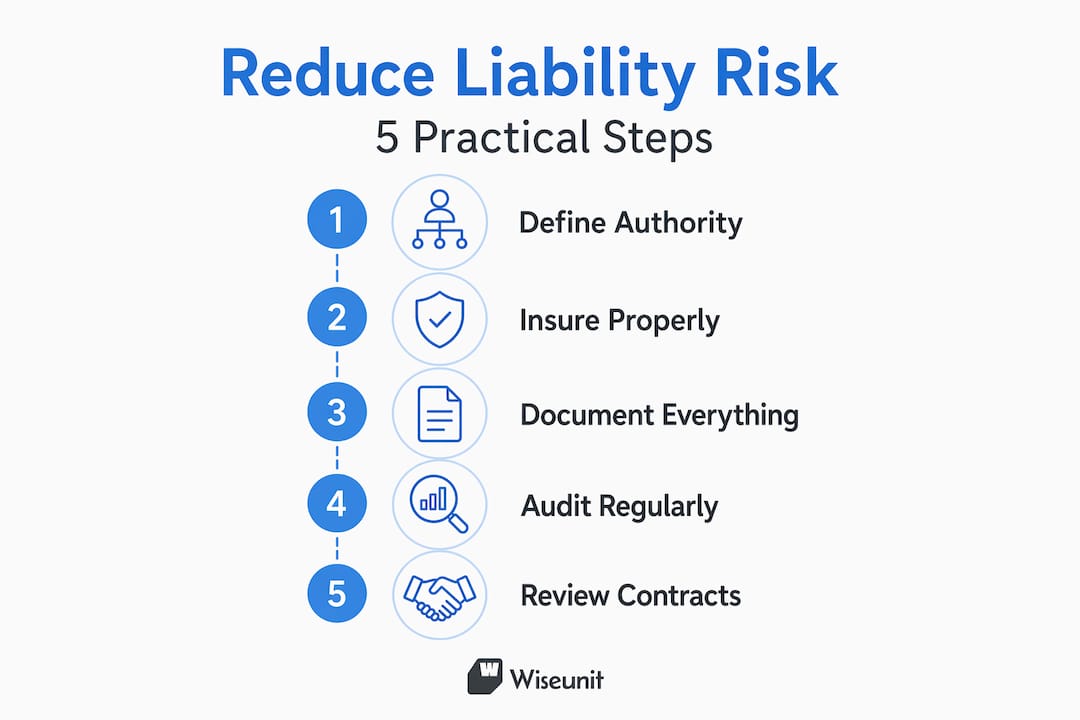
Structuring your management agreement correctly
A well-written management agreement should define every category of authority. Specify which repairs the manager can approve without owner sign-off. Define inspection frequency. Assign compliance responsibilities by name. Agreements should be reviewed regularly to reflect changes in legal requirements and ownership circumstances.
Insurance coordination between owner and manager
The single most common gap in property management insurance coverage is the failure to name the management company as an additional insured on the owner's policy.
| Coverage type | Owner's responsibility | Manager's responsibility |
|---|---|---|
| General liability | Carry property coverage, add manager as additional insured | Carry own general liability policy |
| Professional liability (E&O) | Verify manager carries this coverage | Maintain active E&O policy |
| Premises liability | Ensure property coverage includes common areas | Document hazard response and inspections |
| Environmental liability | Know what your policy excludes | Track regulatory compliance and licensing |
Being an "interested party" on an insurance policy is not the same as being an additional insured. Only additional insured status gives both parties aligned legal defense when a claim is filed.
Documentation as a liability tool
Every inspection, every repair request, every communication with a tenant about a safety issue should be documented and time-stamped. If a tenant later claims they reported a hazard six months ago and no one responded, your ability to defend that claim depends entirely on your records. Understanding how maintenance responsibilities impact liability can help you decide how to structure your oversight role.
Good documentation practices include:
- Written inspection reports after every scheduled visit
- Timestamped logs of all repair requests and responses
- Signed work orders from licensed vendors
- Written confirmation that safety issues were resolved
Pro Tip: If your property manager is not providing you with monthly written reports, ask for them. Verbal updates are not defensible evidence.
Building a property management compliance process that includes scheduled audits of these records protects both you and your management team.
My take on liability most owners still get wrong
I've spent years looking at how property owners handle risk, and the pattern is almost always the same. Owners focus intensely on the liability they can see: the slip-and-fall, the flooded unit, the eviction gone wrong. What they consistently underestimate is the liability that accumulates quietly in paperwork and inaction.
In my experience, the most expensive disputes I've seen did not start with dramatic incidents. They started with a management agreement that had not been reviewed in four years, a mold issue that nobody clearly owned, or a vendor invoice for unauthorized work that created a payment dispute. None of those are headline cases. All of them resulted in legal fees that dwarfed the original cost of fixing the problem.
What I've learned is this: the owners who avoid serious liability exposure are the ones who treat the management relationship as an ongoing operational partnership, not a set-it-and-forget-it arrangement. They review contracts. They ask for documentation. They verify insurance every year. They do not wait for a problem to discover that their agreement did not say what they thought it said.
Property management risks are not static. Regulatory environments shift, tenant protection laws expand, and technology introduces exposures that did not exist a decade ago. Treating liability as a fixed, one-time issue to address at signing is exactly the mindset that creates courtroom surprises.
The practical upside is real: owners who stay engaged with their management company on compliance and documentation have a track record of resolving disputes far faster and at far lower cost than those who do not.
— Laur
How Wiseunit helps reduce maintenance liability risk
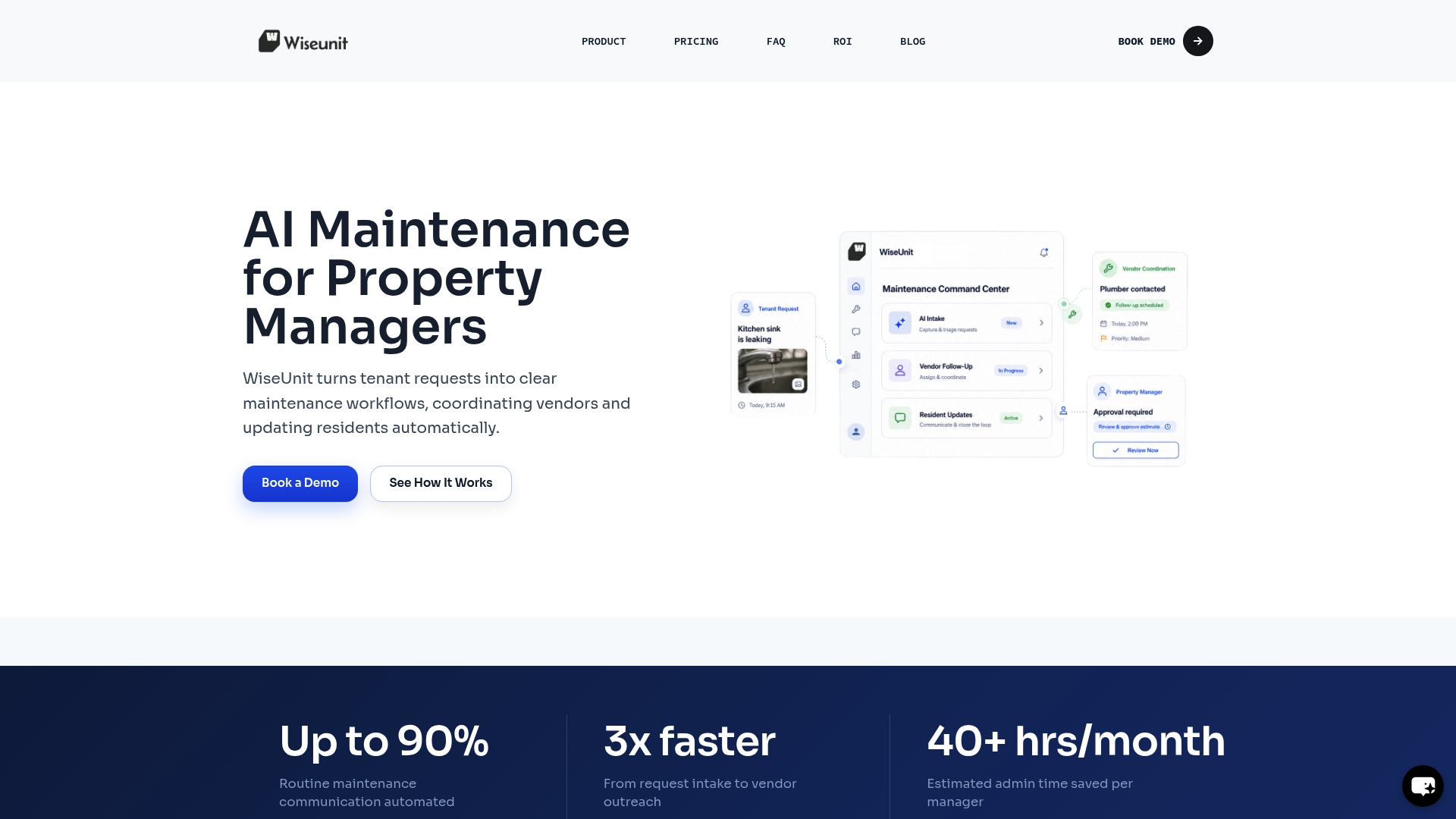
One of the most direct drivers of property management liability is delayed or undocumented maintenance. When a repair request falls through the cracks, the liability clock starts ticking. Wiseunit's AI maintenance coordination platform addresses this at the operational level. Tenants can submit requests through calls, SMS, or online forms, and Wiseunit handles triage, vendor coordination, scheduling, and follow-ups automatically. Every step is logged, time-stamped, and synced to your property management system.
For property owners managing high volumes of units, this means fewer gaps, better records, and a faster response trail that holds up when disputes arise. Wiseunit also connects with platforms like AppFolio, Buildium, and Yardi, so the workflow fits into systems you already use. Use the ROI calculator to see how much time and risk exposure your current process is carrying.
FAQ
What is property management company liability?
Property management company liability is the legal and financial responsibility a management firm holds for injuries, property damage, professional errors, and regulatory failures that occur during their management of a property. Liability is assigned based on control, contractual duties, and whether negligence contributed to the harm.
Can a property owner be held liable for a property manager's mistakes?
Yes. When owners retain partial control or when the management agreement is unclear about authority, courts can assign joint liability to both the owner and the manager. Owners who approve specific decisions, such as large repairs or vendor contracts, share responsibility for outcomes.
What insurance should a property management company carry?
At minimum, a property management company should carry general liability insurance at $1 million per occurrence and professional liability (E&O) insurance at $1 million per claim. Owners should verify this coverage annually and request to be named as additional insured.
Does hiring a property manager remove my personal liability?
No. Hiring a property manager reduces your personal liability for day-to-day management decisions but does not eliminate it. Owners remain exposed for issues tied to property ownership itself, as well as for situations where they retained control or approved decisions that led to harm.
Why do management agreement gaps create liability?
Gaps in management agreements leave authority and responsibility undefined, which means courts decide how to assign them when disputes arise. Proactive contract review and clearly written duties are the most reliable way to prevent a contract dispute from becoming a court case.