

Client reporting in property management is far more than a monthly PDF dropping into an owner's inbox. It is the primary mechanism through which trust is built, decisions are made, and tenant relationships are maintained. Yet most property managers treat it as an afterthought. Understanding what is client reporting in property management, and doing it well, directly affects owner retention, tenant satisfaction, and the operational health of your portfolio. This guide breaks down every layer of effective reporting so you can apply it immediately.
Table of Contents
- Understanding client reporting in property management
- Core components of client reporting: owner statements and tenant communications
- Comparing reporting formats and schedules: monthly statements, portals, and proactive notifications
- Best practices to optimize client reporting for property managers
- Why most client reporting fails and how to fix it
- Streamline client reporting with AI maintenance coordination
- Frequently asked questions
Key Takeaways
| Point | Details |
|---|---|
| Client reporting scope | Client reporting includes owner financial statements and tenant maintenance communications that build transparency and trust. |
| Reporting frequency | Monthly owner reports and proactive tenant notifications ensure timely updates and reduce owner inquiries. |
| Automation benefits | Automating reporting workflows improves accuracy, consistency, and tenant satisfaction by avoiding missed or conflicting updates. |
| Actionable reports | Effective reports combine KPIs, context, and recommendations to guide decisions, not just present data. |
| Tech integration | Using AI maintenance coordination tools helps streamline reporting and communication for better operational outcomes. |
Understanding client reporting in property management
Client reporting covers every structured communication your team sends to two core audiences: property owners and tenants. The financial side gets the most attention, but tenant communication during maintenance is equally critical and far more frequently dropped.
For property owners, client reporting includes:
- Owner financial statements summarizing rent collected, expenses paid, management fees, and net disbursements
- Maintenance activity summaries showing open, pending, and completed work orders with cost breakdowns
- Occupancy and vacancy data with lease renewal timelines
- Capital expenditure updates when significant repairs or improvements are underway
For tenants, client reporting looks different but is no less important. It includes acknowledgment of maintenance requests, scheduling confirmations, status updates when delays occur, and completion notices. Each of these touchpoints tells the tenant whether your company is on top of things, or not.
Context for US and Canadian managers specifically: Owner statements provide detailed financial summaries of income, expenses, and disbursements, typically monthly, with quarterly and annual summaries for tax reporting. In Canada, reporting obligations go further. Trust accounting and monthly owner statements showing rent collected, expenses, fees, and net amounts are required, supporting tax filings such as T776 schedules for rental income.
One dimension of client reporting that many managers undervalue is its operational function. Tenant communication operationally links to maintenance workflows through portals and structured notifications that keep tenants informed proactively. When this link breaks, tenants call your office, which creates a cascade of interruptions your team cannot afford.
Core components of client reporting: owner statements and tenant communications
Having established what client reporting entails, the next step is comparing formats, content, and best practices to get these reports right for both audiences.
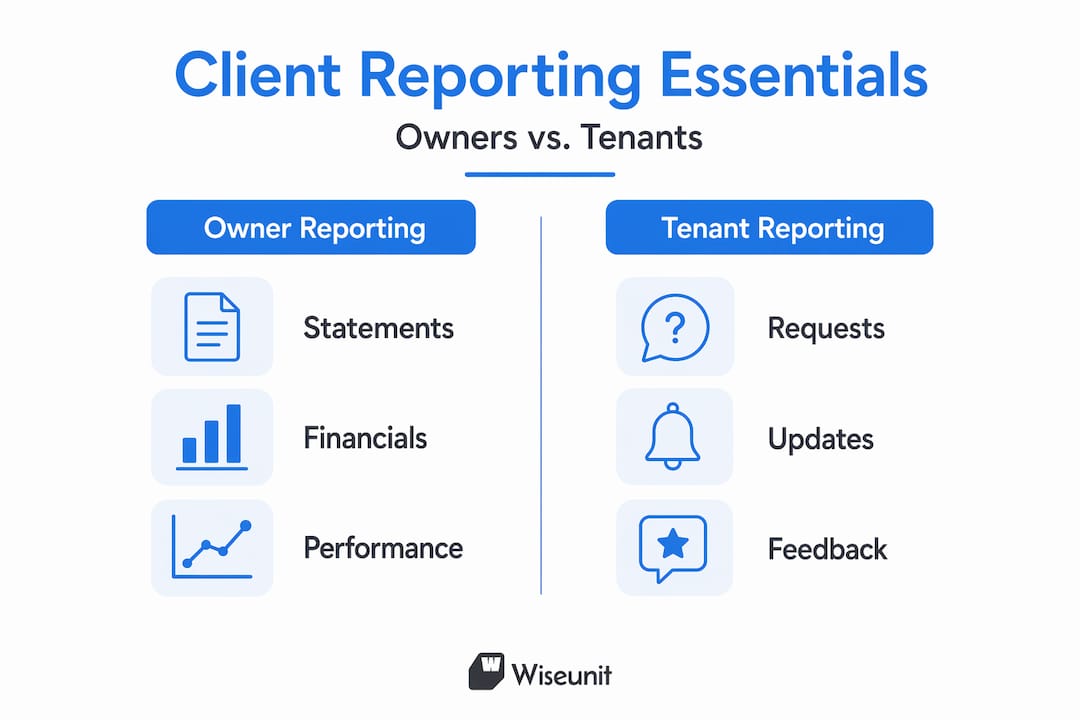
Owner financial statements
Owner statements typically include rent collected, expenses paid, management fees, and net amounts remitted, and are often auto-generated monthly in property management software. The best statements go beyond raw numbers by including brief notes on any unusual expenses, pending repairs that will affect next month's figures, and occupancy status changes.
A practical owner statement covers:
- Gross rental income collected for the period
- Operating expenses itemized by category (repairs, utilities, landscaping, etc.)
- Management fees clearly separated from other costs
- Net owner disbursement with a bank transfer confirmation reference
- Outstanding balances including unpaid rent or pending vendor invoices
- Maintenance summary with status of open work orders
Tenant maintenance communications
Tenant reporting during maintenance should include acknowledgment of requests, scheduling updates, progress notifications, and completion summaries to maintain trust. Think of it as a four-stage communication sequence that maps directly to the maintenance workflow steps your team already follows.
| Maintenance stage | Communication trigger | Recommended channel |
|---|---|---|
| Request received | Immediate acknowledgment | SMS + email |
| Vendor scheduled | Scheduling confirmation | SMS + portal |
| Work in progress | Status update if delay occurs | SMS or email |
| Work completed | Completion summary + feedback request | Email + portal |
This structure removes ambiguity for tenants and reduces inbound calls to your maintenance operations team significantly.
Pro Tip: Add a simple satisfaction rating link to your completion summary message. A one-question survey takes tenants 10 seconds to complete and gives you real data on vendor performance without requiring any manual follow-up.
Comparing reporting formats and schedules: monthly statements, portals, and proactive notifications
Understanding these formats lays the groundwork for aligning reporting practices with your business goals and tenant needs.
Owner reporting: monthly, quarterly, and annual
Automated monthly owner statements plus owner portal access reduce owner inquiries and increase satisfaction. Portals allow owners to log in and check figures between reporting cycles, which eliminates the "quick question" emails that interrupt your team throughout the month.
| Reporting format | Frequency | Primary value |
|---|---|---|
| Owner financial statement | Monthly | Cash flow visibility and trust |
| Owner portal access | Ongoing, self-service | On-demand transparency |
| Quarterly summary | Quarterly | Trend analysis and planning |
| Annual report | Annually | Tax preparation and investment review |
| Maintenance activity log | Monthly or on-demand | Cost accountability and capital planning |
Tenant reporting: proactive and triggered
Proactive tenant notifications triggered by maintenance status updates and delays help preserve tenant confidence and retention. The key word is "triggered." Manual update processes fail because someone forgets to send the message after a vendor reschedules. Automation removes that human failure point entirely.
Here is what an effective tenant notification schedule looks like in practice:
- Within 1 hour of request submission: automated acknowledgment with ticket number
- Within 24 hours: vendor assignment confirmation and estimated scheduling window
- 48 hours before appointment: appointment reminder with vendor name and time window
- Day of appointment: morning reminder with vendor contact information
- Within 4 hours of completion: completion notice with summary of work performed
Managing a maintenance backlog becomes significantly more manageable when tenants receive real-time updates, because they stop escalating unresolved tickets to your front office.
Pro Tip: Segment your owner portal notifications by property for managers who oversee multiple assets for the same owner. Owners with three or four properties in your portfolio find consolidated views far more useful than separate monthly emails per property.
The right combination of formats depends on your operational capacity. Managers handling 200 units can often manage reporting manually with good software. At 500 units or more, automation with software platforms like AppFolio, Buildium, or Yardi becomes a necessity, not a luxury.
Best practices to optimize client reporting for property managers
With best practices in hand, property managers can confidently apply client reporting to drive better outcomes without adding headcount.
Here are the key practices, in order of priority:
-
Automate report generation first. Consistency is the foundation of trust. If owners receive a statement on the 5th one month and the 18th the next, they start to question what is happening with their money. Automating generation removes scheduling as a variable.
-
Include both financial and operational KPIs. Owners care about net income, but they also care about how quickly repairs are completed and whether their property is being maintained. Add average maintenance operations insights response time and work order completion rate to every monthly statement.
-
Build a self-service portal for ongoing access. Reports are snapshots. Portals give clients a live view. Owners who can log in and check a balance do not need to call you to do it.
-
Design reports around decisions, not data. Effective client reports should include an overview, clear KPIs, contextual data, wins, and next steps to communicate progress and guide decisions. A report that shows $4,200 in maintenance expenses this month is less useful than one that shows that figure is 15% below budget and explains why.
-
Review and revise reporting formats annually. Client needs shift. An owner adding two properties to your portfolio needs different reports than they did with one. A tenant base shifting younger may prefer SMS updates over email.
One of the most common gaps property managers face is that their data does not translate into decisions, so reports must focus on action triggers like budget variances and maintenance ETAs. A number without context is noise. A number with a recommended action is a tool.
Pro Tip: Create a one-page executive summary at the top of every owner statement. List the three most important figures and one recommended action for the month. Owners with large portfolios will read this summary even when they skip the detail pages.

Understanding whether your software is tracking or truly executing these workflows is also critical before you invest in new reporting infrastructure. Use an AI platform buying guide to evaluate options against your current reporting gaps.
Why most client reporting fails and how to fix it
Here is the uncomfortable reality: most client reporting in property management fails not because managers lack data, but because they lack discipline around delivery and design.
Irregular cadence is the most common problem. When reporting automation reduces repetitive owner inquiries by up to 80%, the implication is clear: inconsistent reporting generates a proportional volume of follow-up calls, emails, and requests. Every interruption costs your team time they cannot recover.
The second failure point is reports that summarize instead of inform. Owners do not need a recap of what happened. They need to know what it means for their investment and what you plan to do next. A $3,000 roof repair should come with a note explaining whether it was budgeted, whether a capital reserve was used, and whether additional work is anticipated. Without context, owners fill the information gap themselves, often incorrectly.
Tenant communication is where the failure to automate maintenance update notifications creates the most visible damage. When tenants receive contradictory messages, or no messages at all, satisfaction drops fast. A tenant who submits a work order and hears nothing for three days does not assume the team is busy. They assume the request was lost.
The fix is not complicated, but it requires commitment. First, address your maintenance backlog issues before trying to report on them. No reporting system compensates for operationally broken workflows. Second, standardize your reporting templates so the format does not change from month to month. Familiarity builds confidence. Third, treat tenant notification as a non-negotiable part of the maintenance workflow fixes, not an optional add-on.
The property managers who consistently earn strong owner and tenant reviews are not doing anything dramatically different. They are just doing the basics reliably, every time, without gaps.
Streamline client reporting with AI maintenance coordination
Consistent client reporting requires consistent execution, and execution is where most teams hit their ceiling. When your maintenance coordinator is handling vendor calls, scheduling appointments, and chasing down work order updates manually, tenant notifications and owner reporting summaries fall through the cracks.
WiseUnit.ai is an AI maintenance coordination platform built specifically for property management companies managing multifamily, single-family rental, and HOA portfolios. It handles the full maintenance workflow from tenant intake and vendor coordination to scheduling, follow-ups, and status updates inside AppFolio, Buildium, and Yardi. Every step in the process generates the structured communication that your client reporting depends on. Owners get accurate, timely maintenance summaries. Tenants receive proactive notifications without your team lifting a finger. Use the ROI calculator to see what this means for your portfolio, then start a free trial to test it with your actual workflows.
Frequently asked questions
What is the main purpose of client reporting in property management?
Client reporting drives trust, transparency, and operational success by giving property owners and tenants timely, accurate updates about financials and maintenance, which enables better decisions and fewer reactive inquiries.
How often should owner statements be provided to landlords?
Owner statements are typically sent monthly after income and expenses are finalized, with some property managers also providing quarterly summaries for planning and annual reports for tax purposes.
What are best practices for tenant communication during maintenance requests?
Best practices center on proactive maintenance notifications via portals, including automated confirmations, scheduling updates, progress alerts for delays, and completion summaries that give tenants visibility at every stage.
How does client reporting impact tenant retention?
Effective reporting, particularly about maintenance status, directly raises tenant satisfaction. Maintenance satisfaction links directly to resident retention and lease renewal rates, making communication a core retention tool, not just a courtesy.
Are there special tax-related reporting requirements for Canadian non-resident landlords?
Yes. Property managers handling non-resident landlords in Canada must withhold and remit 25% tax on gross rent and issue annual NR4 slips by March 31, including support for Section 216 tax filings.
Recommended
- AI Maintenance Coordination Software for Property Managers | WiseUnit AI
- WiseUnit AI Blog | Maintenance Operations Insights
- Property Management Maintenance Workflow: Step-by-Step Process to Reduce Workload (Toronto, Dallas, Phoenix)
- Property Management Maintenance Operations: How to Scale Without Hiring (Toronto, Dallas, Phoenix)