

Most property managers think of their software as a single tool. Log in, track a lease, close a ticket. Done. But that framing misses what's actually happening when a well-built property management software ecosystem is in place. Understanding what is the property management software ecosystem means recognizing that modern property operations run on an interconnected set of platforms and tools where leasing, maintenance, accounting, communication, and pricing intelligence all share data and trigger one another. The difference between a team managing 50 units in chaos and one managing 500 with ease often comes down to this: how tightly their ecosystem is connected.
Table of Contents
- Key Takeaways
- What is the property management software ecosystem
- Benefits of property management systems for efficiency and tenant satisfaction
- How to choose property management software for your portfolio
- Building and managing your ecosystem without the common pitfalls
- My take on where property management ecosystems are really headed
- How Wiseunit fits into your property management ecosystem
- FAQ
Key Takeaways
| Point | Details |
|---|---|
| Ecosystem vs. single tool | Property management software is a network of integrated systems, not one standalone platform. |
| Operational efficiency gains | Integrated systems eliminate manual workflows and prevent missed follow-ups across maintenance, leasing, and accounting. |
| Software must match your scale | Choosing platforms that fit your portfolio size prevents costly migrations and operational disruption later. |
| Phased rollout reduces risk | Implementing ecosystem tools in stages protects data integrity and gives staff time to adapt. |
| AI is the next execution layer | Automation and AI tools now handle complete workflows, not just ticket tracking, transforming how teams operate. |
What is the property management software ecosystem
At its core, the property management software ecosystem is a collection of specialized tools that work together to run a rental portfolio. The system of record sits at the center. Platforms like AppFolio, Buildium, and Yardi Voyager hold your leases, tenant profiles, unit data, and financial history. Every other tool in the ecosystem either feeds data into this core or pulls from it.
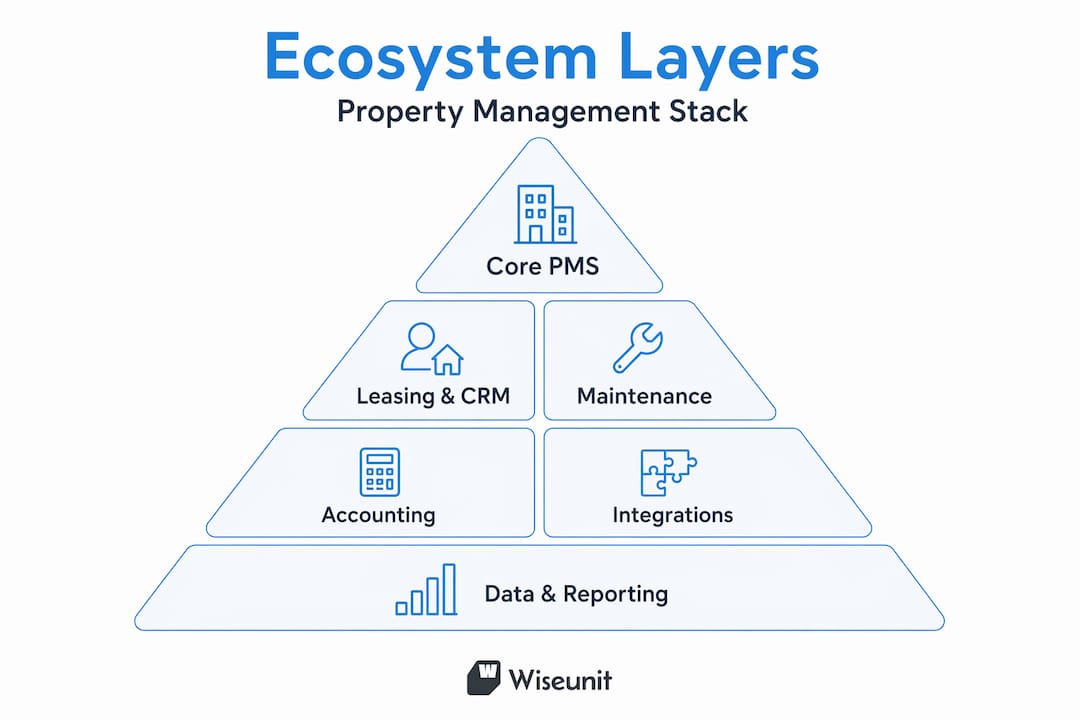
A strong PMS serves as the foundation, with integrated pricing intelligence and CRM workflows layered on top to support daily decisions. Around that core, you have several functional layers:
- Leasing and tenant management: Online applications, digital lease signing, move-in/move-out coordination, and tenant screening.
- Maintenance and service tools: Work order creation, vendor assignment, scheduling, status updates, and cost tracking.
- Accounting and financial reporting: Rent collection, owner statements, AP/AR, and tax document generation.
- Communication and portals: Tenant-facing apps for paying rent, submitting requests, and receiving notices.
- Marketing and vacancy tools: Listing syndication, lead tracking, and showing schedulers.
- Pricing intelligence: Dynamic rent pricing based on market comparables and occupancy trends.
| Ecosystem layer | Primary function | Example use case |
|---|---|---|
| Core PMS | System of record | Stores leases, units, tenants, and financials |
| Maintenance tools | Work order execution | Assigns vendors, tracks urgency, logs costs |
| Tenant portal | Communication hub | Tenants submit requests and view payment history |
| Accounting module | Financial operations | Automates rent collection and owner distributions |
| Pricing intelligence | Revenue optimization | Adjusts renewal rates based on market data |
| CRM and leasing | Prospect management | Tracks leads and automates application workflows |
The key insight here is that these layers don't operate independently. Cloud-based platforms centralize lease data, tenant profiles, work order history, and financials in one environment, minimizing data inconsistencies that plague teams relying on spreadsheets and disconnected apps.
Pro Tip: When evaluating your current tech stack, map every tool your team touches in a given week. If any two tools require manual data transfer between them, that connection is costing you time and accuracy.
Benefits of property management systems for efficiency and tenant satisfaction
The practical benefits of an integrated property management software ecosystem show up fast once you understand where the friction lives in your current operation.
- Eliminated manual follow-up loops. Disconnected manual tasks cause missed follow-ups and inconsistent resident experiences, while integrated systems standardize processes across every unit and team member.
- Real-time maintenance visibility. Software workflows surface open issues, urgency levels, responsible parties, and cost tracking in one view, reducing the back-and-forth that slows resolution.
- Centralized financial accuracy. When rent collection, late fees, maintenance invoices, and owner distributions all live in one system, your books reconcile faster and with fewer errors.
- Better tenant communication. Tenant portals and centralized messaging cut down on missed calls and manual reminders, connecting requests directly to updates. Tenants who receive timely communication are measurably more likely to renew.
- Owner reporting without extra work. Owners want visibility without calling your office. Automated reporting pushed through owner portals answers their questions before they ask them.
Consider a practical scenario. A tenant submits a maintenance request through their portal at 9 PM on a Sunday. In a disconnected system, that request sits in an inbox until Monday, gets manually assigned, and might not have a vendor confirmed until Tuesday. In a fully integrated ecosystem, the request triggers automatic triage, routes to an available vendor, and sends the tenant a confirmation within minutes. That's not a technology upgrade. It's a completely different operating model.
Pro Tip: Tenant satisfaction scores and renewal rates are lagging indicators. If your team is manually chasing maintenance follow-ups or sending duplicate notices, those numbers will tell you in six months. The ecosystem is the fix you implement today.

The transition from disconnected tools to integrated platforms reduces workload and improves data accuracy across the board. For multifamily and HOA portfolios especially, this shift is the difference between a team that's constantly catching up and one that's operating ahead of issues.
How to choose property management software for your portfolio
Choosing software for your operation isn't just a features comparison. It's a decision that affects your team's daily workflow, your tenants' experience, and your ability to grow without breaking your processes.
The starting point is matching the platform to your portfolio size. Buildium fits portfolios under 200 units, Yardi Voyager suits operations at 1,000+ units, and AppFolio excels with mid-to-large portfolios that want built-in AI automation. Buying enterprise software for a 75-unit portfolio wastes budget. Using a basic tool for a 600-unit mixed portfolio creates a ceiling you'll hit within a year.
Beyond size, evaluate these criteria carefully:
- Integration depth. Does the platform connect natively with your accounting software, maintenance tools, and pricing apps? Or does every integration require a custom API build?
- Scalability path. A scalable property management platform reduces future migration costs by accommodating portfolio growth without requiring a platform switch.
- Maintenance workflow support. Can the system execute maintenance from intake to vendor coordination to tenant notification? Or does it only log tickets?
- Mobile access. Your maintenance coordinators and field staff need full functionality on mobile, not a stripped-down app.
- Vendor ecosystem. Does the platform have a marketplace of pre-integrated apps for the tools you already use?
True cost evaluations must include implementation time, staff training, and migration disruptions, not just subscription fees. Managers who focus only on the monthly license cost frequently regret the decision when they realize the actual cost of switching is 3 to 4 times the sticker price.
| Platform | Best fit | Key strength | Typical portfolio size |
|---|---|---|---|
| Buildium | Residential, small to mid | Ease of use, tenant communication | Under 200 units |
| AppFolio | Mid to large multifamily | AI automation, leasing tools | 200 to 2,500+ units |
| Yardi Voyager | Enterprise, institutional | Full-stack financial and asset management | 1,000+ units |
| DoorLoop | Growing portfolios | All-in-one cloud environment | 50 to 500 units |
When evaluating vendors, also ask about their product roadmap. AI and automation are rapidly becoming core layers in property management ecosystems. A platform with no AI strategy today may require you to bolt on third-party tools tomorrow, which creates exactly the integration complexity you're trying to avoid. For a detailed breakdown, the AI platform buyer's guide covers what to look for specifically in 2026.
Building and managing your ecosystem without the common pitfalls
Having the right tools is half the job. The other half is deploying them in a way that doesn't disrupt your operations or leave your team reverting to spreadsheets.
- Implement in phases. Operational disruption during software migration can cause service delays and data loss if not carefully planned. Start with your core PMS, then layer in maintenance tools, then communication, then reporting. Don't go live on everything at once.
- Prioritize staff adoption. The best ecosystem fails if your team works around it. Invest in structured training, designate internal champions per department, and build simple SOPs that show exactly which tool handles which task.
- Maintain data hygiene. Integrations break when source data is inconsistent. Standardize how you enter unit numbers, vendor names, and tenant records across every connected system.
- Eliminate double entry. If your team is copying data from one system to another manually, that's a process gap, not a training issue. Address it at the integration level.
- Use automation for the repeatable. Rent reminders, lease expiration notices, work order status updates, and vendor payment triggers are all candidates for automation. Integrations like pricing intelligence embedded directly in leasing workflows reduce friction and improve decision quality without adding manual steps.
A common real-world challenge: a property management company migrates to a new PMS but keeps their old maintenance ticketing tool because "it still works." Six months later, vendors are getting duplicate calls, tenants are submitting requests to two places, and no one can pull a single maintenance cost report. The solution isn't always a new tool. Sometimes it's consolidating the ones you have. For teams running high maintenance volumes, reviewing a step-by-step maintenance workflow before selecting new software can clarify exactly where your current gaps are.
My take on where property management ecosystems are really headed
I've watched property management teams adopt technology for years, and the pattern is almost always the same. A team starts with one platform, adds tools to fill gaps, and ends up with five disconnected systems that technically work but create more coordination work than they save.
The fundamental shift I've seen happening in 2026 is that integration within property management ecosystems is no longer optional for teams that want to scale. It's the infrastructure. What I find most underappreciated is the hidden cost of complexity. Every disconnected tool adds a mental tax on your team. They have to remember which system is authoritative, reconcile conflicting data, and manually trigger handoffs. That cognitive load is invisible on a balance sheet, but it shows up in slower response times and staff burnout.
What I find genuinely exciting is the emergence of AI as an execution layer, not just a reporting layer. The future isn't software that shows you maintenance is overdue. It's software that handles the follow-up for you. Property managers who embrace that shift early will operate at a scale that their competitors running manual workflows simply can't match. My advice: stop evaluating software on features alone. Evaluate it on how much work it removes from your team's plate entirely.
— Laur
How Wiseunit fits into your property management ecosystem
The tools you choose to run your ecosystem matter, but so does what happens when a maintenance request lands at 11 PM and your coordinator isn't available.
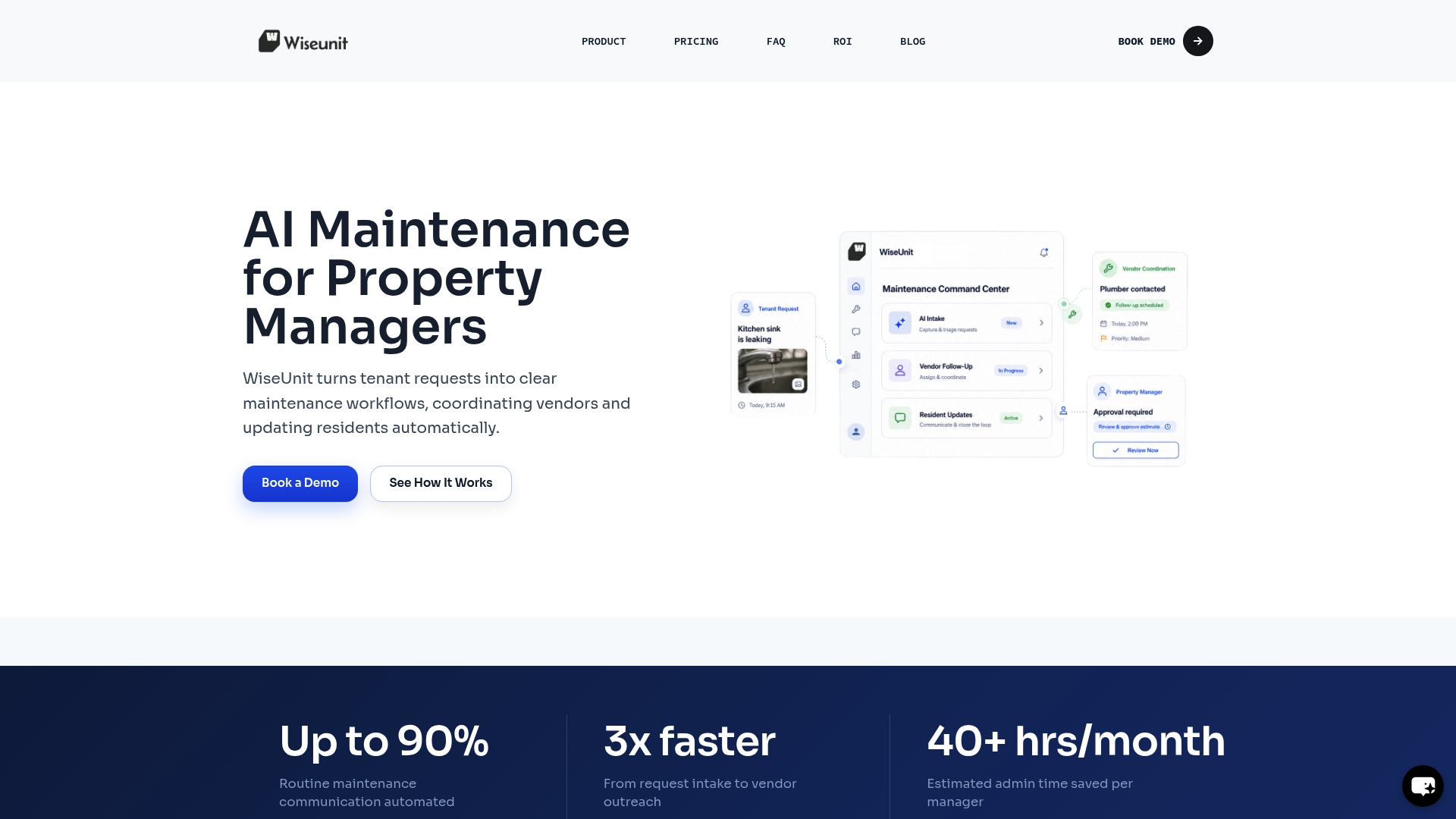
Wiseunit is purpose-built to act as the maintenance execution layer inside your existing ecosystem. Whether you run AppFolio, Buildium, or Yardi, Wiseunit connects directly to your platform and handles the full maintenance workflow from tenant intake through vendor coordination, scheduling, follow-ups, and status updates. Tenants can submit requests by call, SMS, or online form. Wiseunit handles what comes next without adding work to your team. If you want to see how much time and cost this saves your operation, the ROI calculator gives you a concrete estimate based on your portfolio size. Or explore Wiseunit's AI maintenance coordination to see the full capability set.
FAQ
What is a property management software ecosystem?
A property management software ecosystem is a network of integrated tools including a core platform, maintenance tools, tenant portals, accounting software, and pricing apps that share data and automate workflows across a rental portfolio.
What are the core components of a property management tech stack?
The core components include a property management system of record, leasing and CRM tools, maintenance and work order software, an accounting module, tenant communication portals, and pricing intelligence apps.
How do I choose the right property management software?
Match the platform to your portfolio size and growth trajectory, then evaluate integration depth, scalability, mobile access, and total cost of ownership including training and migration expenses, not just monthly fees.
What are the main benefits of property management systems?
Integrated systems reduce manual work, standardize processes, improve maintenance response times, centralize financial reporting, and deliver better tenant communication, all of which directly support higher renewal rates.
How does AI fit into the property management software ecosystem?
AI tools now act as execution layers that handle repeatable workflows like maintenance triage, vendor coordination, and tenant updates automatically, reducing the need for additional staff to manage growing unit counts.
Recommended
- Property Management Software vs AI Execution: Why Software Alone Is No Longer Enough
- How Property Managers Automate Maintenance with AppFolio, Buildium, and Yardi
- Best AI Tools for Property Management in 2026: Full Comparison Guide
- AppFolio vs AI: Why Property Management Software Is No Longer Enough (2026)