

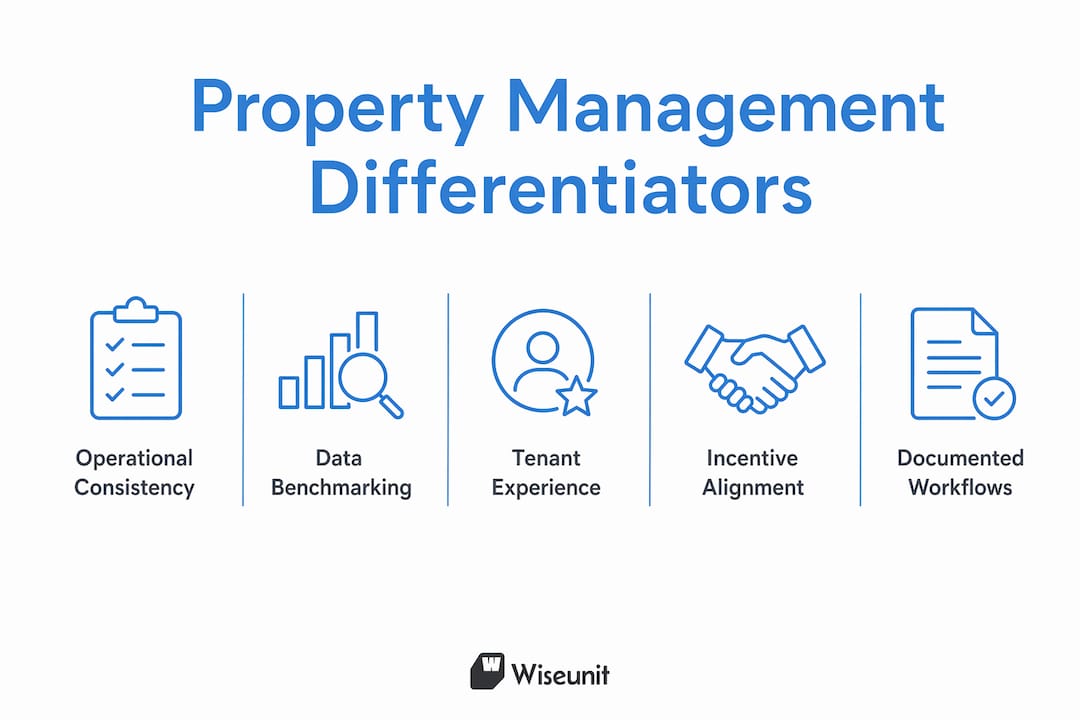
A property management company differentiator is a measurable operational or service characteristic that produces better outcomes for property owners and tenants than standard market offerings. Most owners treat property management as a commodity, comparing fee structures and assuming the rest is roughly equal. That assumption is expensive. The industry term for what separates top performers is operational differentiation, and it shows up in documented workflows, data-driven benchmarking, resident experience programs, and incentive alignment. Understanding these factors is the foundation of knowing how to choose property management that actually grows your asset's value.
What is a property management company differentiator, really?
Operational differentiation in property management is defined by measurable service outcomes, not marketing language. A company that claims "responsive maintenance" without a documented triage process and vendor coordination protocol is describing an aspiration, not a capability. The distinction matters because differentiators are measurable, not just stated. Responsiveness and empathy drive resident loyalty even when technology handles the intake.

The most common misconception is that all property management companies deliver roughly the same service at different price points. In practice, the gap between a company running documented systems and one operating on institutional memory is enormous. One missed lease renewal costs an owner roughly $3,000 in vacancy. A skipped inspection can escalate into a $10,000 repair. These are not edge cases. They are the predictable result of operating without systematic workflow controls.
Three categories define genuine property management differentiators: operational consistency through documented processes, financial transparency through standardized benchmarking, and resident experience through technology balanced with human accountability. Each category is verifiable. Each has a direct line to net operating income (NOI). The sections below break down exactly what to look for in each one.
How documented workflows separate top property management companies
Documented, repeatable workflows are the single most reliable indicator of operational quality in a property management company. A 2026 checklist guide estimates that managing a 100-door portfolio requires 60 to 90 minutes of structured daily workflow. That number scales predictably only when tasks are written down, assigned, and tracked. Without documentation, growth creates chaos rather than capacity.
The practical impact of checklist-driven operations shows up across three time horizons:
- Daily tasks: Maintenance request intake, tenant communication follow-ups, and vendor status checks. These prevent small issues from compounding into complaints or legal exposure.
- Weekly tasks: Rent collection reconciliation, delinquency outreach, and inspection scheduling. Consistent weekly cadence keeps financial reporting clean and reduces late payment rates.
- Monthly tasks: Lease renewal tracking, preventive maintenance scheduling, and owner reporting. Monthly discipline is where most undifferentiated companies fall short, because these tasks feel less urgent until they become crises.
The team efficiency guide from Wiseunit explains how delegation heuristics change as portfolios grow. A solo operator handles everything manually. A team managing 500 units needs role-specific checklists and escalation protocols. The companies that scale without degrading service quality are the ones that treat their operations like a franchise model: every location runs the same playbook.
Pro Tip: When evaluating a property management company, ask to see their maintenance workflow documentation. If they cannot produce a written process for how a maintenance request moves from tenant submission to vendor completion to owner notification, that is a red flag, not a minor gap.
The maintenance workflow guide from Wiseunit details how systematic maintenance checklists reduce workload and improve operational consistency across multifamily, single-family, and HOA portfolios. Operational consistency is not a soft benefit. It is the mechanism by which service quality survives staff turnover, portfolio growth, and market stress.
Why data benchmarking is a core property management differentiator
Benchmarking is defined as the practice of comparing a property's income and expense performance against standardized industry data to validate whether a management company is actually delivering above-market results. Without it, owner reporting is essentially self-graded. With it, claims become verifiable.
IREM's Income/Expense IQ tool incorporates data from BOMA International, NAA, and IREM members to produce apples-to-apples comparisons across property types, geographies, and unit counts. This matters because a management company can show you a 5% maintenance cost reduction in isolation and make it sound impressive. Benchmarked against comparable properties in the same market, that number might be average, below average, or genuinely exceptional. The data tells you which.
The table below summarizes how benchmarking applies across the key financial and operational metrics property owners should track:
| Metric | What benchmarking reveals |
|---|---|
| Maintenance cost per unit | Whether expenses are controlled or inflated relative to market peers |
| Vacancy rate | How quickly units are leased compared to comparable properties |
| Renewal rate | Whether tenant retention reflects genuine satisfaction or just inertia |
| Operating expense ratio | If overhead is managed efficiently or eroding NOI unnecessarily |
| Rent growth vs. market | Whether rents are being optimized or left below achievable levels |
Standardized reporting dashboards that incorporate these metrics increase owner confidence and make it significantly harder for underperforming companies to obscure weak results behind narrative reporting. Owners who require benchmarked data from their management company are not being demanding. They are applying basic financial discipline to a major asset.
Pro Tip: Request that any property management company you evaluate provide at least one year of income and expense data formatted against an industry benchmark like IREM's IQ tool or a comparable regional dataset. If they cannot or will not, treat that as a meaningful signal about their operational transparency.
How tenant experience technology drives renewal rates and NOI
Tenant experience is defined as the sum of every interaction a resident has with their property management company, from the lease signing process through maintenance resolution and renewal communication. Companies that treat this as a soft metric miss its direct financial impact. Higher renewal rates reduce vacancy costs. Faster maintenance resolution reduces escalation and legal risk. Both flow directly to NOI.
RPM Living's CX playbook identifies responsiveness, empathy, and ease of doing business as the three fundamentals of resident experience. Residents now compare multifamily experiences to the best global consumer brands, expecting speed, simplicity, and proactive updates. A tenant who submits a maintenance request and hears nothing for 48 hours is not just frustrated. They are forming a renewal decision.
The most effective property management companies use technology to scale communication without removing the human element. Specific practices that distinguish high-performing operators include:
- Proactive status updates: Tenants receive automatic notifications when a maintenance request is received, when a vendor is scheduled, and when work is completed. This eliminates the follow-up call and signals operational control.
- Multi-channel intake: Requests accepted via phone, SMS, and online forms reduce friction for tenants and capture more issues before they escalate.
- Empathy protocols: Automated systems handle logistics. Human staff handle complaints, sensitive situations, and renewal conversations. The combination is more effective than either alone.
- Frictionless package and amenity access: Technology like electronic package room systems reduces daily friction points that tenants notice even when they cannot articulate why they are dissatisfied.
The key insight from RPM Living's model is that technology enables scale, but it does not replace the judgment calls that determine whether a resident feels valued. Companies that automate everything and remove human touchpoints tend to see satisfaction scores drop even as response times improve. The balance is the differentiator.
How incentive alignment and operational accountability protect asset value
The caretaking model of property management treats the owner's property as a unit to be maintained at minimum cost. The business operation model treats it as an asset to be optimized for long-term value. These are not the same thing, and the difference compounds over time.
Vertically integrated property management models outperform caretaking approaches by aligning company incentives with owner outcomes. When a management company controls vendor relationships, maintenance scheduling, and resident engagement under one operational structure, the incentives point in the same direction. Preventive maintenance gets prioritized because deferred repairs hurt the asset the company is also accountable for. Resident retention gets prioritized because turnover costs affect the portfolio the company manages.
The operational accountability model produces four measurable advantages:
- Preventive maintenance programs reduce emergency repair costs by catching issues before they escalate, protecting both the physical asset and the owner's budget.
- Vendor relationship management produces better pricing and faster response times than ad hoc contractor sourcing, which directly affects maintenance cost per unit.
- Resident engagement programs increase renewal rates by creating community touchpoints beyond the transactional landlord-tenant relationship.
- Systematic problem-solving protocols mean that recurring issues get root-cause analysis rather than repeated band-aid fixes, reducing long-term maintenance spend.
Growth systems that scale in property management are built on this accountability model. Companies that grow by adding units without adding operational infrastructure tend to see service quality degrade. Companies that grow by strengthening systems first maintain quality and improve NOI across the portfolio.
Key takeaways
The strongest property management company differentiators are operational and measurable, not marketing claims. Documented workflows, benchmarked financial data, and resident experience programs each produce verifiable outcomes that protect and grow asset value.
| Point | Details |
|---|---|
| Documented workflows prevent costly gaps | Missing a lease renewal or inspection creates $3,000 to $10,000 in avoidable costs. |
| Benchmarking makes claims verifiable | IREM's Income/Expense IQ lets owners compare performance against real market data. |
| Tenant experience drives financial outcomes | Renewal rates and NOI both improve when responsiveness and empathy are built into operations. |
| Incentive alignment separates operators from caretakers | Vertically integrated models prioritize asset value because their accountability matches owner goals. |
| Technology scales communication, not empathy | Automation handles logistics; human judgment handles the decisions that affect resident loyalty. |
What I've learned about spotting real differentiators vs. polished pitches
Most property management companies describe themselves using the same five or six phrases: responsive, experienced, technology-forward, owner-focused, and transparent. After years of working with property management teams across multifamily, single-family, and HOA portfolios, I can tell you that these words are nearly useless as evaluation criteria. Every company says them. Almost none can prove them on demand.
The owners and investors who consistently choose better management companies ask for evidence, not descriptions. They request a sample maintenance workflow. They ask how the company handles a missed lease renewal. They want to see what an owner report looks like before they sign, not after. These requests reveal operational reality faster than any sales conversation.
The benchmarking point is the one most owners underweight. Subjective narratives about "great vendor relationships" and "proactive communication" are impossible to compare across companies. Standardized income and expense data is not. When you can compare two companies' maintenance cost per unit against the same regional benchmark, the conversation changes entirely. One company's story either holds up or it does not.
The uncomfortable truth is that most property owners choose management companies based on fee structure and first impressions. The companies that charge slightly more and lead with operational documentation tend to outperform over a three to five year horizon. The fee difference is almost always smaller than the NOI difference. Prioritize evidence of systems over the comfort of a confident pitch.
— Laur
How Wiseunit helps property managers build a real operational edge
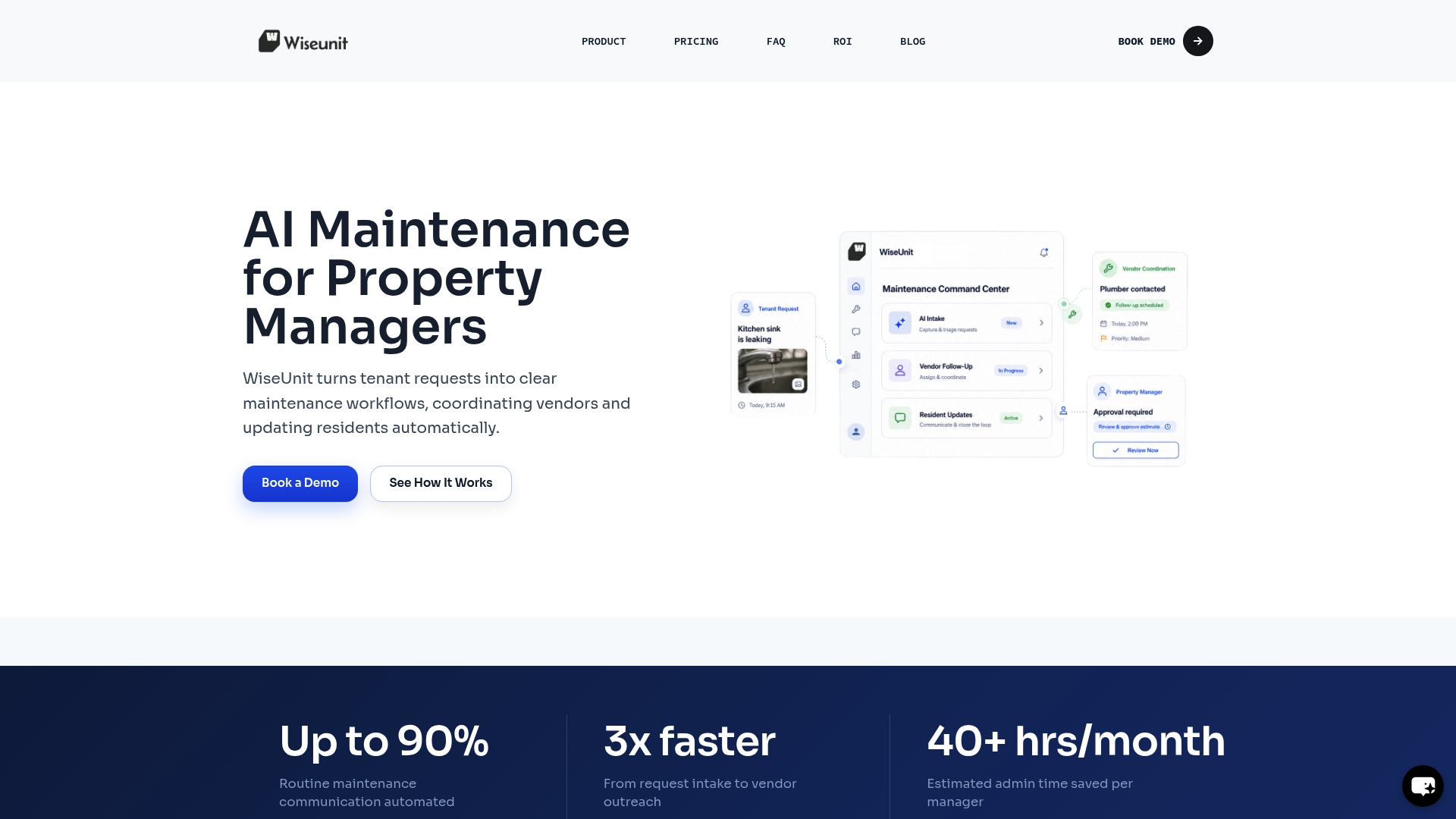
Wiseunit is built specifically for property management companies that want maintenance coordination to function as a genuine differentiator, not a recurring source of tenant complaints and staff overload. The platform executes the full maintenance workflow: tenant intake via calls, SMS, or online forms; automatic issue triage; vendor coordination and scheduling; and status updates synced directly into AppFolio, Buildium, or Yardi. Property managers stop chasing updates and start managing outcomes.
For teams managing high volumes of maintenance requests across multifamily, single-family, or HOA portfolios, Wiseunit reduces manual work and speeds up response times without requiring additional maintenance coordinators. If you want to see the financial impact before committing, the ROI calculator gives you a concrete estimate based on your portfolio size and current workflow. To explore the full platform, visit WiseUnit AI and see how maintenance execution becomes an operational advantage.
FAQ
What is a property management company differentiator?
A property management company differentiator is a measurable operational or service characteristic that produces better outcomes than standard market offerings. Common differentiators include documented maintenance workflows, benchmarked financial reporting, and structured resident experience programs.
How do I evaluate property management differentiators objectively?
Request standardized income and expense data benchmarked against industry sources like IREM's Income/Expense IQ, and ask to see written workflow documentation for maintenance and lease renewal processes. Claims that cannot be supported by data or documentation are marketing, not differentiators.
Why does tenant experience matter as a property management differentiator?
Tenant experience directly affects renewal rates and vacancy costs, both of which flow to NOI. RPM Living's CX playbook shows that responsiveness, empathy, and ease of doing business are the fundamentals that drive resident loyalty and operational KPIs.
What is the difference between a caretaking and a business operation model in property management?
A caretaking model maintains a property at minimum cost. A business operation model treats the property as an asset to be optimized, using preventive maintenance, vendor management, and resident engagement to grow long-term value and NOI.
How do documented workflows reduce risk for property owners?
Systematic checklist use prevents costly oversights: a missed lease renewal creates roughly $3,000 in vacancy costs, and a skipped inspection can escalate into a $10,000 repair. Documented workflows make these outcomes predictable and preventable rather than random and expensive.