

Self-managed rental maintenance efficiency is defined as the systematic use of automation tools, vendor networks, and scheduled workflows to reduce coordination time, lower costs, and improve tenant satisfaction without adding staff. The industry term for this operational approach is computerized maintenance management, and it applies directly to independent landlords managing their own portfolios. Digital maintenance systems reduce coordination time by up to 73% while pushing tenant satisfaction from 72% to 94%. A 200-unit portfolio can save $120,000–$180,000 annually by making this shift. The core insight is straightforward: self-managed property upkeep succeeds when you run it like an operations manager, not a handyman.
What tools are essential for self-managed rental maintenance efficiency?
Efficient rental maintenance starts with the right infrastructure. Without it, you spend your time reacting to problems instead of preventing them.
The foundational layer is a digital maintenance management system. Platforms like OxMaint give you a centralized place to log requests, track repair history, and monitor vendor performance. Maintenance coordination software replaces scattered texts and phone calls with a documented, searchable workflow. That audit trail alone reduces disputes and supports insurance or tax claims.

The second layer is your vendor bench. Every trade category, plumbing, electrical, HVAC, and general repairs, should have 2–3 pre-vetted contractors ready to dispatch. Successful self-managers rely on a small, trusted vendor bench paired with a dedicated maintenance portal to create documented audit trails and eliminate late-night calls. Without backup vendors, a single contractor being unavailable can turn a minor issue into a multi-day emergency.
The third layer is scheduling automation. Tools like FixReminder automate recurring task reminders so nothing falls through the cracks. Manual spreadsheet tracking causes critical maintenance tasks to go neglected for years, creating emergencies that cost multiple times more than scheduled upkeep would have.
Here is a comparison of manual versus automated maintenance management:
| Factor | Manual Management | Automated Management |
|---|---|---|
| Time per request | 1–3 hours | 15–30 minutes |
| Cost per request | $75–$150 | $15–$35 |
| Tenant satisfaction rate | ~72% | ~94% |
| Emergency call frequency | High | Reduced by 47% |
| Audit trail | None or incomplete | Full and searchable |
Pro Tip: Before choosing any software, map your current workflow on paper. Identify where requests get lost or delayed. That gap is exactly where your first automation should go.
Tenant portals are the fourth prerequisite. When tenants submit requests through a portal rather than calling or texting you directly, you gain structured data, time-stamped records, and the ability to triage without interrupting your day.
How do you implement automated maintenance workflows?
Automation does not mean removing yourself from the process. It means removing the manual steps that slow everything down. Here is how to build an automated workflow from intake to resolution.
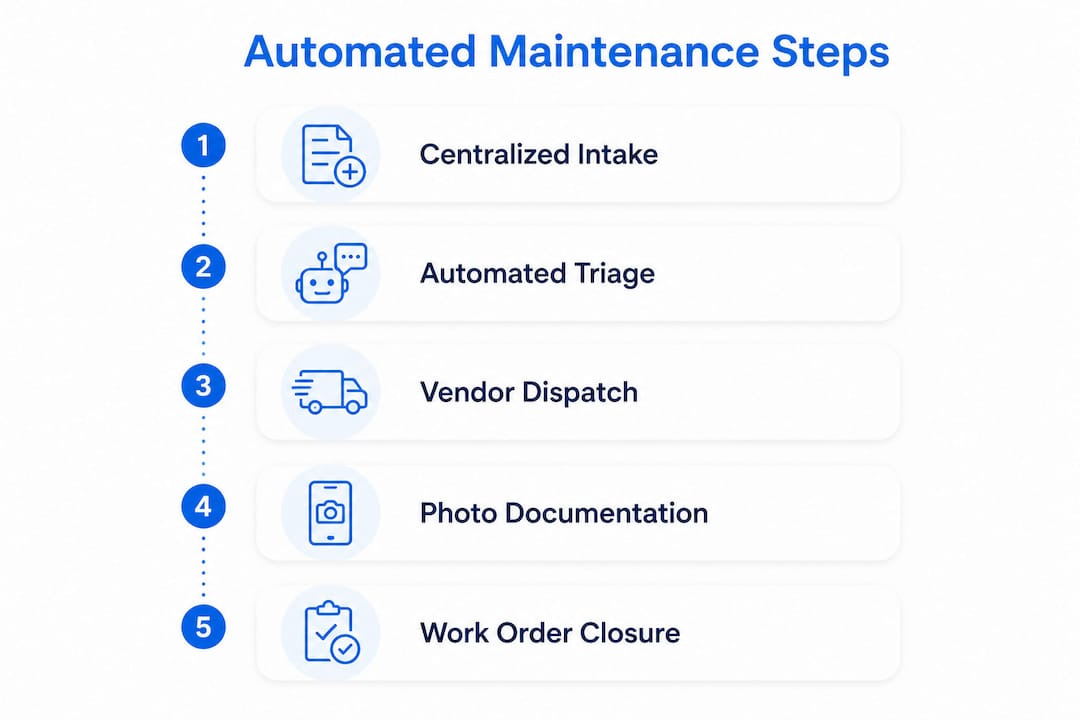
Step 1: Set up a centralized intake channel. Tenants should submit all requests through one channel, whether that is a web form, SMS line, or phone system that logs automatically. This eliminates the "I texted you three days ago" problem and creates a time-stamped record for every issue.
Step 2: Automate triage. AI-assisted triage tools categorize requests by urgency and trade type without requiring you to read every submission. Automating triage cuts administrative time per request from 1–3 hours down to 15–30 minutes and reduces cost per request from $75–$150 to $15–$35. For a 500-unit portfolio, that translates to nearly 300 hours saved per month.
Step 3: Assign vendors automatically. Once a request is categorized, your system routes it to the appropriate vendor based on trade and availability. Pre-loaded vendor profiles with contact details, trade categories, and preferred scheduling windows make this possible.
Step 4: Build your recurring maintenance schedule. Preventative tasks should run on a fixed calendar, not on memory. A practical schedule looks like this:
- Monthly: Test smoke and CO detectors, check HVAC filters, inspect common area lighting
- Quarterly: Inspect plumbing for leaks, clean dryer vents, check exterior caulking
- Annually: Service HVAC systems, inspect roof and gutters, test water heater pressure relief valves, conduct full unit walkthrough
Step 5: Document turnovers with photo checklists. Photo documentation during turnovers increases on-time completion rates from 71% to 96% and reduces deposit disputes significantly. A standardized checklist with timestamped photos creates accountability for both tenants and vendors.
Step 6: Review and close work orders with confirmation. Every completed job should trigger an automatic tenant notification and a vendor confirmation. This closes the loop without requiring a manual follow-up call.
Pro Tip: Set up a 48-hour auto-follow-up message to tenants after a work order is closed. A simple "Was your issue resolved?" message catches problems early and signals that you take maintenance seriously.
Structured automated workflows reduce emergency calls by 47% and cut repeat issues by 68%. Those numbers reflect what happens when you stop managing maintenance reactively and start running it as a scheduled operation.
What challenges come up in self-managed maintenance and how do you fix them?
Even well-designed systems break down. Knowing where the failure points are lets you address them before they become expensive.
The most common failure is neglected automated triggers. When landlords set up reminders but ignore them, deferred maintenance accumulates. A skipped HVAC service in spring becomes a $4,000 compressor replacement in August. Planned maintenance reduces annual costs per unit by 35% because emergency repairs cost 2–3 times more than scheduled tasks. Treating your maintenance calendar as non-negotiable is the single most cost-protective habit you can build.
The second challenge is overreliance on physical labor. Many landlords default to doing repairs themselves to save money. That approach does not scale and creates liability exposure in licensed trade categories. The smarter model is hybrid: you handle routine inspections and tenant communication while licensed contractors handle electrical, plumbing, and HVAC work.
- Triage errors: AI tools occasionally miscategorize requests. Build in a weekly review of flagged or escalated tickets to catch patterns early.
- Vendor no-shows: Always have a backup contractor per trade. A vendor who cancels without notice should be replaced in your bench, not tolerated repeatedly.
- Tenant communication gaps: Silence after a request is submitted is the fastest way to generate a complaint. Automated status updates at intake, assignment, and completion prevent most frustration.
- Data blind spots: Run a monthly audit of your maintenance history. Repeat issues at the same unit or with the same vendor signal a systemic problem worth addressing directly.
"The landlords who struggle long-term are not the ones with the worst properties. They are the ones without systems. Every emergency feels like a surprise because they have no data on what was coming."
Pro Tip: Review your three most expensive repairs from the past 12 months. In most cases, at least two of them were preventable with a scheduled inspection. Use that list to build your next quarterly checklist.
How does maintenance efficiency affect tenant satisfaction and profitability?
The financial case for efficient rental maintenance is direct and measurable. Switching from reactive to planned maintenance reduces annual maintenance costs per unit by 35%. That reduction comes from fewer emergency dispatches, better vendor pricing through repeat relationships, and less damage from deferred repairs.
Tenant satisfaction follows the same logic. Faster response times and clear communication are the two factors tenants cite most when rating their rental experience. When your system automatically acknowledges a request, assigns a vendor, and sends a completion notice, tenants feel heard without you spending an hour on the phone.
For portfolios above 50 units, proactive maintenance adoption is the primary driver of profitability and tenant retention. The ability to scale without adding headcount depends entirely on whether your workflows can handle volume without breaking down.
| Metric | Before Automation | After Automation |
|---|---|---|
| Tenant satisfaction | 72% | 94% |
| Emergency maintenance calls | Baseline | Down 47% |
| Repeat repair rate | Baseline | Down 68% |
| On-time turnover completion | 71% | 96% |
| Annual cost per unit | Baseline | Down 35% |
Maintenance coordination consumes 25–35% of property management staff time. Automation triples workload capacity per coordinator. That means you can manage more units, not more people.
Improved vendor accountability also compounds over time. Vendors who know their performance is tracked and documented deliver better work. That reduces repeat repairs, extends the life of your property systems, and protects your net operating income. You can explore maintenance cost budgeting strategies to model these savings against your current portfolio.
Key takeaways
Self-managed rental maintenance efficiency is achieved by combining automation, scheduled preventative tasks, and a reliable vendor bench to reduce costs, eliminate reactive chaos, and retain tenants longer.
| Point | Details |
|---|---|
| Automate intake and triage | Reduce time per request from 1–3 hours to 15–30 minutes using AI-assisted tools. |
| Build a vendor bench | Pre-vet 2–3 contractors per trade to enable fast dispatch and eliminate single-vendor dependency. |
| Schedule preventative tasks | Monthly, quarterly, and annual checklists cut annual per-unit costs by up to 35%. |
| Document everything | Photo checklists and audit trails reduce disputes and support insurance or tax claims. |
| Track performance data | Monthly maintenance audits identify repeat issues and vendor problems before they escalate. |
The mindset shift that actually changes everything
The landlords I have seen struggle the longest are not the ones with the worst properties. They are the ones who still think of maintenance as a series of individual problems to solve rather than a system to run.
When I first started advising on self-managed property upkeep, the most common mistake was treating every repair call as a one-off event. No documentation, no vendor history, no pattern recognition. The result was the same $800 plumbing call every six months because no one ever fixed the root cause.
The shift that changes everything is this: stop being the person who fixes things and become the person who runs the operation that fixes things. That means investing real time upfront to set up your intake channels, build your vendor relationships, and configure your scheduling tools. It feels slow at first. The payoff is that six months later, you are not the bottleneck anymore.
Vendor relationships deserve more credit than they get. A plumber who knows your properties, trusts your payment process, and gets consistent work from you will answer your call on a Saturday. That is not luck. That is the result of treating vendors like partners rather than one-time service calls.
Technology is not optional at this point. Landlords managing more than a handful of units who still rely on memory and text messages are leaving money on the table and creating liability exposure. The tools exist. The data is clear. The only remaining question is when you decide to use them.
— Laur
Let Wiseunit handle the coordination work
If you recognize your operation in any of the challenges above, Wiseunit was built specifically to solve them.
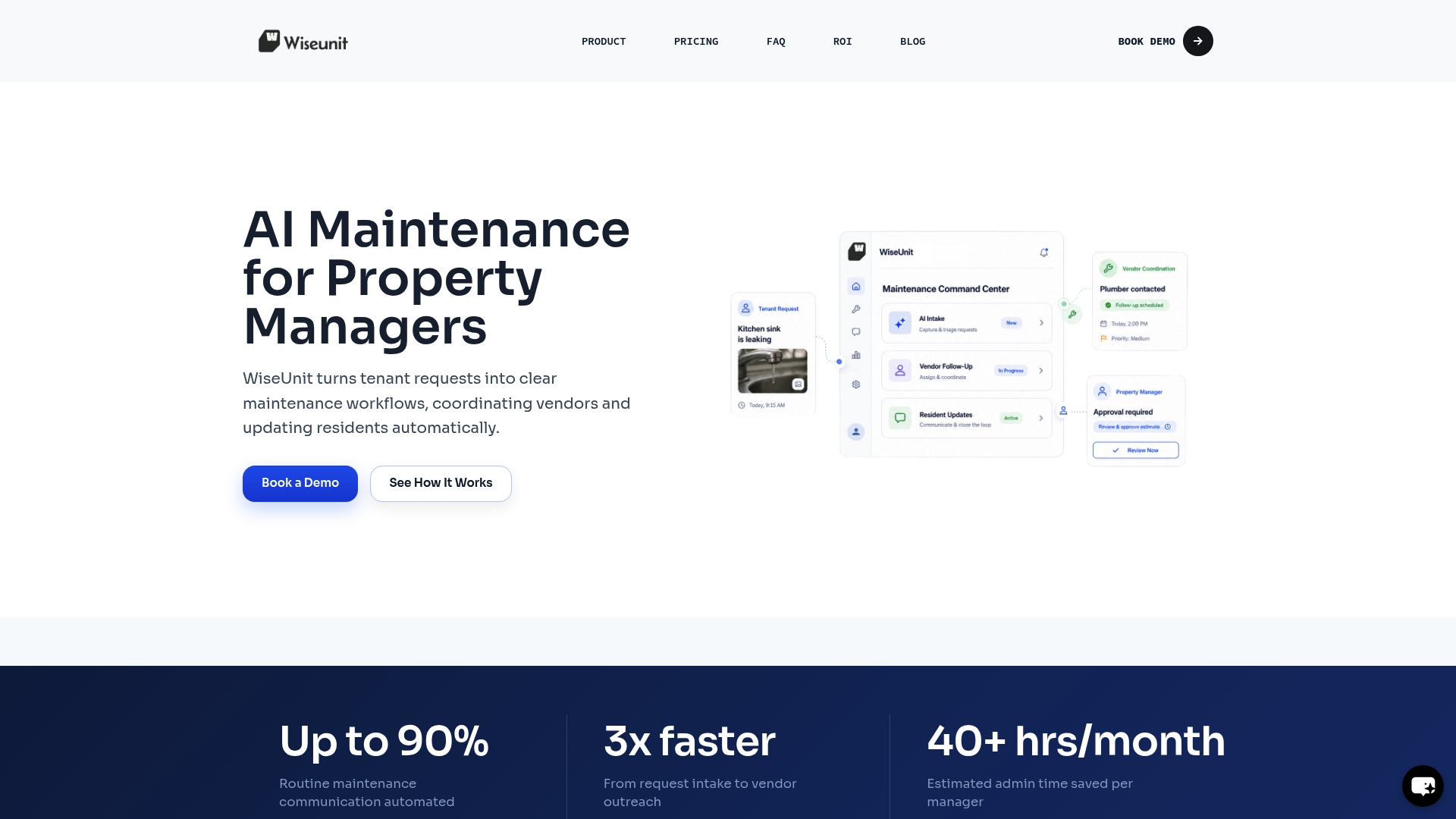
Wiseunit is an AI-powered maintenance execution platform that handles the full workflow from tenant intake through vendor dispatch, scheduling, follow-ups, and system updates inside AppFolio, Buildium, or Yardi. Tenants submit requests by call, SMS, or web form. Wiseunit triages, assigns, and tracks every work order automatically. Your team stops being the coordination layer and starts focusing on decisions that actually require human judgment. Use the ROI calculator to see exactly how much time and money your portfolio stands to recover.
FAQ
What is self-managed rental maintenance efficiency?
Self-managed rental maintenance efficiency is the use of automated workflows, vendor systems, and scheduled preventative tasks to reduce coordination time and costs in independently managed rental properties. It is the operational equivalent of running a maintenance department without a full staff.
How much time can automation save on maintenance requests?
Automating triage and vendor dispatch reduces time per request from 1–3 hours down to 15–30 minutes. For a 500-unit portfolio, that adds up to nearly 300 hours saved per month.
What is the most common cause of high maintenance costs in self-managed rentals?
Reactive maintenance is the primary cost driver. Emergency repairs cost 2–3 times more than scheduled tasks, and switching to planned maintenance reduces annual per-unit costs by 35%.
How many vendors should a self-managed landlord have per trade?
The standard recommendation is 2–3 pre-vetted contractors per trade category. This gives you dispatch flexibility and eliminates the risk of a single vendor cancellation turning into a tenant emergency.
Does maintenance automation work for small portfolios?
Yes. Even landlords managing 5–20 units benefit from digital intake, automated reminders, and documented vendor records. The time savings and dispute protection apply regardless of portfolio size, and the tools scale as you grow.