

Choosing the wrong maintenance vendor can cost you more than just money. It can void insurance, trigger code violations, and send tenants packing. For property management companies handling dozens or hundreds of units, understanding the types of rental property maintenance vendors available is not a nice-to-have. It is a core operational decision that directly shapes your cost structure, your liability exposure, and how satisfied your tenants are when something breaks at 11 p.m. on a Friday. This article lays out the main vendor categories, the criteria you need to evaluate them, and how to match the right vendor type to the right situation.
Table of Contents
- Key criteria for evaluating rental property maintenance vendors
- Licensed trades: plumbing, electrical, HVAC, and more
- Handyman services and general contractors: flexibility and limits
- Property management firms as maintenance coordinators
- Specialty trades vendors: roofing, restoration, and more
- Comparing rental property maintenance vendor types side by side
- Which rental property maintenance vendors work best for your property type and goals?
- Why relying on vendor networks outperforms direct individual hires
- Streamline your maintenance vendor coordination with AI software
- Frequently asked questions
Key Takeaways
| Point | Details |
|---|---|
| Vendor evaluation criteria | Evaluate maintenance vendors based on licensing, experience, pre-authorization limits, and response times. |
| Licensed trades importance | Licensed trades ensure compliance and avoid insurance risks for critical systems like plumbing and HVAC. |
| Handyman licensing rules | Handyman licensing regulations vary by state, especially above $500-$1,000 job thresholds. |
| Benefits of management firms | Property management firms provide vendor coordination, volume discounts, and faster maintenance responses. |
| Use preventive maintenance | Scheduling preventive maintenance reduces emergency repairs and lowers overall costs. |
Key criteria for evaluating rental property maintenance vendors
Before you can select the right types of rental property maintenance vendors for your portfolio, you need a consistent evaluation framework. Not all vendors are created equal, and the differences go well beyond price.
Here are the core criteria every property manager should apply:
- Licensing and regulatory compliance: Verify that vendors hold current state-issued licenses for their trade. This is non-negotiable for plumbing, electrical, HVAC, and structural work.
- Experience measured in unit-years: Ask vendors how many units they service annually and for how long. Volume and tenure matter more than years in business alone. MPM-designated staff and extensive unit-years experience are markers of reliable vendor performance.
- Pre-authorized spending limits: Set clear thresholds before work begins. Pre-authorized limits typically range from $200 to $500 per incident without owner approval, which allows your team to dispatch quickly without bottlenecks.
- Response time commitments: Get written guarantees on response windows, especially for emergency repairs. Vendors without defined SLAs (service level agreements) will always deprioritize your calls during peak demand.
- Insurance validity and warranty adherence: Require certificates of insurance before any work begins and confirm they cover general liability and workers' compensation. Check that vendors honor manufacturer warranties on installed equipment.
- Volume pricing relationships: Vendors who work regularly with your portfolio will often offer discounted rates. This is one of the strongest arguments for vendor management best practices that consolidate your spend with fewer, better-qualified providers.
Pro Tip: Build a vendor scorecard with these criteria and review it quarterly. Vendors who consistently miss response windows or require re-work should be replaced before a pattern becomes a crisis.
Having introduced the importance of selecting the right vendors, let's explore the specific types of rental property maintenance vendors that fit these criteria.
Licensed trades: plumbing, electrical, HVAC, and more
Licensed trades are the backbone of any rental property repair services program. These are the vendors you call when the stakes are highest, and where cutting corners creates the most serious consequences.
Electrical, plumbing, HVAC, and structural work require contractor licenses issued by state licensing boards. These are not administrative formalities. They exist because improper work on these systems can cause fires, floods, structural failures, and serious injury.
Key facts about licensed trade vendors:
- They must pull permits for most regulated work, which creates a paper trail that protects you during inspections or insurance claims.
- Unlicensed contractors in regulated trades can void insurance coverage and expose owners to municipal penalties.
- Hiring through established vendor networks reduces the risk of emergency premiums, which can run two to three times the standard rate for after-hours calls.
- Licensed HVAC technicians, for example, are required in most states to handle refrigerants legally. Using an unlicensed tech is not just a code issue. It is a federal one.
Stat to know: Properties that rely on ad-hoc licensed trade hires outside vendor networks routinely pay 20 to 40 percent more per service call due to lack of volume pricing and inconsistent scheduling.
The practical solution is to pre-qualify two or three licensed vendors per trade category in each market you operate. Verify their licenses directly through your state's contractor licensing board database, not just from a certificate they hand you. Licenses can lapse, and a lapsed license at the time of a claim is treated the same as no license at all. Smart maintenance cost reduction starts with getting this layer right.
Beyond licensed trades, there are other important vendor types that handle varied rental property maintenance needs.
Handyman services and general contractors: flexibility and limits
Handyman vendors fill an important gap in rental property upkeep. They handle the volume of smaller, non-regulated jobs that would otherwise clog your licensed trade vendor queue and drive up costs unnecessarily.

The regulatory picture here is more nuanced than most property managers realize. Handyman services are unregulated below $500 to $1,000 job thresholds in many states, but at least 18 states impose licensing requirements above those dollar values. That means a handyman who legally patched drywall last month may be operating outside their license if you ask them to also replace a light fixture in the same visit, depending on the total job value.
What handyman vendors do well:
- Appliance repairs, door hardware, caulking, minor carpentry, and cosmetic fixes
- Fast turnaround on low-priority work orders, often same-day or next-day
- Cost-effective pricing for jobs that do not require a licensed specialist
General contractors (GCs) occupy a different tier. They manage larger renovation or repair projects that require coordinating multiple trades, pulling permits, and overseeing subcontractors. A GC is the right call when you are dealing with a kitchen remodel between tenants, a significant water damage restoration, or any project where the scope is likely to expand.
Pro Tip: Track your handyman work orders by dollar value per vendor per month. If a single handyman is regularly completing jobs that aggregate above your state's licensing threshold, you may be creating compliance exposure without realizing it. Good maintenance operations scaling requires that kind of visibility.
Next, we'll consider property management firms as vendors coordinating multiple maintenance services.
Property management firms as maintenance coordinators
Some property management companies function as full-service maintenance coordinators, acting as the intermediary between property owners and the tradespeople who do the actual work. This model is common in multifamily and single-family rental portfolios where the owner wants one point of contact for everything.
The financial structure is straightforward. Property management firms coordinating rental maintenance typically charge 8 to 12 percent of collected rent and can deliver 10 to 25 percent cost savings through their vendor networks. The savings come from volume pricing, pre-negotiated rates, and the ability to batch similar work orders across multiple properties.
Benefits of using a property management firm for maintenance coordination:
- Access to pre-vetted vendor lists across all trade categories
- 24 to 48 hour response times through established vendor networks, compared to the 3 to 5 day average for direct hires
- Centralized record-keeping for warranties, permits, and service history
- Reduced owner liability through proper vendor insurance verification
- Certified management quality through designations like CRMC (Certified Residential Management Company) and MPM (Master Property Manager)
Stat to know: Firms with CRMC certification are required to demonstrate a minimum of 500 unit-years of management experience, meaning their vendor relationships are built on real operational volume, not just promises.
The tradeoff is cost and control. You pay the management fee whether maintenance volume is high or low, and you have less direct input on which specific vendors are dispatched. For high-volume portfolios, the efficiency gains typically outweigh these concerns. Understanding your maintenance workflow is the first step in deciding whether this model fits your operation. You can also explore how to automate maintenance within platforms like AppFolio, Buildium, or Yardi to complement this approach.
Alongside these, specialty trade vendors offer focused expertise for complex repair needs.
Specialty trades vendors: roofing, restoration, and more
Specialty trades sit at the top of the complexity scale. These vendors handle work that is too technical, too large, or too risk-sensitive for a general contractor or handyman to manage safely.
Specialty trades such as roofing and restoration require licensed contractors governed by state boards, with variable reciprocity between states. That last point matters if you manage properties across state lines. A roofing contractor licensed in Texas may not be legally permitted to work in Oklahoma without additional licensing.
Common specialty trade vendor categories include:
- Roofing contractors: Flat, pitched, and membrane systems. Typically project-based with warranty coverage requirements.
- Water and fire restoration specialists: These vendors work on a time-sensitive basis and often coordinate directly with insurance adjusters.
- Mold remediation contractors: Require specific certifications (IICRC is the standard) and must follow EPA guidelines.
- Elevator and lift service technicians: Heavily regulated, often requiring annual inspections and permits.
- Asbestos and lead abatement firms: Federal and state regulations govern these strictly. Only certified firms can legally perform this work.
Specialty vendors are almost always contracted on a project basis rather than a retainer. The key is having them pre-qualified before you need them. Waiting until a roof is actively leaking to find a licensed roofing contractor is how you end up paying emergency rates and accepting whoever is available. Proactive specialty trade cost savings come from having these relationships established in advance.
To clarify these differences, let's compare all major vendor types side by side.
Comparing rental property maintenance vendor types side by side
| Vendor type | Licensing required | Typical job scope | Cost level | Response time | Key risk |
|---|---|---|---|---|---|
| Licensed trades | Yes, state-issued | Plumbing, electrical, HVAC, structural | Medium to high | 24 to 48 hours (network) | Voids insurance if unlicensed |
| Handyman services | Varies by state and job value | Minor repairs, cosmetics, appliances | Low to medium | Same day to next day | Compliance risk above threshold |
| General contractors | Yes, for permitted work | Large renovations, multi-trade projects | High | 2 to 5 days | Cost overruns, subcontractor issues |
| Property management firms | Firm-level licensing | Full coordination across all trades | Fee-based (8 to 12%) | 24 to 48 hours | Less direct vendor control |
| Specialty trades | Yes, trade-specific | Roofing, restoration, abatement | High, project-based | Varies by urgency | Availability during peak seasons |
A few patterns worth noting from this comparison:
- Vendor networks managed by property management firms provide 10 to 25 percent cost savings below retail pricing through volume discounts. That gap is real and consistent across markets.
- Handyman services offer the best cost-to-speed ratio for low-complexity work, but only when job values stay within your state's licensing threshold.
- Specialty trades carry the longest lead times and highest per-project costs, making pre-qualification essential.
For a more detailed breakdown of how to build your vendor roster, the vendor comparison guide covers selection criteria by portfolio type.
With this comparison in mind, let's explore how different property management scenarios should drive vendor selection.
Which rental property maintenance vendors work best for your property type and goals?
Matching vendor types to your specific situation is where general knowledge becomes operational value. Here is a practical framework:
- Large multifamily portfolios (50+ units): Use a property management firm with a certified vendor network as your coordination layer. The volume justifies the management fee, and the 24 to 48 hour response guarantees protect tenant satisfaction at scale.
- Small-scale single-family rentals (1 to 10 units): Build direct relationships with one licensed vendor per trade category and one reliable handyman. Keep job values below your state's licensing threshold for handyman work.
- Properties with aging systems: Prioritize licensed HVAC, plumbing, and electrical vendors with preventive maintenance contracts. Reactive-only maintenance on older systems costs significantly more over time.
- Properties undergoing renovation or turnover: Engage a general contractor who can coordinate multiple trades under one contract. This reduces your administrative burden and keeps projects on schedule.
- Properties in markets with strict code enforcement: Specialty trades and licensed contractors are non-negotiable. Verify licenses directly with the state board before any work begins.
Experienced managers set pre-authorized limits at $200 to $500 per repair and schedule quarterly preventive maintenance to reduce emergency repairs. That combination of financial controls and proactive scheduling is the single most effective way to keep maintenance costs predictable.
Pro Tip: Review your maintenance workflow advice annually. Vendor relationships, licensing status, and local code requirements all change. A vendor who was the right fit two years ago may no longer meet your current standards.
Why relying on vendor networks outperforms direct individual hires
Here is an uncomfortable truth that many property owners only learn after a bad experience: hiring individual tradespeople directly, without a managed vendor network, almost always costs more in the long run.
The logic seems sound at first. Skip the management fee, call the plumber directly, save money. But that math ignores several real costs. Emergency premiums when your preferred plumber is unavailable. Re-work when an unvetted contractor does the job wrong. Insurance gaps when a vendor's certificate lapses between jobs. Time spent by your staff chasing quotes, scheduling, and following up.
Vendor networks provide 10 to 25 percent discounts and 24 to 48 hour response times, while direct hires routinely face emergency premiums and inconsistent availability. The discount alone often covers a significant portion of the management fee. Add in the reduced administrative burden and the risk mitigation from pre-verified insurance and licensing, and the math shifts decisively toward managed networks.
The other factor most operators underestimate is quality consistency. A vetted vendor network has accountability built in. Vendors who perform poorly get removed. That feedback loop simply does not exist when you are calling individual contractors from a list. The maintenance cost reduction you get from a well-managed network is not just about discounts. It is about fewer callbacks, fewer insurance claims, and fewer tenant complaints that turn into vacancies.
Streamline your maintenance vendor coordination with AI software
Managing multiple vendor types across a growing portfolio creates real coordination complexity. Dispatch decisions, spending limit enforcement, scheduling follow-ups, and status updates inside your property management system all require consistent execution to work well.
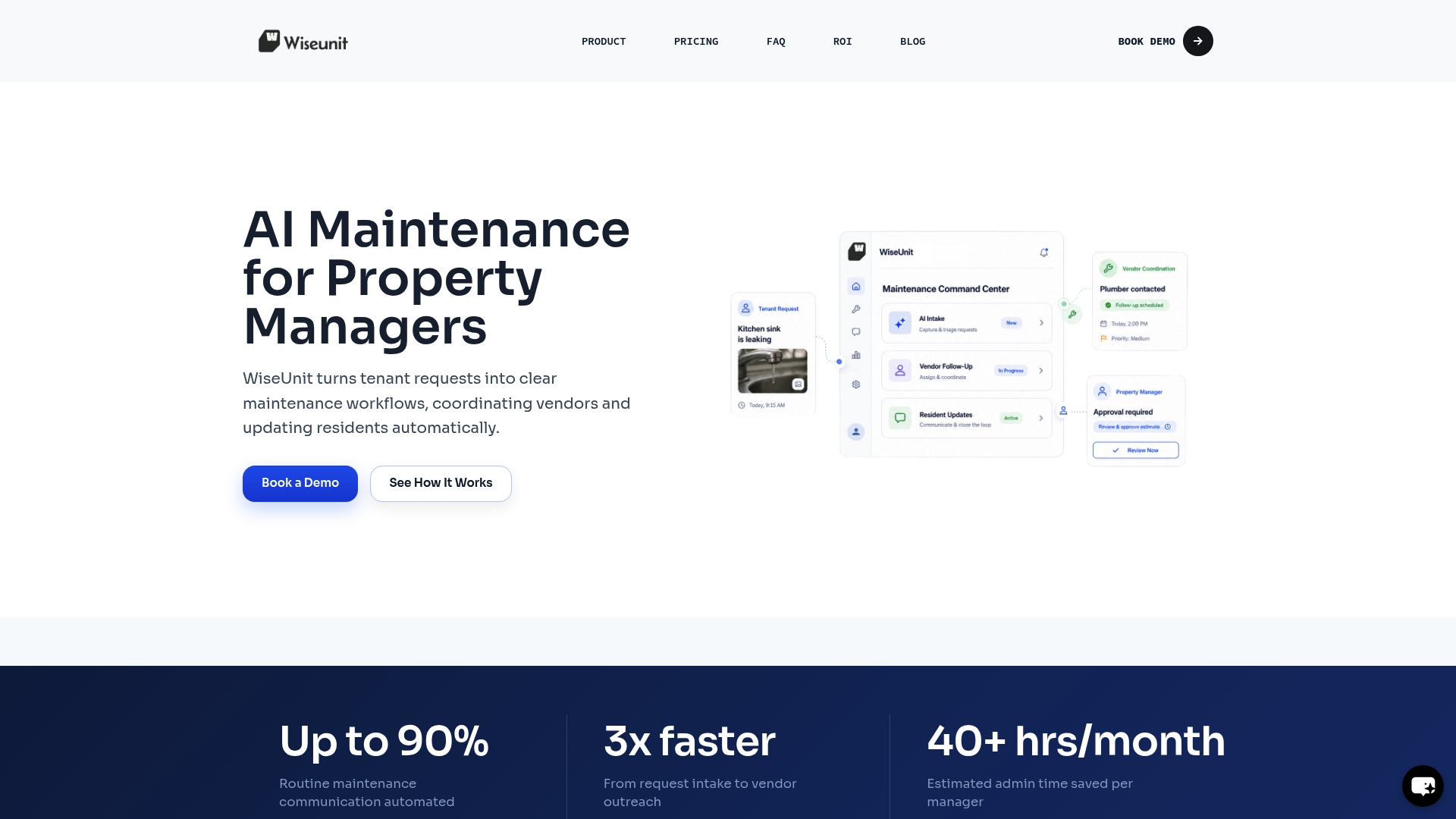
WiseUnit AI is built specifically for this operational layer. The platform handles tenant intake through calls, SMS, or online forms, then automatically triages requests, coordinates vendor dispatch, enforces pre-authorized spending limits, and syncs status updates inside AppFolio, Buildium, or Yardi. Your team stops chasing vendors and starts managing by exception. Whether you are applying the vendor management guide principles to your current roster or looking to scale without adding headcount, WiseUnit gives you the execution layer to make it work. Explore how teams are using it to improve maintenance operations scaling across multifamily and single-family portfolios.
Frequently asked questions
What types of maintenance vendors require state licenses?
Licensed trades such as plumbing, electrical, HVAC, and structural contractors require state-issued licenses due to regulatory and safety standards. Always verify license status directly through your state's contractor licensing board before dispatching any vendor.
When do handyman services require licensing?
In at least 18 states, handyman services must be licensed when work exceeds specific job value thresholds, typically between $500 and $1,000. Check your state's specific threshold before assigning jobs to unlicensed handymen.
How do property management firms reduce maintenance costs for landlords?
They leverage vendor networks to secure 10 to 25 percent discounts below retail pricing and coordinate services for faster response times and reduced emergency premiums. The savings often offset a significant portion of their management fee.
What are typical pre-authorized spending limits for maintenance vendors?
Pre-authorized limits typically range from $200 to $500 per repair incident, allowing timely service without requiring owner approval for routine work. Setting these limits in advance prevents both delays and unauthorized overspending.
Why is it risky to use unlicensed contractors for regulated maintenance work?
Unlicensed contractors in regulated trades can void insurance policies, invalidate permits, and expose property owners to municipal penalties. The short-term cost savings are rarely worth the financial and legal exposure.
Recommended
- Property Management Maintenance Workflow: Step-by-Step Process to Reduce Workload (Toronto, Dallas, Phoenix)
- How Top Property Managers Reduce Maintenance Costs Without Hiring More Staff (2026)
- WiseUnit AI Blog | Maintenance Operations Insights
- AI Maintenance Coordination Software for Property Managers | WiseUnit AI