
Slow maintenance response times, miscommunication between staff and vendors, and tenant complaints that pile up faster than you can address them. Sound familiar? For property management teams handling multifamily and single-family rentals across the US and Canada, these operational breakdowns aren't just frustrating. They cost you tenants and money. This property management team efficiency guide walks through the exact steps to fix the underlying systems, not just the symptoms, covering preparation, execution, troubleshooting, and how to measure whether your improvements are actually working.
Table of Contents
- Prepare your property management team for efficiency success
- Execute efficient maintenance workflows to improve response and satisfaction
- Troubleshooting common efficiency pitfalls and mistakes
- Verify and sustain improved team efficiency with metrics and continuous review
- Why focusing on technology alone won't fix your property management efficiency
- Boost your property management efficiency with WiseUnit AI
- Frequently asked questions
Key Takeaways
| Point | Details |
|---|---|
| Set clear SLAs | Defining service level agreements helps your team meet consistent maintenance response times to improve tenant satisfaction. |
| Standardize workflows | Using checklists, templates, and centralized SOPs prevents operational inconsistencies across properties. |
| Leverage technology wisely | AI and CMMS tools multiply efficiency but must be paired with human communication and disciplined processes. |
| Track key KPIs | Regular monitoring of maintenance workflows and leasing metrics identifies bottlenecks and drives continuous improvement. |
| Scale with systems | Rapid growth requires operational infrastructure to avoid fragmented procedures and unpredictable performance. |
Prepare your property management team for efficiency success
Before you can improve how your team operates, you need to build the foundation that makes consistent performance possible. Too many companies jump straight to buying new software without defining what "efficient" looks like for their specific portfolio. Start here instead.
Set your priorities and meeting cadence first. Your team can't execute efficiently if priorities shift without notice. Publish a clear list of team objectives tied to operational outcomes, such as reducing work order resolution times or improving tenant satisfaction scores. Pair that with a weekly stand-up (15 minutes, no exceptions) and a monthly operational review where you assess what's working and what isn't.
Define your SLAs before you need them. A service level agreement (SLA) is a documented commitment to how fast your team will respond and resolve specific types of requests. Setting high standards and clear SLAs from day one improves consistency and performance across your entire portfolio. Without them, every coordinator interprets urgency differently.
Select the right KPIs and stick to them. Your property management KPIs checklist should include 5 to 7 metrics that you actually review every week. Good candidates include:
- Maintenance response time (hours to first contact)
- Work order resolution time (days from open to close)
- Occupancy rate by property
- Average days to lease
- Tenant satisfaction score (post-maintenance survey)
- Lease renewal rate
- Cost per work order
Centralize your documents and SOPs. Scattered files across email threads and individual desktops are an operational liability. Use a cloud-based platform to store all standard operating procedures, vendor contacts, lease templates, and inspection checklists. Every team member should be able to find what they need in under 60 seconds.
Build checklists and templates for recurring tasks. A consistent maintenance workflow process starts before a request even comes in. Templates for move-in inspections, maintenance triage, and vendor dispatch eliminate the guesswork that slows teams down during high-volume periods.
- Create a move-in and move-out inspection checklist
- Build a maintenance triage template with priority categories
- Develop a vendor dispatch protocol with contact hierarchy
- Document your escalation path for after-hours emergencies
- Standardize your tenant communication templates by request type
Pro Tip: When scaling maintenance operations across multiple properties, assign one person per region to own SOP updates. Distributed ownership prevents documentation from going stale.
With preparation and foundational systems in place, the next step is executing efficient maintenance workflows and improving tenant communication.
Execute efficient maintenance workflows to improve response and satisfaction
Knowing what to do is different from doing it consistently at scale. This section covers how to run the actual day-to-day maintenance workflow in a way that meets tenant expectations and keeps your team from burning out.
Step 1: Use a CMMS with real-time visibility. A computerized maintenance management system (CMMS) gives your team, vendors, and tenants a shared view of every request. Look for mobile photo uploads, timestamps, and live status updates. Without this, your coordinators spend hours chasing status updates by phone.
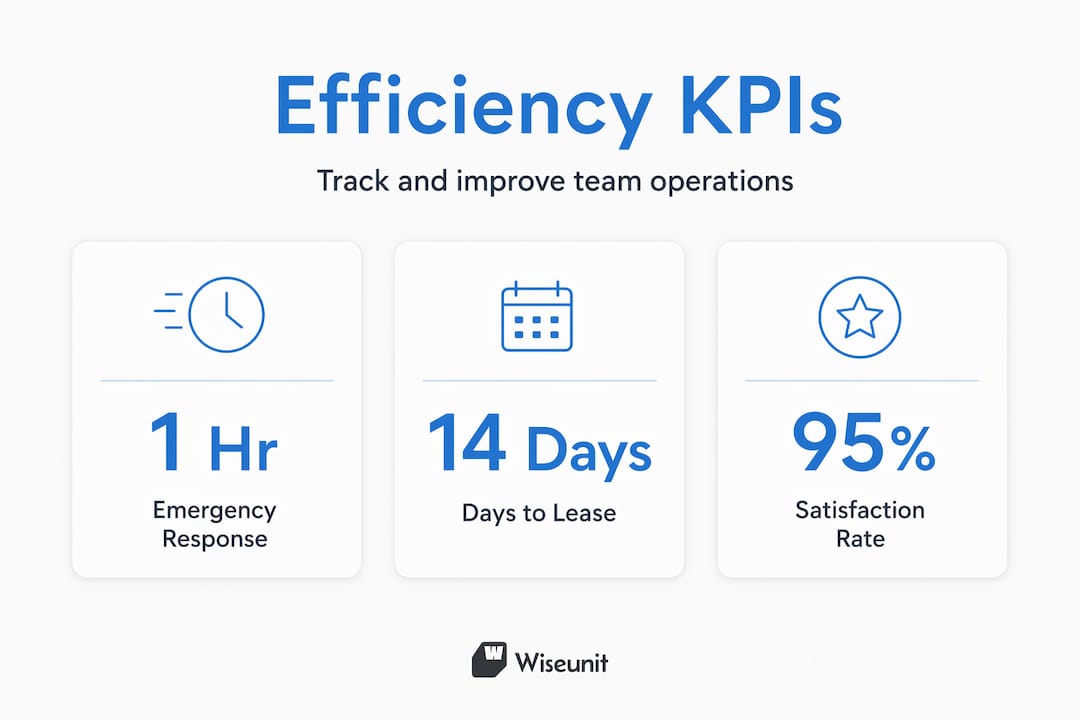
Step 2: Triage every request immediately. Speed at the intake stage sets the tone for the entire workflow. Maintenance response times under 4 hours for standard requests and under 1 hour for emergencies maximize tenant satisfaction. Build triage rules directly into your intake process so every coordinator applies the same criteria.
Step 3: Sequence work orders to reduce rework. Group work orders by building, floor, or unit type when possible. A maintenance tech who visits the same building twice in one day for separate, schedulable repairs is a process failure, not a staffing problem.
Step 4: Communicate proactively with tenants. Don't wait for tenants to ask for an update. Send a confirmation when a request is received, a second message when a vendor is assigned, and a follow-up after the work is done. Tenants who feel informed are far more likely to renew their leases, even when repairs take longer than expected.
Step 5: Review your maintenance workflow data weekly. Bottlenecks don't announce themselves. You find them by looking at the data. Which vendors consistently miss SLA windows? Which property types generate the most emergency calls? Weekly reviews turn raw numbers into actionable process changes.
Improving team productivity in property management isn't about working faster. It's about eliminating the steps that add time without adding value.
| KPI | Target benchmark | Warning threshold |
|---|---|---|
| Emergency response time | Under 1 hour | Over 2 hours |
| Standard request response | Under 4 hours | Over 8 hours |
| Work order resolution time | Under 3 days | Over 7 days |
| Tenant satisfaction score | 4.5 out of 5 | Below 4.0 |
| First-time fix rate | Above 85% | Below 70% |
Property management workflow optimization at this level doesn't require a larger team. It requires clearer systems. AI maintenance coordination software can handle intake, triage, vendor dispatch, and status updates automatically, which means your coordinators focus on the exceptions, not the routine.
Pro Tip: After completing a work order, send a one-question satisfaction survey via SMS. Response rates are higher than email, and the data feeds directly into your weekly KPI review.
After executing streamlined maintenance workflows, it's important to identify and address the common efficiency challenges that undo these gains.
Troubleshooting common efficiency pitfalls and mistakes
Even well-prepared teams run into operational problems. The issues below are the most common reasons property management teams lose efficiency after an initial improvement push.
Inconsistent SOPs across properties. When each property coordinator handles maintenance triage differently, you end up with unpredictable tenant experiences. One coordinator calls vendors the same morning. Another waits until a batch of requests accumulates. The result is inconsistent response times and a support team that can't cover for each other. Fix this by auditing your SOPs quarterly and testing them with new staff during onboarding.
No centralized data. Teams that rely on individual memory or local spreadsheets can't scale. When a coordinator leaves, that institutional knowledge walks out the door. Centralizing your vendor management systems and work order data prevents this and makes performance tracking possible.
Growing faster than your systems can support. Scaling too quickly without standardized systems makes operational performance unpredictable and inconsistent across properties. Adding 50 units to your portfolio sounds like a win. But if your intake process, vendor network, and communication workflows aren't ready, service quality will drop across your existing properties too.
Over-relying on automation without human follow-up. Automation handles volume. Humans handle nuance. A tenant who receives an automated update but can't reach anyone when their heat fails in January won't renew. Sustainable customer retention strategies always combine process efficiency with genuine responsiveness.
Letting vendor costs creep up without review. Many companies set up vendor contracts once and never revisit them. Annual rebidding and SLA renegotiation keep costs competitive and quality high.
| Pitfall | Root cause | Fix |
|---|---|---|
| Inconsistent response times | No triage SOP | Build and enforce a written triage protocol |
| Repeated vendor no-shows | No SLA in vendor contract | Add SLA terms and track compliance |
| Tenant complaints after repair | No post-work follow-up | Automate a satisfaction check-in |
| Coordinator bottlenecks | Work not distributed evenly | Use role-based dashboards to balance load |
| Cost overruns | Vendor pricing not reviewed | Schedule annual vendor rebidding |
Pro Tip: Run a 30-day process audit before adding any new technology. Document where time is actually lost. That audit will tell you which problems software can solve and which ones need a process change first.
Once you understand how to avoid these pitfalls, the final step is verifying that your improvements are working and setting up systems to keep them working.
Verify and sustain improved team efficiency with metrics and continuous review
Improvements that aren't measured don't last. This section covers how to set up the review processes that keep your team performing at a high level even as your portfolio grows and staff changes.
Track the right KPIs weekly, not monthly. Monitoring KPIs such as maintenance response times, occupancy, and tenant satisfaction ensures continuous operational improvement. Monthly reviews are too slow to catch problems early. Weekly check-ins let you course-correct before a single bad week turns into a trend.
Use dashboards with role-based views. A maintenance coordinator needs to see open work orders and vendor assignments. A regional manager needs to see SLA compliance rates and tenant satisfaction trends. Building dashboards by role means every person on your team acts on the information most relevant to their job, without wading through data that doesn't apply to them.
Schedule quarterly SOP reviews. Book them in advance so they don't get bumped. Use each review to assess whether your current procedures still reflect how work actually gets done, update your maintenance workflow guide, and retire any steps that no longer add value.
Benchmark against industry standards. The industry benchmark for days to lease is 14 to 21 days; exceeding 30 days signals pricing or marketing problems. Use benchmarks like this to set realistic targets and identify gaps between your current performance and what's achievable.
Collect and act on tenant and owner feedback. Metrics tell you what happened. Feedback tells you why. A tenant survey after a maintenance visit or a quarterly call with an owner reveals operational gaps that raw numbers miss. That feedback also informs reducing maintenance costs by identifying where rework and callbacks are happening most often.
| Metric | Review frequency | Owner |
|---|---|---|
| Maintenance response time | Weekly | Maintenance coordinator |
| Tenant satisfaction score | Weekly | Property manager |
| Occupancy rate | Monthly | Regional manager |
| Days to lease | Monthly | Leasing team |
| Work order resolution time | Weekly | Maintenance coordinator |
| SOP compliance | Quarterly | Operations lead |
Pro Tip: Add a "what broke this week" section to your weekly team meeting. Normalize surfacing process failures without blame. Teams that talk openly about breakdowns fix them faster than teams that hide them.
With verification and continuous improvement processes in place, it's worth addressing a perspective that many property managers overlook entirely.
Why focusing on technology alone won't fix your property management efficiency
Here's the uncomfortable truth that most software vendors won't say out loud: technology doesn't fix inefficient teams. It amplifies them.
If your vendor dispatch process is chaotic, automating that dispatch will produce chaotic results faster. If your team doesn't follow SOPs consistently, giving them a new platform won't change their behavior. The operators who see the biggest gains from tools like AI maintenance coordination are the ones who already have clear processes and use technology to execute those processes at scale.
AI can reduce workload but still lacks the human touch critical for tenant responsiveness and satisfaction. That gap matters. A tenant whose emergency repair was handled quickly but coldly is still at risk of not renewing. The operational metrics might look great while the relationship erodes quietly.
The most efficient property management teams we've observed share three traits. They have written, enforced SOPs that get reviewed regularly. They have staff who understand why the processes exist, not just what to do. And they use technology to handle volume while humans handle judgment. That's the balance that produces both efficiency and tenant retention.
Investing in property management training resources and team culture isn't soft. It's operational infrastructure. The teams that skip this step and go straight to automation end up layering tools on top of broken processes, which is expensive and demoralizing for staff.
Lasting property management operational efficiency requires a culture of accountability, clear ownership, and a genuine commitment to reviewing what isn't working. Technology earns its place when it supports that culture, not when it's expected to substitute for it.
Boost your property management efficiency with WiseUnit AI
If you've worked through this guide and are ready to put better processes into action, WiseUnit AI is built specifically for what you're trying to do. It functions as a maintenance execution layer for property management teams, handling the full workflow from tenant intake and issue triage through vendor coordination, scheduling, follow-ups, and status updates inside platforms like AppFolio, Buildium, and Yardi.
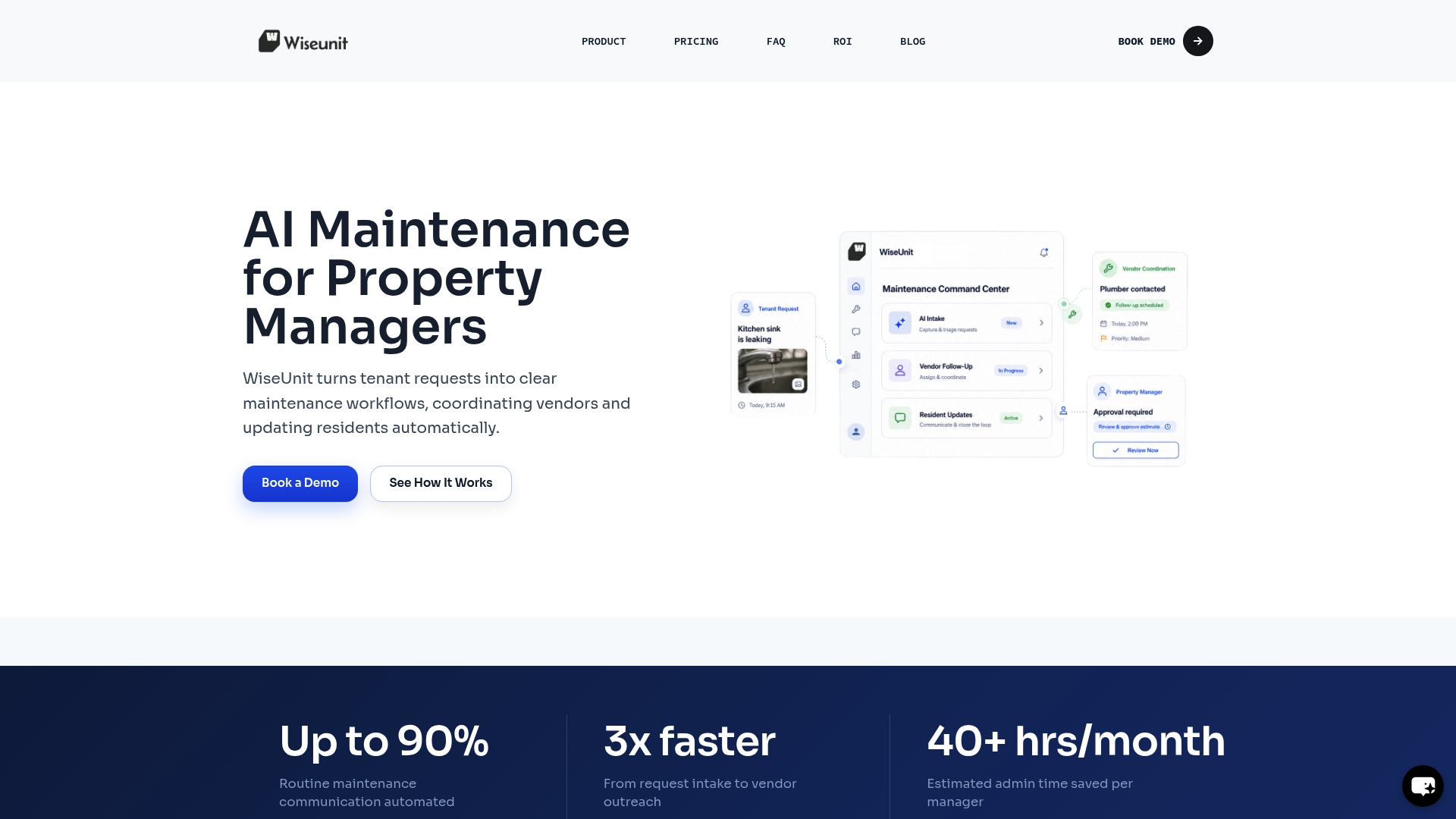
Tenants submit requests via call, SMS, or online form. WiseUnit coordinates the next steps automatically and keeps your team, vendors, and tenants updated in real time. That means your coordinators spend their time on the work that actually requires human judgment. To see what the efficiency gains look like for your specific portfolio, use the WiseUnit AI ROI calculator to estimate your potential time and cost savings. Or start free and experience the difference in your first week.
Frequently asked questions
What is a reasonable maintenance response time for property managers?
Industry benchmarks recommend responding to standard maintenance requests within 4 hours and emergency requests within 1 hour for optimal tenant satisfaction. Teams that consistently hit these targets report significantly higher lease renewal rates.
How can property management companies reduce the average days to lease a unit?
Accurate pricing, targeted marketing, and a documented leasing workflow are the primary drivers. The industry benchmark is 14 to 21 days, and exceeding 30 days almost always points to a pricing or process failure rather than a market problem.
Why do property management companies struggle with efficiency during rapid scaling?
Scaling without standardized systems makes operational performance unpredictable and inconsistent across properties, which means problems that were manageable at 200 units become uncontrollable at 500. Operational infrastructure has to grow ahead of the portfolio, not behind it.
Can AI fully replace human involvement in property management maintenance workflows?
No. AI reduces workload and handles routine coordination efficiently, but human judgment and responsiveness remain essential for tenant communication and satisfaction. The most effective approach combines AI execution with human oversight at key decision points.
What KPIs should property management teams track to maintain efficiency?
Focus on 5 to 7 KPIs reviewed weekly, including maintenance response time, work order resolution time, days to lease, occupancy rate, and tenant satisfaction scores. Keeping the list short ensures the team actually uses the data to make decisions.
Recommended
- AI Maintenance Coordination Software for Property Managers | WiseUnit AI
- Property Management Maintenance Operations: How to Scale Without Hiring (Toronto, Dallas, Phoenix)
- Property Management Maintenance Workflow: Step-by-Step Process to Reduce Workload (Toronto, Dallas, Phoenix)
- How Top Property Managers Reduce Maintenance Costs Without Hiring More Staff (2026)