

Vendor coordination property management is the structured process of assigning, scheduling, and overseeing third-party contractors to complete maintenance work across a real estate portfolio. According to NARPM 2025 benchmarking data, manual vendor coordination consumes about 2.4 hours of staff time per maintenance request. That adds up fast. For a 200-unit portfolio, the right coordination system saves over 1,260 hours annually, cuts vendor no-show rates, and prevents minor repairs from becoming expensive emergencies. The tools making this possible include platforms like AppFolio, Buildium, and Yardi, all of which support automated scheduling and vendor communication.
What does vendor coordination in property management require?
Successful vendor coordination, also called vendor relationship management (VRM) in formal operations contexts, starts before any work order is created. You need three things in place before dispatching a single contractor: qualified vendors, compliant contracts, and verified insurance.
Vendor pre-qualification is the first gate. Every vendor on your approved list should carry a valid license, a current Certificate of Insurance (COI), and a documented track record. The COI verification process must happen at the time of service, not just during onboarding. Insurance lapses between jobs. If you dispatch a vendor with an expired COI and something goes wrong on site, liability transfers directly to you as the property manager or owner.

Contract essentials protect both sides. Every vendor agreement should define scope of work, labor rates, response time expectations, and service level agreements (SLAs). Without a written SLA, you have no basis for disputing a slow response or a missed appointment. Platforms like AppFolio and Buildium include contract storage features that keep these documents accessible during dispatch.
Here is a quick overview of the core requirements and tools:
| Requirement | Purpose | Recommended Tool |
|---|---|---|
| COI verification | Prevents liability exposure | Buildium, manual tracking |
| Vendor licensing check | Confirms legal compliance | State licensing portals |
| Written SLAs | Sets performance expectations | AppFolio, Yardi |
| Scheduling software | Reduces no-shows and conflicts | Wiseunit, AppFolio |
| Communication log | Creates accountability trail | Buildium, SMS platforms |
- Collect W-9 forms and business licenses during onboarding
- Set calendar reminders for COI expiration dates (quarterly review minimum)
- Store all vendor documents in a centralized digital folder, not email threads
- Define emergency vs. routine response windows in every contract
Pro Tip: Set COI expiration alerts 30 days in advance. Chasing insurance certificates the day a job is scheduled creates delays and exposes you to liability.
How do you execute a vendor coordination workflow step by step?
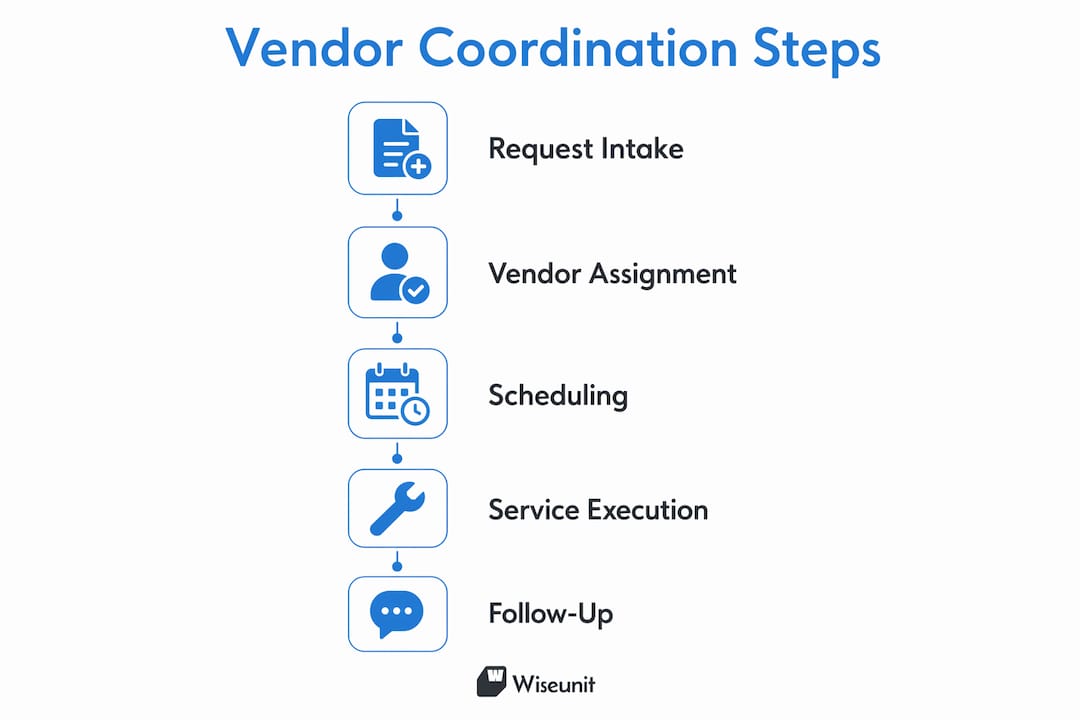
The vendor coordination lifecycle contains six defined stages: request intake, vendor assignment, scheduling and confirmation, tenant communication, job tracking, and completion verification. Skipping or rushing any stage creates gaps that cost money and damage tenant relationships.
Here is how each phase works in practice:
- Request intake. The tenant submits a maintenance request by phone, SMS, or online form. Log the issue immediately with a timestamp, unit number, and issue category. Platforms like Yardi and AppFolio auto-create work orders from tenant submissions.
- Vendor assignment. Match the request to a qualified vendor based on trade, availability, and performance history. Avoid defaulting to the same vendor for every job without checking their current workload.
- Scheduling and confirmation. Confirm the appointment in writing. The triple-confirmation protocol requires a written acceptance at booking, a 24-hour reminder, and a 2-hour reminder before the job. This single practice drops no-show rates from 18% to 3%.
- Tenant communication. Notify the tenant of the scheduled time, the vendor's name, and what access is needed. Tenants who receive updates are less likely to file complaints or escalate issues.
- Job tracking. Monitor job status in real time where possible. Structured dispatch with scoped work orders prevents vendors from expanding scope without authorization and reduces invoice disputes.
- Completion verification. Confirm the job is done, collect photos or a sign-off, and update the work order in your property management system. Close the loop with the tenant.
Pro Tip: Build a vendor performance score into your work order system. Track on-time arrival, job quality, and invoice accuracy. Use that data to rank vendors during assignment in step two.
Here is how manual and automated coordination compare at each stage:
| Stage | Manual Process | Automated Process |
|---|---|---|
| Request intake | Phone call, manual data entry | Auto-created work order from tenant submission |
| Vendor assignment | Staff selects vendor by memory | System matches vendor by trade and availability |
| Scheduling | Phone tag, no written record | Automated booking with written confirmation |
| Tenant communication | Manual call or email | Auto-notification via SMS or email |
| Job tracking | Staff follows up by phone | Real-time status updates in dashboard |
| Completion verification | Paper sign-off or verbal confirmation | Digital photo upload and auto-close |
The financial stakes are real. Reactive, unstructured dispatch can turn an $800 repair into an $8,000 emergency because no one tracked the asset history or caught the issue early. A structured workflow prevents that escalation.
What are the biggest challenges in vendor coordination?
The most common problems in property management vendor coordination are not technical. They are operational. Most stem from relying on phone calls, memory, and manual follow-up to manage a process that involves dozens of moving parts.
Here are the core challenges property managers face:
- Phone scheduling creates single-point failures. One missed call means a delayed job. One forgotten callback means a no-show. The no-show rate with manual phone scheduling sits at 18%, compared to 3% with automated confirmation workflows.
- No centralized record. When vendor communication lives in individual inboxes or phone logs, no one else on the team can pick up where someone left off. Centralized coordination workflows improve consistency and accountability across portfolios.
- Insurance gaps go unnoticed. COI expiration is easy to miss without a tracking system. The liability exposure is significant and often discovered only after an incident.
- Scope creep and invoice disputes. Without a scoped work order, vendors may bill for work that was never authorized. Structured dispatch with asset registers reduces this risk.
Automation addresses each of these directly. Automated workflows cut coordination time from over 2,000 hours to fewer than 400 hours annually for a 200-unit portfolio. That is not a marginal improvement. It is a fundamental shift in how much your team can handle without adding headcount.
"Vendor dispatch quality highly impacts financial outcomes. Structured dispatch with scoped work orders prevents costly emergency repairs and ensures accountability." — OxMaint AI
Automated reminder systems, digital work orders, and real-time tracking solve the communication failures that cause most vendor problems. The technology exists. The barrier is usually the decision to implement it.
How do you build strong vendor relationships that last?
Vendor relationship management (VRM) is the practice of treating contractors as long-term partners rather than one-time service providers. Research from CFlow Apps shows that 45% of vendor relationships plateau without active collaboration. That plateau shows up as slower response times, lower quality work, and vendors prioritizing other clients when your jobs compete for their schedule.
Strong VRM requires four consistent practices:
- Balanced scorecards. Track quality, responsiveness, and reliability for every vendor. Review scores quarterly and share them with vendors directly. Transparency builds accountability on both sides.
- Performance evaluations. Schedule brief check-ins with your top vendors twice a year. Discuss what is working, what is not, and what volume you expect to send them. Vendors who feel valued return that investment.
- Transparent communication. When a vendor misses a job or delivers substandard work, address it directly and document the conversation. Avoid letting issues accumulate until the relationship breaks down.
- Negotiation based on volume. If you consistently send a vendor 10 to 15 jobs per month, use that volume as leverage to negotiate preferred rates or priority scheduling. Most vendors will offer better terms to reliable, high-volume clients.
Pro Tip: Monitor COI expiration dates as part of your vendor scorecard review. A vendor who lets their insurance lapse is signaling operational disorganization. That is a performance issue, not just a paperwork problem.
For a deeper look at vendor management systems and KPIs, including how to scale these practices across larger portfolios, the frameworks apply whether you manage 50 units or 500.
The shift from transactional to collaborative vendor relationships does not happen overnight. It requires consistent follow-through on your side. Vendors respond to property managers who pay on time, communicate clearly, and provide accurate work orders. Build that reputation and your vendor pool will prioritize your jobs.
Key takeaways
Effective vendor coordination in property management requires structured workflows, verified vendor compliance, and consistent relationship management to reduce costs, cut no-shows, and scale without adding staff.
| Point | Details |
|---|---|
| Pre-qualify every vendor | Verify licensing, COI, and performance history before adding vendors to your approved list. |
| Use triple-confirmation scheduling | Written acceptance plus 24-hour and 2-hour reminders drops no-show rates from 18% to 3%. |
| Follow the six-stage lifecycle | Request intake through completion verification prevents cost escalation and compliance gaps. |
| Automate to scale | Automated workflows reduce coordination time from 2,000+ hours to under 400 hours annually for a 200-unit portfolio. |
| Invest in vendor relationships | Collaborative VRM with scorecards and regular check-ins improves service quality and vendor loyalty over time. |
What i've learned from watching vendor coordination break down
After years of working closely with property management teams, the pattern I see most often is not a technology problem. It is a process problem that technology then exposes.
Teams that struggle most with vendor coordination are usually managing everything reactively. A tenant calls, someone scrambles to find a vendor, a phone call gets made, and no one writes anything down. That works for five units. It collapses at fifty.
The managers who run the tightest operations share one habit: they treat every vendor interaction as a data point. Who showed up on time? Who billed accurately? Who communicated proactively when there was a delay? That data, collected consistently, becomes the foundation for every future dispatch decision.
What surprises most people is how much the vendor relationship side matters operationally. Property managers often focus on technology and ignore the fact that a vendor who trusts you will answer your call at 7 a.m. on a Saturday. That trust is built through fair payment terms, clear work orders, and honest feedback. No software replaces it.
The future of vendor coordination is not fully automated. The best outcomes come from pairing disciplined process with the right tools, so your team focuses on decisions while the system handles the logistics. That combination is where the real efficiency gains live.
— Laur
Let Wiseunit handle the vendor coordination logistics
Property managers using Wiseunit's AI maintenance platform report significant reductions in manual coordination time. Wiseunit acts as the execution layer for your maintenance workflow, handling tenant intake, issue triage, vendor assignment, scheduling, and follow-ups automatically. It syncs directly with AppFolio, Buildium, and Yardi, so your records stay current without manual data entry.
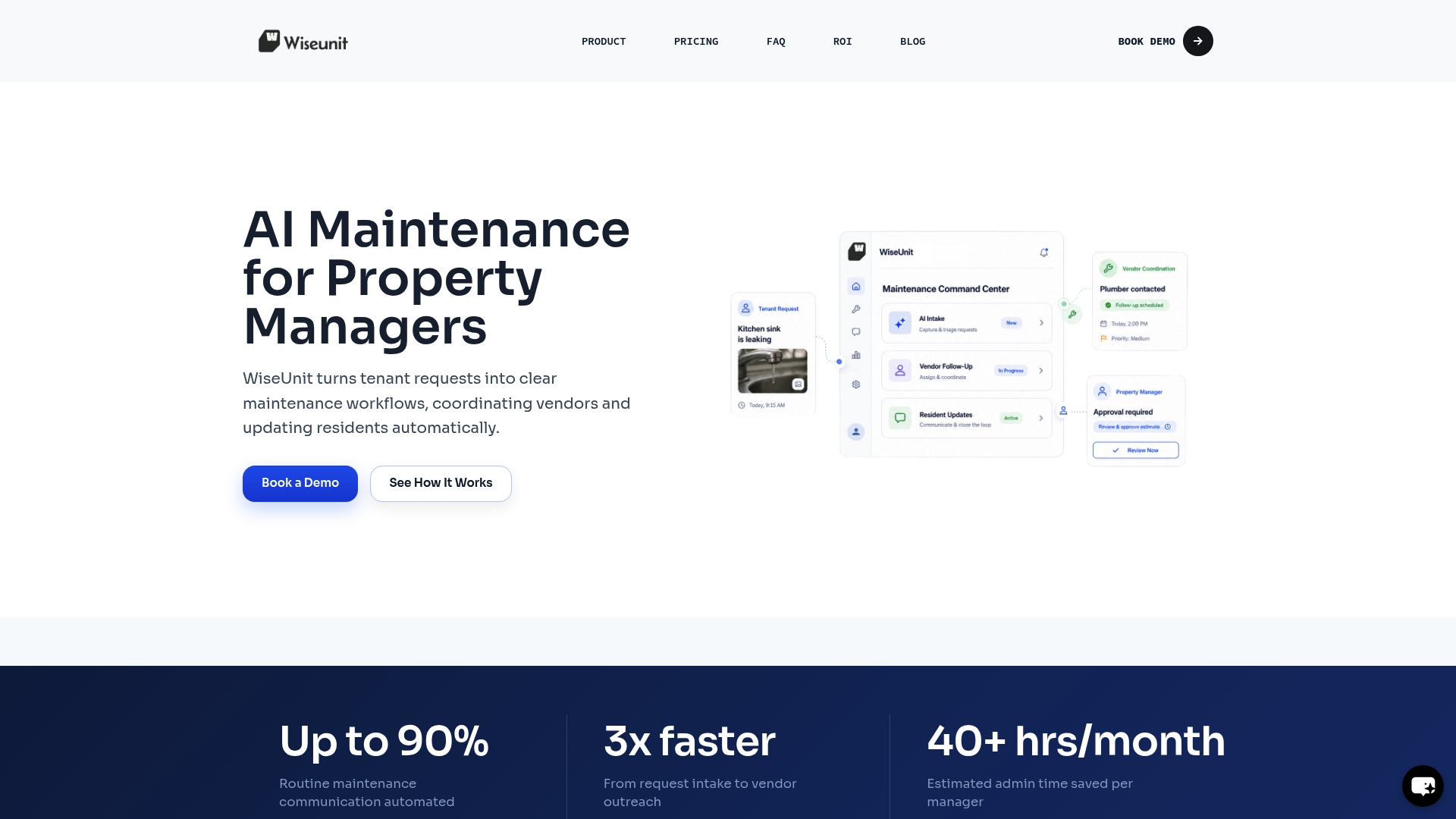
Tenants submit requests by phone, SMS, or online form. Wiseunit routes the request, contacts the right vendor, sends confirmation reminders, and updates all parties in real time. Your team stays informed without managing every step manually. For teams managing multifamily, single-family rental, or HOA portfolios with high maintenance volume, Wiseunit scales your capacity without requiring additional coordinators. Use the ROI calculator to see exactly how much time and cost your portfolio could recover.
FAQ
What is vendor coordination in property management?
Vendor coordination in property management is the process of selecting, scheduling, and overseeing third-party contractors to complete maintenance and repair work across a rental portfolio. It covers every stage from request intake to job completion verification.
How much time does vendor coordination take without automation?
Manual vendor coordination averages 2.4 hours of staff time per maintenance request. For a 200-unit portfolio, that totals over 2,000 hours annually before automation is applied.
What is the triple-confirmation protocol?
The triple-confirmation protocol requires a written booking acceptance, a 24-hour reminder, and a 2-hour reminder before a scheduled job. This approach reduces vendor no-show rates from 18% to 3%.
Why does COI verification matter at the time of service?
A vendor's Certificate of Insurance can lapse between their onboarding date and the day they perform work. Verifying COI at service time prevents liability from transferring to the property manager if an uninsured incident occurs on site.
What is vendor relationship management in property management?
Vendor relationship management (VRM) is the practice of building long-term, collaborative partnerships with contractors rather than treating each job as a one-off transaction. It includes performance tracking, regular communication, and volume-based negotiation to improve service quality over time.