

Running maintenance across a multifamily property is one of the most operationally demanding jobs in real estate. Requests come in through different channels, vendors need coordinating, and tenants expect fast answers. Multifamily AI maintenance coordination, or what the industry more formally calls intelligent maintenance coordination, uses AI-driven workflow execution to handle intake, triage, dispatch, and follow-up with far less manual effort. This guide walks you through exactly how to set it up, where it breaks down, and how to measure whether it's actually working.
Table of Contents
- Key Takeaways
- What you need before deploying AI maintenance coordination
- The step-by-step AI maintenance workflow
- Avoiding compliance and communication risks
- Measuring success and improving over time
- My perspective on getting AI coordination right
- How Wiseunit handles AI maintenance coordination
- FAQ
Key Takeaways
| Point | Details |
|---|---|
| AI executes, not just tracks | The real value of AI in maintenance is workflow execution from intake to completion, not just ticket logging. |
| Integration comes first | AI coordination only works well when connected to your existing platforms, vendor networks, and data sources. |
| Governance prevents mistakes | Human review and data separation controls are non-negotiable before deploying AI for tenant communications. |
| Metrics drive improvement | Tracking response time, first-visit resolution, and tenant satisfaction turns AI into a learning system. |
| Start small, scale deliberately | Piloting AI on one workflow before full deployment reduces risk and builds team confidence. |
What you need before deploying AI maintenance coordination
Before any AI tool can coordinate maintenance effectively, your operational foundation needs to be solid. Think of it like plumbing. The AI is the pressure, but without connected pipes, nothing flows anywhere useful.
The core data sources you need integrated before deployment include:
- Work order history — at least 12 months of structured records showing issue type, vendor assigned, time to resolution, and repeat visit frequency
- Vendor data — names, trade categories, service areas, performance ratings, and current availability
- Inspection records — unit-level condition data, ideally tied to a platform that supports automated triggers
- Tenant contact preferences — SMS, email, or portal, since AI communication tools need to know where to reach each resident
- Your property management system (PMS) — whether that's AppFolio, Buildium, or Yardi, your AI layer must write back to it, not operate alongside it
Platform integration matters more than most vendors will tell you upfront. The HappyCo and Lessen integration is a strong real-world example. When an AI-powered inspection flags an issue inside HappyCo, it can instantly generate a maintenance request and send it into Lessen's execution network without any manual re-entry. That closed loop, from signal to dispatch to status sync, is what separates genuine AI coordination from a glorified ticketing system.
Here's a quick comparison of what to look for when evaluating tools:
| Feature | Basic ticket tool | AI coordination platform |
|---|---|---|
| Tenant intake | Manual form entry | SMS, phone, or portal with AI triage |
| Vendor dispatch | Manual assignment | AI-matched by trade, location, availability |
| Status updates | Manual email or call | Automated updates to tenant and PMS |
| Inspection triggers | Not supported | Auto-generates work orders from inspection data |
| Audit trail | Limited | Full execution log per request |
Data governance deserves its own conversation. The NAR's guidance on AI for property managers explicitly cautions against feeding tenant personally identifiable information (PII) into AI tools without clear policies. Before you deploy, define which data the AI can access, which gets masked, and who reviews outputs before they reach tenants.
Pro Tip: Run a data audit on your PMS before integrating any AI tool. Vendors with inconsistent formatting or missing trade categories will cause misroutes from day one.
The step-by-step AI maintenance workflow
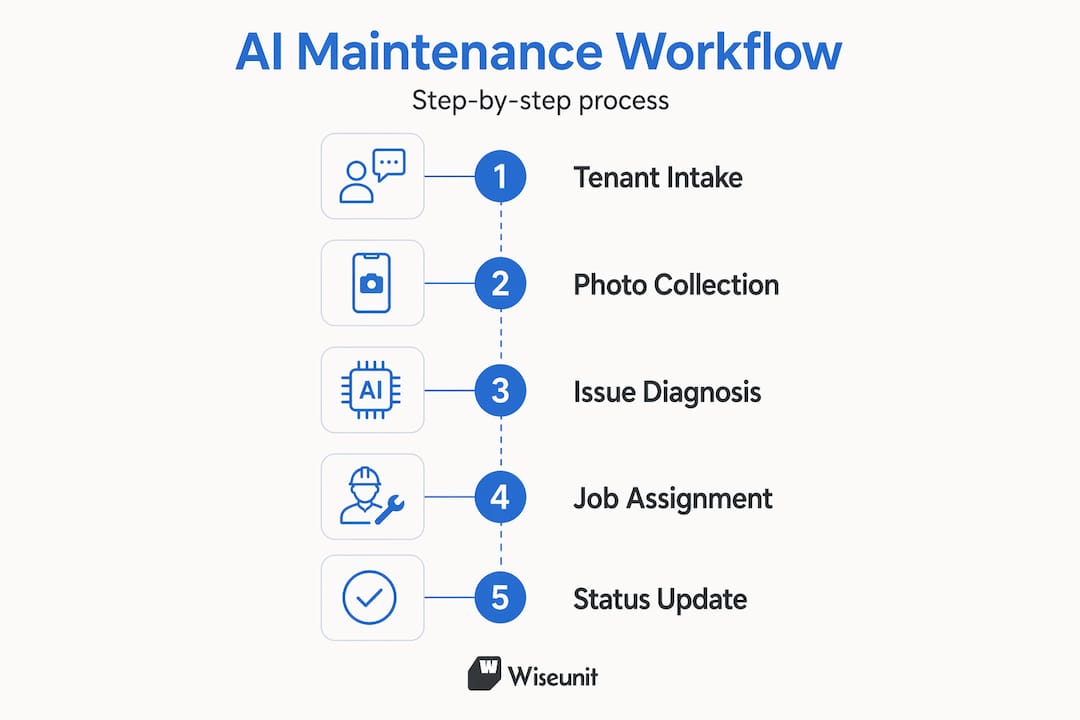
Understanding the theory is one thing. Seeing the actual sequence of events is another. Here is how a fully integrated intelligent maintenance coordination workflow runs from start to finish.
-
Tenant submits a request. Via SMS, a phone call, or an online form. The AI receives the submission and immediately acknowledges it with a confirmation message. No waiting on hold, no unreturned voicemails.
-
AI conducts intake triage. The system asks clarifying questions. Is there water on the floor? Is this an emergency? Does the tenant have a pet that needs to be secured during the visit? This structured intake, including photo collection via SMS, is what enables accurate dispatch the first time.
-
Issue classification and priority assignment. The AI categorizes the request by trade (plumbing, HVAC, electrical, appliance), severity (emergency, urgent, routine), and unit location. This removes the judgment call from your front-line staff and applies consistent rules every time.
-
Vendor matching and dispatch. Using your vendor database, the AI identifies the best available provider by trade, proximity, and performance history. Networks like Lessen's 30,000-plus vetted providers show how this scales across large portfolios. The dispatch happens automatically, with the vendor receiving job details, unit access notes, and tenant contact info.
-
Scheduling confirmation sent to tenant. The tenant receives an SMS or email confirmation with the appointment window. They can confirm, reschedule, or flag a concern. No phone tag required.
-
Real-time status syncing. As the vendor accepts, travels to, and completes the job, status updates flow back to the tenant and to the property manager's PMS. Your dashboard stays current without anyone manually updating a ticket.
-
Post-job follow-up. The AI sends a brief satisfaction check to the tenant and flags any unresolved issues to the property manager for review. If a callback is needed, it gets logged and escalated automatically.
-
Work order closure and record update. The completed job syncs into your PMS with timestamps, cost data, and vendor notes attached. No separate data entry step.
This end-to-end sequence is what AI property management execution looks like in practice. Critically, each step produces structured data that improves the next dispatch decision.
Pro Tip: Treat photo collection at intake as a first-time-right protocol. Tenants who submit a clear photo of a leaking pipe get faster, more accurate vendor dispatch. Build the photo prompt into your SMS intake flow from day one.

Avoiding compliance and communication risks
Generative AI adoption in property management jumped from 20% to 58% between 2024 and 2025. That speed of adoption is outpacing governance. The risks are real, and they cluster around two areas: AI hallucinations in tenant communications and mishandling of tenant data.
An AI hallucination in this context means the system generates a confident but factually wrong response. Imagine a tenant asking about their repair timeline and the AI confirming a date that no vendor ever agreed to. That kind of error erodes trust fast and can create legal exposure.
Here is a practical governance checklist for teams deploying AI in tenant-facing communications:
- Separate data layers. Tenant PII (name, unit number, contact info) should not flow into your AI's prompt construction without masking or role-based access controls. Keep capture, processing, and output as distinct system functions.
- Require human review for non-standard situations. Routine confirmations can be fully automated. Anything involving lease terms, legal notices, rent discussions, or emergency safety situations should require a human to approve before sending.
- Create an escalation path. Every AI interaction should have a clear handoff point. When the AI cannot confidently classify an issue or the tenant expresses frustration, it routes to a coordinator, not a dead end.
- Document your AI policies in writing. Your team needs to know what the AI is authorized to do and what it is not. This protects you during disputes and creates a baseline for training.
- Audit communications regularly. Pull a sample of AI-generated messages weekly and review them for accuracy and tone. This catches drift before it becomes a pattern.
The NAR's position on AI governance is clear: policies alone are not enough. Operational controls, meaning actual system architecture choices, are what make governance real rather than aspirational.
The greatest risk with AI in property management is not losing efficiency. It is generating incorrect or non-compliant communications that reach tenants before anyone checks them. Governance is an operational design problem, not a policy document problem.
Measuring success and improving over time
Deploying AI coordination is not a set-and-forget decision. The teams that get the most from it treat it as a system that improves with data. That requires tracking the right metrics from the start.
The most useful indicators to monitor are:
- Average time to first response (goal: under 5 minutes for AI-handled intake)
- Time from request submission to vendor dispatch
- First-visit resolution rate (repairs completed without a callback)
- Tenant satisfaction score collected post-job
- Number of manual interventions per 100 requests (a declining number signals good AI calibration)
Beyond raw metrics, agentic AI systems produce audit logs that show exactly what decision was made at each step and why. When a vendor is misrouted or a tenant complaint surfaces, the log tells you where the workflow broke down. That specificity is what allows you to fix the root cause rather than just the symptom.
Here is a quick reference for tracking performance improvements over time:
| Metric | Baseline target | Mature AI target |
|---|---|---|
| First response time | Under 15 minutes | Under 5 minutes |
| Dispatch time | Same day | Within 2 hours |
| First-visit resolution | 65% | 80%+ |
| Manual interventions per 100 requests | 30+ | Under 10 |
| Tenant satisfaction (post-job survey) | 3.5/5 | 4.2/5+ |
Staff adoption is just as important as system performance. AI tools that reduce manager time spent on admin tasks by 10 to 15 hours weekly only deliver that value if your team trusts and uses the system consistently. Build regular review sessions into your monthly calendar to look at flagged cases together and calibrate the AI's rules as your portfolio evolves.
Pro Tip: Review your misrouted or manually overridden jobs every month as a team. These edge cases contain the most useful signal for improving your AI configuration. One workflow fix from a pattern you spot can prevent dozens of future errors.
My perspective on getting AI coordination right
I've watched a lot of property management teams approach AI adoption the same way. They see a demo, get excited, and then push for full deployment across their entire portfolio within 90 days. That is almost always when the problems start.
In my experience, the teams that get the best results do the opposite. They pick one specific workflow, usually maintenance intake and vendor dispatch, and they run the AI alongside their existing process for the first 30 days. They compare outputs. They catch errors before those errors reach a tenant.
What I've found is that the human-AI balance is not a fixed setting. It shifts as your data matures and your team builds confidence. A coordinator who spent six months reviewing AI-dispatched jobs develops a sharper eye for when the system is right and when it needs a nudge. That judgment is not replaceable, and it should not be. The AI should be handling the volume and the speed. The coordinator should be handling the exceptions and the relationships.
The uncomfortable truth is that most AI coordination failures trace back to poor data preparation or skipped governance steps, not to the AI itself. The technology is ready. The question is whether your team's processes and data quality are ready to support it.
If I were advising a property management team starting today, I'd say this: get your vendor data clean, define your escalation rules before you go live, and plan for a 60-day calibration period before you evaluate results. Teams that do this consistently report real, durable improvements. Teams that skip it spend months firefighting avoidable issues.
— Laur
How Wiseunit handles AI maintenance coordination
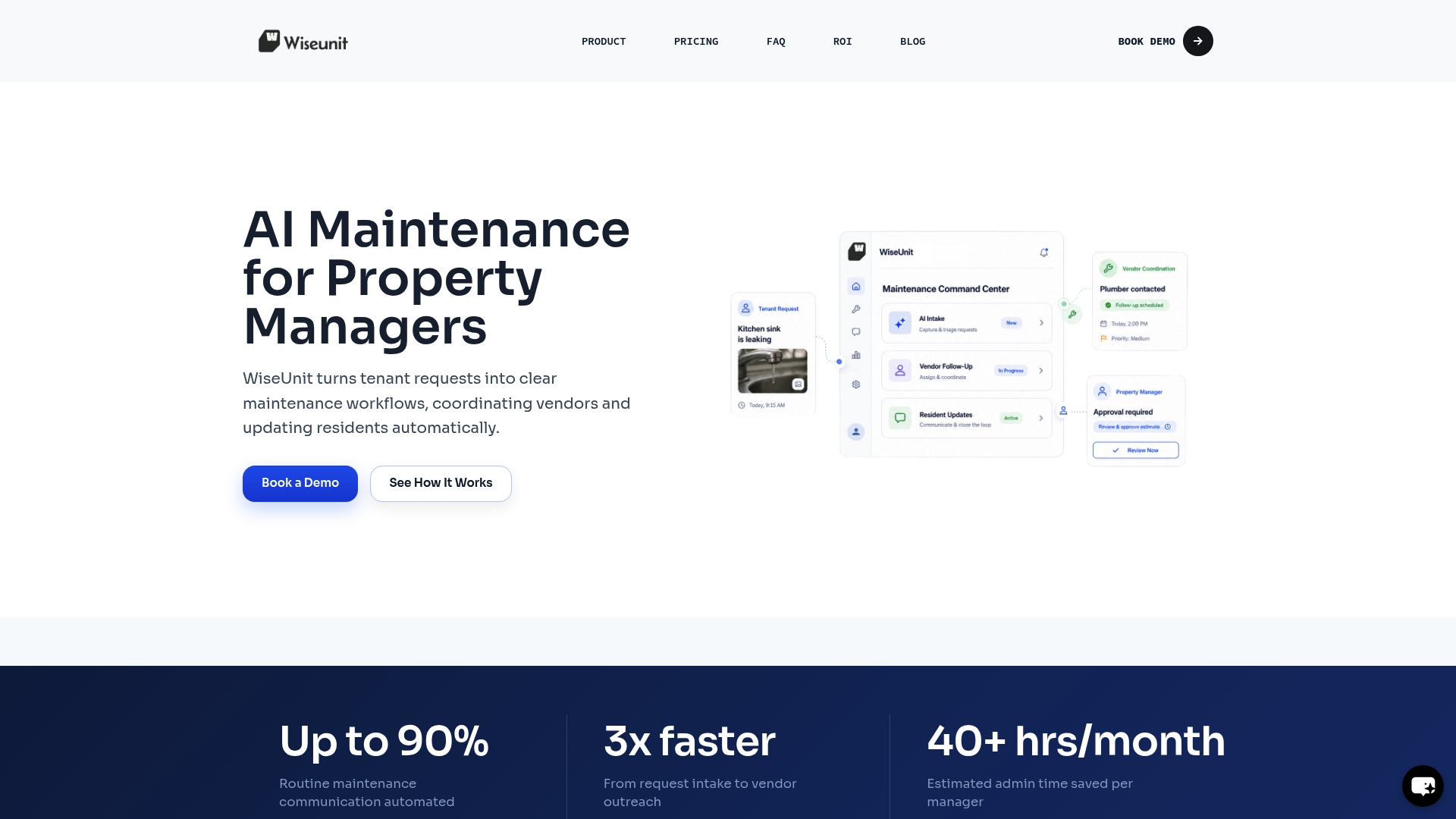
Wiseunit is built specifically for the workflow described in this article. It handles tenant intake through calls, SMS, and online forms, then executes triage, vendor coordination, scheduling, follow-ups, and PMS updates inside platforms like AppFolio, Buildium, and Yardi. It does not just log tickets. It completes the work order cycle from first contact to closed job.
For teams managing multifamily maintenance at scale, Wiseunit reduces the manual coordination load without requiring you to hire additional maintenance coordinators. If you want to see what the numbers look like for your portfolio, the ROI calculator gives you a concrete estimate based on your unit count and current request volume. No commitment required.
FAQ
What is multifamily AI maintenance coordination?
Multifamily AI maintenance coordination refers to using AI-powered systems to manage the full maintenance workflow in apartment communities, from tenant intake and issue triage to vendor dispatch and status updates, without relying on manual handoffs between staff.
How does AI improve tenant communication during maintenance?
AI handles instant request confirmations via SMS, collects photos for accurate diagnosis, and sends scheduling updates automatically. This eliminates the back-and-forth calls that frustrate tenants and delay resolution.
What platforms does AI maintenance coordination integrate with?
Most AI coordination tools are designed to sync with major property management software. Wiseunit, for example, integrates directly with AppFolio, Buildium, and Yardi to write status updates back into your existing system without manual data entry.
How do you prevent AI errors from reaching tenants?
Operational controls matter more than policy documents alone. Separate your data capture, AI processing, and final message delivery into distinct steps, and require human review for anything outside routine confirmations. Regular audits of AI-generated messages catch issues before they become patterns.
How long does it take to see results from AI maintenance coordination?
Most teams see measurable improvements in response time and dispatch accuracy within 60 to 90 days of deployment, provided vendor data is clean and escalation rules are defined before going live.