
Work order software in apartments is defined as a digital system that automates the full maintenance lifecycle, from tenant request intake through technician dispatch, parts sourcing, and job closure, replacing fragmented phone calls and spreadsheets with a structured, trackable workflow. Property managers using platforms like AppFolio, Buildium, and Yardi already handle leasing and financials in one place, but maintenance coordination has historically been the operational gap where requests get lost, tenants go silent, and costs spiral. Dedicated apartment maintenance software closes that gap by giving every stakeholder, manager, technician, and tenant, a single source of truth for every open job. The result is faster repairs, lower costs, and a measurably better tenant experience.
How work order software improves maintenance processes in apartment complexes
Work order management for apartments works by converting every incoming maintenance request into a structured, trackable job record the moment it is submitted. That single shift, from unstructured communication to a formal work order, is where most operational gains begin.
Here is how the core workflow operates in practice:
-
Automated work order creation. Tenant submits a request via portal, SMS, or email. The system automatically creates a work order with a timestamp, unit number, issue category, and priority level. No manual data entry required.
-
Intelligent task prioritization. The software ranks jobs by asset criticality and tenant impact. A non-functional HVAC unit in July gets a higher priority score than a slow-draining sink, so your team always works the right jobs first.
-
Technician assignment by skill and availability. The system matches the job to the right technician based on trade, certification, and current workload. Technicians receive job details on their mobile device, update progress in real time, and close work orders on-site with photos and notes attached.
-
Inventory management integration. Before dispatch, the software checks parts availability and reserves what is needed. About 32% of unexpected downtime comes from missing parts at the repair site. Pre-staging eliminates that delay before the technician ever leaves the shop.
-
Real-time tracking and status visibility. Managers see every open job on a dashboard. Tenants receive automatic status updates. Nobody needs to call the office to ask what is happening.
Pro Tip: Set up automated priority escalation rules so any work order open beyond 48 hours without a status update triggers a supervisor alert. This one rule alone prevents the majority of tenant complaints about slow response times.
What are the key benefits of work order software for apartment managers?
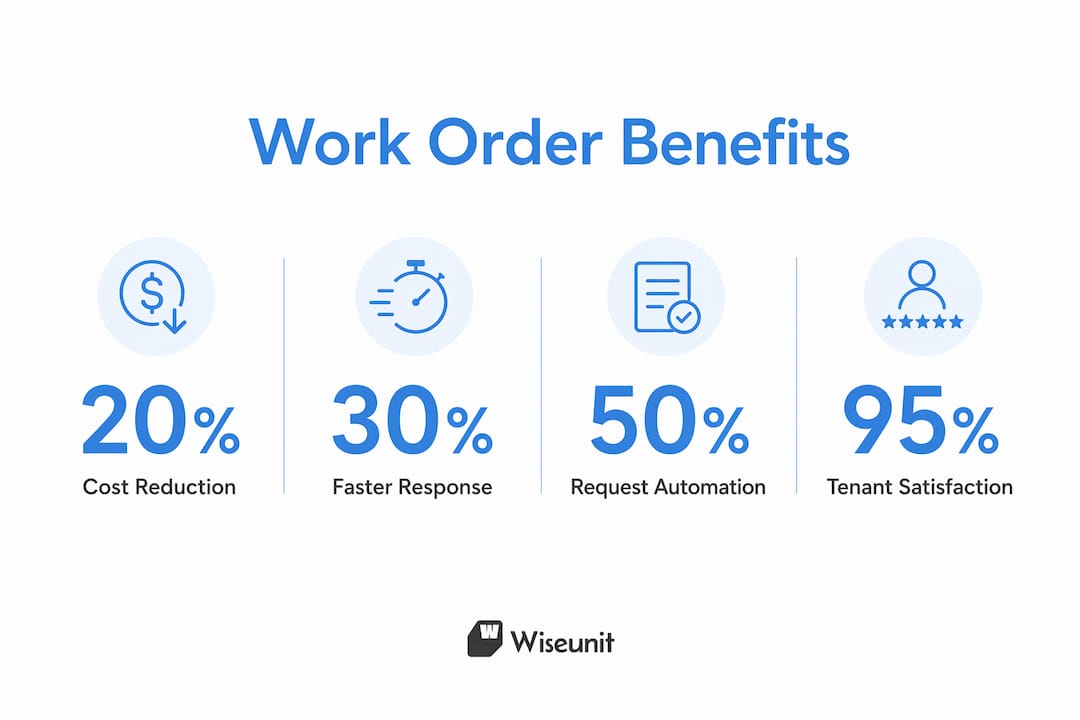
The benefits of work order software are measurable, not theoretical. Property managers who make the switch from reactive, phone-based maintenance to a structured system see gains across cost, time, and tenant retention.
-
Reduced maintenance costs. Maintenance costs drop by up to 20% when teams shift from reactive repairs to planned workflows. Reactive work is expensive because it demands emergency labor rates, overnight parts shipping, and often causes secondary damage from delayed fixes.
-
Less downtime. Automated systems reduce downtime by 27% on average. For a 200-unit apartment community, that translates directly into fewer vacant days and stronger retention numbers.
-
Extended asset life. Consistent preventive maintenance programs enabled by work order software extend asset lifespan by up to 20%. HVAC systems, water heaters, and elevators all last significantly longer when serviced on schedule rather than repaired after failure.
-
Higher technician productivity. Mobile-enabled tools increase productivity by up to 20% by eliminating manual handoffs, paper work orders, and back-and-forth phone calls. Technicians spend more time fixing and less time coordinating.
-
Audit-ready documentation. Every job generates a complete record: photos, timestamps, technician notes, and parts used. This documentation trail protects you from liability claims, supports CapEx justification to owners, and makes annual audits straightforward.
"The greatest value of work order software is achieving process consistency, not just fixing individual problems." This is the insight most property managers miss when evaluating software. A single fast repair is a win. A system that delivers consistent repairs across 300 units, every month, is a competitive advantage.
For a deeper look at how these savings add up across a portfolio, the multifamily maintenance operations guide from Wiseunit breaks down the numbers by property type.
How does work order software integrate with existing property management systems?
Work order software and a Property Management System (PMS) serve different functions, and understanding that distinction prevents a common and costly mistake.
| Function | Property Management System (PMS) | Work Order Software / CMMS |
|---|---|---|
| Primary role | Leasing, rent collection, owner reporting | Maintenance request intake, dispatch, tracking |
| Financial data | Unit ledgers, accounts payable, owner statements | Labor costs, parts usage, vendor invoices |
| Tenant communication | Lease documents, rent notices | Maintenance status updates, scheduling windows |
| Integration benefit | Receives cost postings from completed jobs | Sends repair costs to PMS ledger automatically |
When these two systems are connected, repair costs post automatically to the correct unit ledger the moment a work order closes. Vendor invoices and material usage are captured without manual entry. This prevents the revenue leakage that happens when maintenance work gets completed but never billed back to the right account or owner.
Property managers using AppFolio, Buildium, or Yardi should prioritize work order tools that offer native or API-based integration with their existing PMS. The goal is a single data flow: tenant submits request, work order is created, job is completed, cost is posted, owner sees it in their next statement. No manual reconciliation. You can see how this plays out in practice with AppFolio, Buildium, and Yardi integrations covered in detail by Wiseunit.
Pro Tip: Before selecting any apartment maintenance software, map your current cost-posting workflow on paper. Identify every manual step between job completion and owner billing. Then confirm your shortlisted software eliminates each one. If it does not, the integration is incomplete.
What are best practices for tenant-friendly maintenance request intake?
Tenant compliance with your request intake process determines the quality of your data and the speed of your response. If the intake channel is too complex, tenants call instead of submitting, and you lose the structured data that makes work order management work.
The most effective intake channels share one trait: they require minimal effort from the tenant.
- QR codes posted in common areas and unit hallways let tenants submit a request by scanning with their phone camera. No app download, no login, no friction.
- SMS-based intake works for tenants who prefer texting. A simple keyword trigger, such as texting "REPAIR" to a dedicated number, opens a guided intake flow.
- Email submission remains the fallback for tenants who prefer written communication and provides a natural paper trail.
- Resident portals within platforms like AppFolio or Buildium work well for tech-comfortable tenants but should never be the only option.
Complex apps often discourage tenant engagement and lead to unstructured requests that arrive by phone, creating exactly the chaos you are trying to avoid. The fix is not a better app. It is offering multiple low-friction channels simultaneously.
Once a request is submitted, communication consistency matters as much as speed. Tenants should receive three automatic touchpoints: a confirmation that the request was received, a scheduling window with a technician name, and a closure note confirming the job is complete. This three-message sequence reduces resident complaints significantly because it replaces uncertainty with information.
Pro Tip: Add a brief satisfaction prompt to your closure message, something as simple as "Was your issue resolved? Reply YES or NO." The response rate is high because the ask is minimal, and the data tells you exactly where your maintenance process is breaking down.
How can predictive analytics and advanced features improve apartment maintenance?
The next tier of efficient work order systems in housing moves beyond tracking completed jobs and into preventing failures before they happen. AI and predictive analytics integrated with work order systems can reduce maintenance costs by up to 25% and increase uptime by 10 to 20%. That is a meaningful gain for any portfolio managing aging HVAC systems, elevators, or plumbing infrastructure.
| Advanced feature | How it works | Operational impact |
|---|---|---|
| IoT sensor triggers | Sensors on HVAC, pumps, or elevators detect anomalies and auto-generate work orders | Catches failures before tenant impact |
| Automated parts reservation | System checks inventory and reserves parts at work order creation | Eliminates the 32% of downtime caused by missing materials |
| Mobile manuals and history | Technicians access equipment history and repair guides on-site via mobile | Reduces diagnostic time and repeat visits |
| Data analytics and trend reporting | Aggregates job data to identify recurring failures by unit, building, or asset type | Supports capital planning and budget forecasting |
The mobile dimension deserves specific attention. When technicians can pull up the full repair history of a unit's HVAC system while standing in front of it, they diagnose faster and fix correctly the first time. Mobile-enabled maintenance execution, including photo capture and barcode scanning, reduces errors and improves productivity in ways that paper-based or desktop-only systems cannot match.
Data analytics is where long-term value compounds. If your work order system shows that units in Building C generate three times the plumbing requests of comparable units in Building A, that is a capital planning signal, not just a maintenance note. The property management maintenance workflow guide from Wiseunit covers how to use this data to reduce workload over time.
Key takeaways
Work order software delivers its highest value in apartments when it connects tenant intake, technician dispatch, parts management, and PMS cost posting into one unbroken workflow.
| Point | Details |
|---|---|
| Automate intake first | Use SMS, QR codes, and portals together to maximize tenant compliance and data quality. |
| Plan maintenance, don't react | Planned workflows reduce costs by up to 20% and downtime by 27% compared to reactive repairs. |
| Integrate with your PMS | Automatic cost posting to unit ledgers prevents revenue loss and simplifies owner reporting. |
| Keep tenant communication consistent | Three automatic touchpoints (confirmation, schedule, closure) reduce complaints and build trust. |
| Use data for capital planning | Work order trend data by unit and building type directly informs CapEx decisions and budget forecasts. |
The part most property managers skip
I have reviewed maintenance operations at dozens of apartment communities, and the pattern is consistent. Teams invest in software, configure the dashboard, and then immediately try to activate every feature at once. Predictive analytics, IoT triggers, owner reporting portals, all of it, before the basic intake and assignment workflow is even stable.
Incremental rollout focused on request intake, task assignment, and standardized closure is the approach that actually works. Get those three steps running cleanly for 60 days before adding complexity. The teams that do this see adoption rates above 90% within a quarter. The teams that do not are still troubleshooting their configuration six months later while tenants call the front desk.
The other mistake I see regularly is over-digitizing the tenant side. A beautifully designed resident app that requires account creation, a password, and three screens to submit a leaky faucet request will be ignored. Tenants will call. Your staff will manually enter the request anyway, and you have lost the efficiency you paid for. Simpler intake channels consistently outperform sophisticated ones in compliance and data accuracy.
Technology complements good processes. It does not replace them. If your current workflow for assigning a technician to a job is unclear, software will make that confusion faster and more visible, not fix it. Map the process first. Then automate it.
— Laur
See how Wiseunit handles this for you
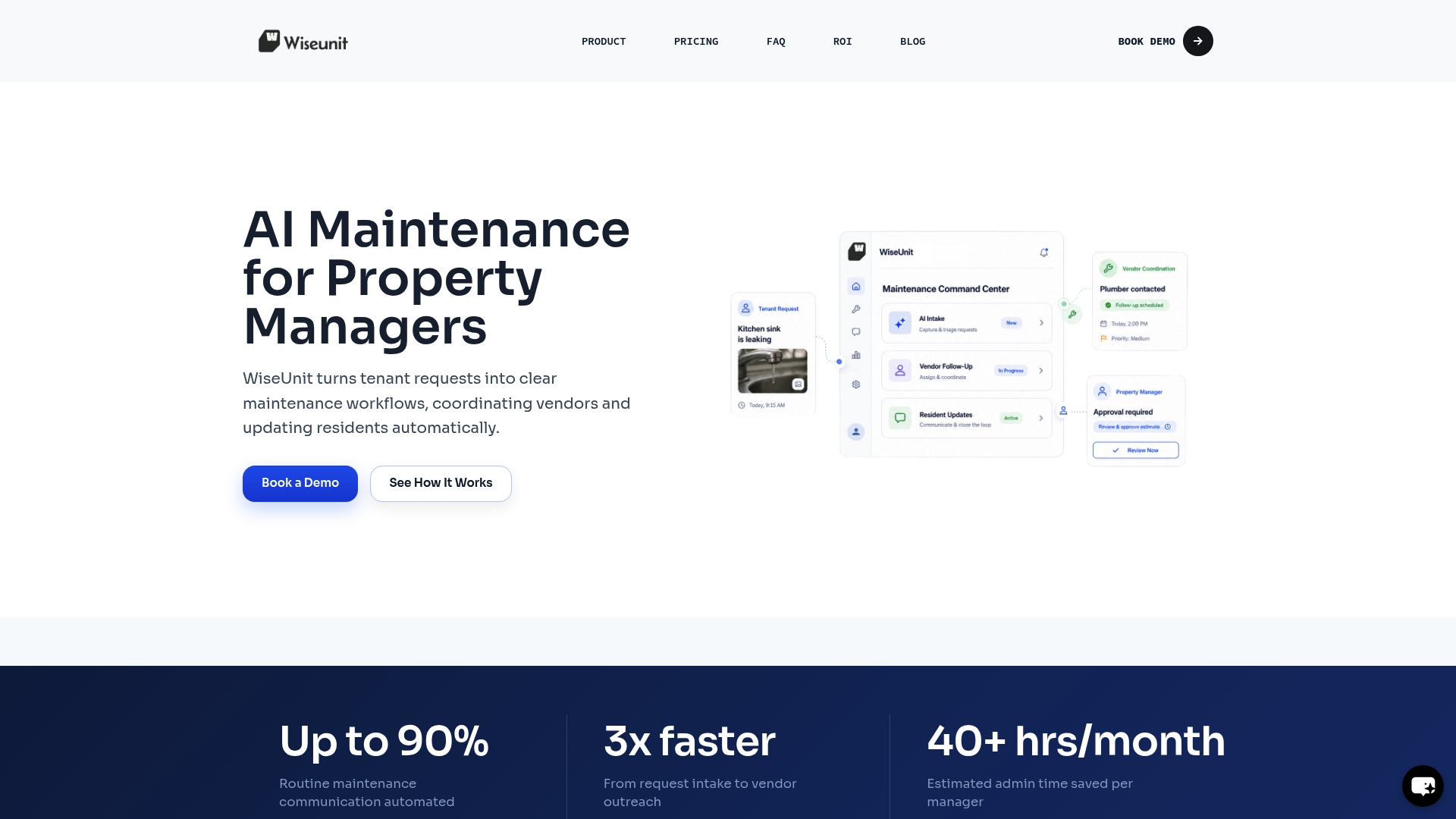
Wiseunit is an AI-driven maintenance execution platform built specifically for property management teams. Rather than simply tracking tickets, Wiseunit executes the full workflow: tenants submit requests by call, SMS, or online form, and Wiseunit handles triage, vendor coordination, scheduling, and status updates inside your existing PMS, whether that is AppFolio, Buildium, or Yardi. Your team stops chasing updates and starts managing by exception. Use the ROI calculator to see what your portfolio could save, or start for free and run your first maintenance workflow today. Visit WiseUnit AI to learn more.
FAQ
What is the role of work order software in apartments?
Work order software in apartments automates the full maintenance lifecycle, from tenant request intake through technician dispatch, parts management, and job closure. It replaces unstructured phone calls and manual tracking with a structured, transparent workflow that reduces costs and improves tenant satisfaction.
How does work order software reduce maintenance costs?
Dedicated maintenance software reduces costs by up to 20% by shifting teams from reactive repairs to planned, preventive workflows. Planned maintenance eliminates emergency labor premiums and prevents secondary damage from delayed fixes.
What is the difference between a PMS and work order software?
A Property Management System handles financials, leasing, and owner reporting, while work order software manages the day-to-day operational rhythm of maintenance requests, technician dispatch, and job tracking. The two systems work best when integrated so repair costs post automatically to the correct unit ledger.
Which tenant intake channels work best for maintenance requests?
SMS, QR codes, and email consistently outperform dedicated apps for tenant compliance because they require no login or download. Offering multiple low-friction channels simultaneously captures the highest volume of structured requests and reduces untracked phone calls.
How long does it take to see ROI from apartment maintenance software?
ROI from dedicated maintenance management software is typically realized within 12 to 18 months after implementation, driven by reduced labor costs, lower parts spend, and improved asset longevity from consistent preventive maintenance programs.
Recommended
- Types of Multifamily Work Order Systems Explained
- Property Management Maintenance Workflow: Step-by-Step Process to Reduce Workload (Toronto, Dallas, Phoenix)
- How Property Managers Automate Maintenance with AppFolio, Buildium, and Yardi
- Maintenance Coordination Software Explained for Property Managers