

Property management team scaling strategies are deliberate methods for growing operational capacity without proportional headcount increases. The most effective approach combines documented SOPs, maintenance workflow automation, and centralized staffing models before adding a single new hire. Teams that automate first and hire second consistently outperform those that react to volume by adding staff to broken processes. Tools like Wiseunit, AppFolio, and Buildium now make it possible to manage significantly more units with the same core team, provided the operational infrastructure is in place first.
1. build operational systems before you scale
The foundation of any scaling effort is documented processes. SOPs are critical starting at 20–30 units to prevent costly operational breakdowns as portfolios grow. Without written procedures, every new hire reinvents the wheel, and every departure takes institutional knowledge with them.
The core systems to document before scaling include:
- Maintenance request intake and triage: Who receives the request, how urgency is classified, and which vendor category responds
- Leasing workflows: Application processing steps, screening criteria, and approval timelines
- Rent collection and delinquency escalation: Automated reminders, late notice triggers, and owner notification thresholds
- Owner reporting cadence: What gets reported, when, and in what format
Centralized communication platforms like AppFolio, Buildium, or Yardi eliminate single points of failure. When one coordinator is out, the workflow continues because the system holds the process, not the person. Performance KPIs tied to these workflows, such as average maintenance resolution time and tenant response rate, surface problems before they become crises.
Pro Tip: Start your SOP library with your three highest-volume tasks. For most teams, that means maintenance intake, rent collection follow-up, and lease renewal outreach. Document those three first and build from there.

2. automate maintenance workflows first
Maintenance coordination is the single largest consumer of staff time in most property management operations. Automated maintenance dispatch systems save 6–10 hours per week in coordination time by handling request intake, triage, vendor selection, scheduling, and tenant updates without manual intervention.
The table below shows how automation changes the time profile of a typical maintenance coordinator:
| Task | Manual Time per Week | Automated Time per Week |
|---|---|---|
| Request intake and classification | 4–5 hours | Under 30 minutes |
| Vendor outreach and scheduling | 3–4 hours | Under 1 hour |
| Tenant status updates | 2–3 hours | Under 20 minutes |
| After-hours triage | 1–2 hours | 0 hours (AI handles) |
That time recapture is not theoretical. Automated tenant communication reduces reactive messaging from 8–12 hours per week down to 2–3 hours. The coordinator's role shifts from fielding calls to reviewing exceptions and managing complex cases that genuinely require human judgment.
Wiseunit operates as a maintenance execution layer, not just a ticket tracker. Tenants submit requests via call, SMS, or online form. The AI triages the issue, coordinates the vendor, schedules the work, and updates AppFolio, Buildium, or Yardi automatically. Your team handles the edge cases.
Pro Tip: Before selecting any automation tool, map your current maintenance workflow end to end. Identify the three steps where requests stall most often. Those are your highest-value automation targets.
3. automate rent collection and owner reporting
Maintenance is not the only workflow worth automating. Automating rent collection cycles reclaims 12–15 hours per month for staff by handling reminders, late notices, escalating follow-ups, and owner notifications without manual input.
Owner reporting is similarly time-intensive when done manually. Automated monthly reports pulled directly from your property management system eliminate hours of data compilation. Owners receive consistent, accurate updates, and your team spends that time on higher-value work.
Technology investments that replace manual processes yield the highest efficiency returns. Rent collection, maintenance dispatch, and lease renewals are the three prime targets. Automating all three before hiring your next coordinator is the most direct path to margin improvement.
4. adopt a centralized staffing model
The Centralized Staffing Model consolidates back-office functions into a regional hub that serves multiple properties. Centralized staffing reduces administrative overhead by 15–20% by grouping renewals, accounts payable, and tenant screening under one specialized team rather than duplicating those functions at each property.
The practical benefits include:
- Reduced duplication: One renewals specialist handles the entire portfolio instead of each property manager doing their own
- Faster processing: Specialists work faster than generalists on high-volume tasks
- Cleaner accountability: Each function has a clear owner and measurable output
Onsite teams shift focus to tenant experience and asset preservation rather than paperwork. This increases service quality and reduces admin burnout simultaneously. The model works especially well for multifamily portfolios above 200 units where back-office volume justifies the hub structure.
"Hiring is best viewed as a strategic pivot rather than a reactive move to volume changes." — Property Management Staffing: The Definitive 2026 Guide
5. use a hybrid workforce for maintenance peaks
Seasonal maintenance spikes create a staffing dilemma. Hiring full-time staff to cover peak periods means carrying excess payroll during slow months. Top firms combine direct hire leadership with gig-economy contractors to handle volume fluctuations without permanent payroll bloat.
The hybrid model works as follows. Your core team handles day-to-day coordination, vendor relationships, and quality control. Gig contractors from platforms that serve the trades sector fill in during spring turnover season, summer HVAC demand, and winter emergency calls. You pay for capacity only when you need it.
This approach pairs well with vendor type diversification. Having a pre-vetted roster of on-call contractors means your team can activate additional capacity within hours rather than days. The result is consistent service quality regardless of seasonal demand.
6. track revenue per client, not just door count
Door count is a vanity metric. Focusing on average revenue per client and reducing churn produces more sustainable growth than chasing new doors at thin margins. A portfolio of 300 well-retained, full-service clients outperforms 500 clients with high churn and minimal ancillary revenue.
Strategies to increase revenue from existing clients include:
- Premium service tiers: Offer faster maintenance response windows or dedicated coordinator access at a higher monthly fee
- Ancillary fees: Charge for lease renewals, inspection reports, and maintenance coordination above a set threshold
- Owner experience improvements: Consistent reporting, proactive communication, and transparent vendor billing reduce churn without requiring new client acquisition
Client retention metrics are the clearest signal of scalable profitability. A team that retains 95% of its owner clients annually grows its portfolio without the acquisition cost of replacing lost accounts. Track churn rate alongside door count and you will see a more accurate picture of your actual growth trajectory.
Explore the team efficiency guide for a deeper look at performance metrics that reflect real operational health.
7. overcome the 200-door wall
The 200–400 door range is where most property management companies hit a growth ceiling. Adding staff to broken manual processes at this stage causes margin compression and burnout rather than growth. The problem is not headcount. The problem is process maturity.
The comparison below illustrates the difference between scalable and unsustainable practices at this stage:
| Practice | Scalable | Unsustainable |
|---|---|---|
| Maintenance intake | AI triage with vendor auto-dispatch | Manual calls and email chains |
| Staffing response to volume | Gig contractors for peaks | Immediate full-time hire |
| SOP documentation | Written, tested, and version-controlled | Informal and person-dependent |
| Performance tracking | KPI dashboards updated weekly | Anecdotal manager feedback |
| Owner communication | Automated monthly reports | Ad hoc emails on request |
Standardizing maintenance workflows with vendor response SLAs and AI triage transforms maintenance coordinators into exception managers. They oversee complex cases rather than routing every request manually. That shift is what allows a team of three to manage what previously required five.
The maintenance operations guide covers how teams in markets like Toronto, Dallas, and Phoenix have applied this model to grow past the 200-door ceiling without proportional hiring.
8. hire strategically for leadership roles
Once your systems are in place, the hires that matter most are leadership roles, not additional coordinators. A strong operations manager who understands both process design and people management multiplies the output of your entire team. A second coordinator hired before your workflows are documented just adds another person to a chaotic system.
Retention of existing staff is equally important. Work-life balance, clear role definitions, and competitive compensation reduce turnover in a field where institutional knowledge is expensive to replace. Teams with low turnover maintain service quality more consistently than teams that cycle through staff frequently.
The growth systems guide outlines how to structure your team for the next growth phase, including when to hire a dedicated operations lead versus when to automate the function instead.
Key takeaways
Scaling a property management team sustainably requires operational system maturity, targeted automation, and flexible staffing models before any significant headcount expansion.
| Point | Details |
|---|---|
| Automate before hiring | Maintenance dispatch and rent collection automation should precede any new coordinator hire. |
| Document SOPs early | Written procedures starting at 20–30 units prevent costly breakdowns at 200-plus doors. |
| Centralize back-office functions | Regional hubs reduce administrative overhead by 15–20% and free onsite teams for higher-value work. |
| Track revenue per client | Average revenue per client and churn rate are more reliable growth indicators than door count alone. |
| Use hybrid staffing | Gig contractors for seasonal peaks prevent payroll bloat while maintaining service capacity. |
The scaling trap nobody talks about
Most articles on scaling property management teams focus on hiring timelines and org charts. The real problem I see repeatedly is simpler and more damaging: teams automate nothing, document nothing, and then wonder why adding a third coordinator did not fix the chaos.
The 200-door wall is real, but it is not a staffing problem. It is a systems problem wearing a staffing costume. Every team I have seen break through that ceiling did the same thing first: they mapped their maintenance workflow end to end, identified where requests stalled, and automated those specific points before touching their org chart.
The other mistake is treating door count as the primary success metric. A team managing 400 doors with 12% annual owner churn is running harder every year just to stay flat. A team managing 280 doors with 3% churn and strong ancillary revenue is actually growing. The numbers that matter are retention rate, revenue per client, and maintenance resolution time. Those three tell you more about your operational health than your total door count ever will.
Start small. Pick one workflow, document it, automate one step, and measure the result. That momentum builds faster than any hiring plan.
— Laur
See how Wiseunit handles maintenance coordination for you
Property management teams that automate maintenance workflows before expanding headcount grow faster and with less friction. Wiseunit acts as the execution layer for your maintenance operations, handling tenant intake, issue triage, vendor coordination, scheduling, and status updates inside AppFolio, Buildium, or Yardi automatically.
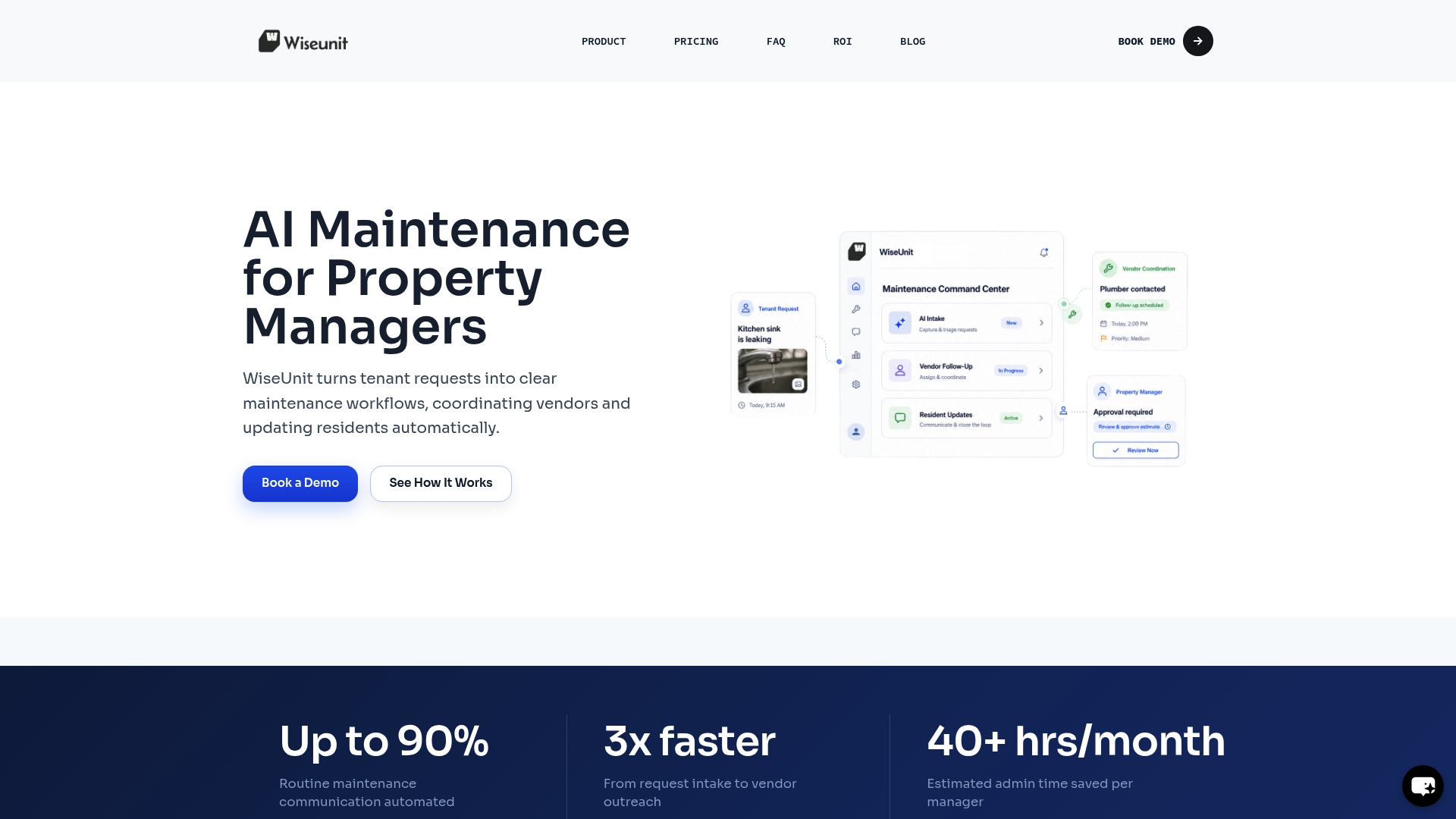
Teams using Wiseunit recover 6–10 hours per week in coordination time and reduce reactive tenant messaging by more than 70%. That capacity goes directly toward managing more units without adding maintenance coordinators. If you want to see what that looks like for your specific portfolio size, the ROI calculator gives you a concrete estimate in under two minutes. Or explore the full AI maintenance coordination platform to see how Wiseunit fits into your current workflow.
FAQ
When should i start documenting sops?
SOPs are critical starting at 20–30 units. Waiting until you hit 100 or 200 doors means rebuilding processes under pressure rather than refining ones that already work.
What is the 200-door wall in property management?
The 200–400 door range is a common growth ceiling where adding staff without automated systems causes burnout and margin compression. Process maturity must precede team expansion at this stage.
How much time does maintenance automation actually save?
Automated maintenance dispatch saves 6–10 hours per week in coordination time. Automated tenant communication cuts reactive messaging from 8–12 hours per week down to 2–3 hours.
Is door count a reliable growth metric?
Door count alone is not a reliable metric. Average revenue per client and client churn rate are stronger indicators of sustainable, profitable growth in property management.
What is a centralized staffing model?
A Centralized Staffing Model consolidates back-office functions like renewals, screening, and accounts payable into a regional hub. This structure reduces administrative overhead by 15–20% and frees onsite teams to focus on tenant experience.
Recommended
- Property Management Maintenance Operations: How to Scale Without Hiring (Toronto, Dallas, Phoenix)
- Property Management Company Growth Systems That Scale
- Property Management Maintenance Workflow: Step-by-Step Process to Reduce Workload (Toronto, Dallas, Phoenix)
- Property management team efficiency guide