

Most property management companies don't fail because of bad service. They fail because the owner never built systems to replace themselves. If you've hit a wall somewhere between 50 and 150 doors, you already know the feeling: more units means more chaos, not more profit. Property management company growth systems are what separate operators who scale past 300 doors from those who stay stuck managing every detail personally. This guide breaks down the exact systems, hiring moves, and metrics that make the difference.
Table of Contents
- Key Takeaways
- Property management company growth systems explained
- Building foundational operational systems
- Smart hiring aligned to growth phases
- Owner acquisition and retention systems
- KPIs and profitability levers that protect margins
- Why systems matter more than hustle
- How Wiseunit helps you execute these systems
- FAQ
Key Takeaways
| Point | Details |
|---|---|
| Systems precede scale | Build documented workflows before adding doors or headcount to prevent operational breakdown. |
| Hire against thresholds | Your first maintenance coordinator hire at ~80 doors frees 15 to 20 hours per week for growth work. |
| Three acquisition channels dominate | Google Business Profile, referral programs, and agent partnerships drive 90% of new owner contracts. |
| Track six KPIs monthly | Renewal rate, vacancy days, rent collection rate, maintenance cost ratio, response time, and owner churn tell the full story. |
| Automation protects margins | Automated maintenance triage and leasing workflows reduce vacancy days and prevent revenue loss at scale. |
Property management company growth systems explained
Growth in property management follows a predictable arc, and growth stages have defined system requirements at each threshold. Understanding where you are on that arc tells you exactly what to build next.
Here's how the stages typically break down:
- 0 to 50 doors: The foundational grind. You're doing everything personally. Marketing budgets run $500 to $1,000 per month. The goal is proving your service model and landing your first repeatable workflows.
- 50 to 150 doors: The "messy middle." This is where most owners stall. You need your first hires and basic documented processes, but payroll feels risky without a predictable revenue base.
- 150 to 300 doors: Expanding teams and active business development. Marketing budgets scale to $2,000 to $5,000 per month. You're managing managers, not properties.
- 300+ doors: Professionalized departments. Finance, operations, leasing, and maintenance each need a dedicated lead. You're a business owner, not a property manager.
The critical insight here is that owners who cling to hands-on management stall while those who transition their identity to system builder grow revenue. The 50 to 100 door range is where that identity shift has to happen. If you're still personally handling maintenance calls at 80 doors, you've already delayed the transition too long.
Pro Tip: Map every task you personally handle in a given week. Any task you perform more than twice that doesn't require your judgment is a candidate for a documented SOP or an automation.
The most common mistake at this stage is trying to grow door count without first stabilizing operations. Adding 20 new units to a broken system doesn't generate profit. It amplifies every existing problem.
Building foundational operational systems
Operational consistency is the first thing that breaks when a property management company scales too fast. Standardized processes enforced by software move institutional knowledge from individual people into repeatable business workflows. That's the shift that makes you scalable.
Here's a practical sequence for building your operational foundation:
- Document your maintenance triage process. Every request should follow the same intake, categorization, vendor assignment, and follow-up path. No exceptions based on who's on duty.
- Standardize your leasing workflow. Define exactly when marketing starts relative to a lease end date. Vacancy is a workflow failure when marketing starts late or renewals are handled reactively.
- Create a tenant screening checklist. Consistent criteria applied every time reduces risk and keeps you legally protected.
- Build an owner communication cadence. Monthly reports, maintenance updates, and renewal discussions should happen on a schedule, not when owners call to ask.
- Lock down your accounting processes. Trust accounting errors are one of the fastest ways to lose your license and your clients simultaneously.
"Software configurations must enforce standardized processes, not rely on configuration by individual teams, to maintain operational identity and enable scalable onboarding." — KeyCrew
The technology layer matters here. Property management platforms like AppFolio, Buildium, and Yardi can enforce workflow steps, but only if you configure them intentionally. Embedding SOPs into software workflows improves renewals, reduces administrative tasks, and shortens renovation timelines. The platform becomes the system, not just the record.
Where most companies fall short is treating their software as a ticket tracker rather than a workflow engine. If your team can skip steps, override processes, or route requests manually, your system has gaps. Those gaps become expensive at 200 doors.

Pro Tip: Audit your property management software configuration quarterly. If a new hire could complete a critical workflow incorrectly without any system alert, that's a gap you need to close before you scale.
Smart hiring aligned to growth phases
Hiring too early burns cash. Hiring too late burns you out and stalls growth. The key is tying each hire to a specific operational trigger, not a revenue milestone.
The most important first hire is a maintenance coordinator at around 80 doors. At a salary of $35,000 to $45,000 per year, this person frees 15 to 20 hours of your week and can manage maintenance for 200 or more doors. That's not a cost. That's leverage.
Beyond the maintenance coordinator, here's how the hiring sequence typically unfolds:
- Leasing agent (~100 doors): Takes over showings, applications, and move-in coordination. Reduces vacancy days by keeping leasing activity moving even when you're occupied elsewhere.
- Office manager or bookkeeper (~150 doors): Handles trust accounting, owner statements, and vendor payments. Frees you from financial administration that has zero growth value.
- Business development manager (~250 doors): Dedicated to owner acquisition. This hire only makes sense once your operations are stable enough to absorb new clients without degrading service.
The trap to avoid is reactive hiring. Hiring someone because you're overwhelmed today usually means you're hiring the wrong role for the wrong reasons. When you scale maintenance operations without adding headcount, you extend the runway before each hire becomes necessary, which means each hire is more deliberate and better timed.
Pro Tip: Before hiring, calculate the revenue per door you need to cover each new salary at a 30% margin buffer. If the math doesn't work at your current door count, identify which system improvement or automation could delay the hire by 60 to 90 days.
Owner acquisition and retention systems
New doors don't come from doing great work and waiting. They come from structured acquisition systems running consistently in the background. Three channels drive 90% of new owner contracts: Google Business Profile optimization, referral programs with tangible incentives, and real estate agent partnerships.
Here's how each channel works in practice:
- Google Business Profile and local SEO: Most absentee owners searching for property management start on Google. A fully optimized profile with consistent reviews, accurate service area data, and regular posts captures this intent before a competitor does.
- Referral programs: Structured outreach at key lifecycle points, such as after a successful lease renewal or a resolved maintenance issue, converts satisfied clients into active referrers. Tangible incentives like one month of reduced management fees outperform vague "tell your friends" asks every time.
- Real estate agent partnerships: Agents regularly encounter investors who need management. A formal referral agreement with a clear commission structure turns these relationships into a predictable pipeline.
| Channel | Cost to Acquire | Lead Quality | Scalability |
|---|---|---|---|
| Google Business Profile / SEO | Low to medium | High | High |
| Referral program | Low | Very high | Medium |
| Agent partnerships | Low | High | Medium to high |
| Google Ads | High | Medium | High |
| Cold outreach to absentee owners | Low | Medium | High |
Retention is just as important as acquisition. Losing a client with 10 units because of a poor maintenance experience costs more than the margin on three new single-family rentals. Track your owner churn rate monthly and investigate every departure. The LTV to CAC ratio determines how aggressively you should invest in marketing versus fixing operational leaks first.
KPIs and profitability levers that protect margins
Adding doors without protecting margins is a path to a bigger, less profitable business. Tracking a focused set of KPIs monthly and acting on what you find produces better results than collecting data you never use.
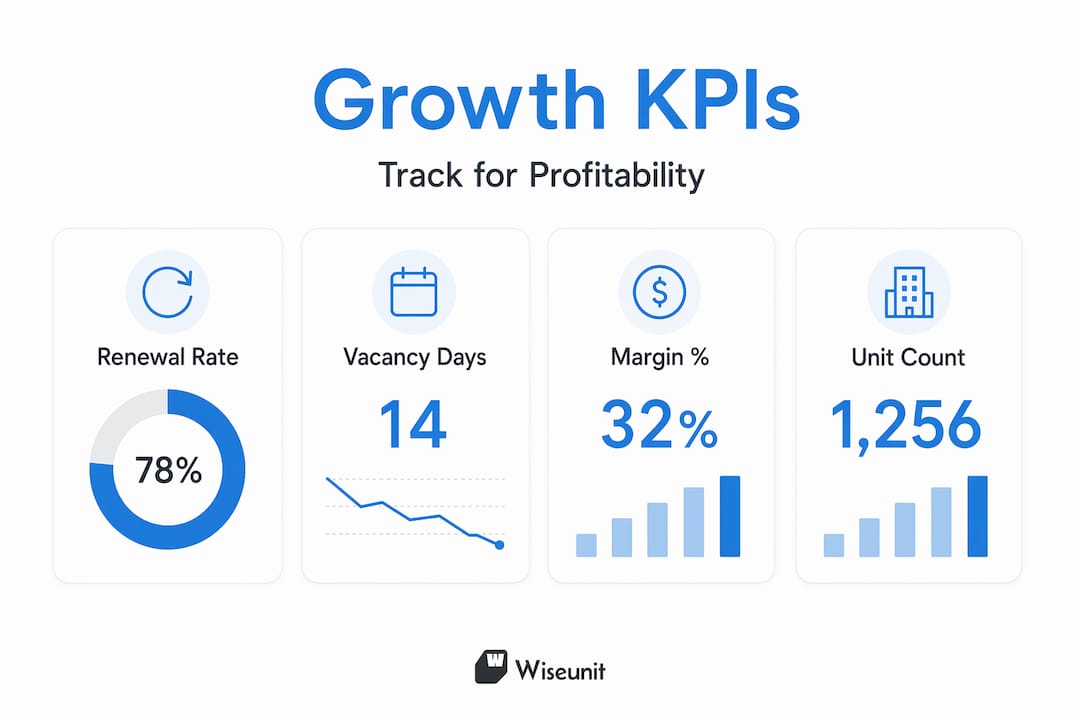
| KPI | What it measures | Target benchmark |
|---|---|---|
| Renewal rate | Tenant retention and leasing efficiency | 70% or higher |
| Vacancy days | Leasing speed and workflow execution | Under 21 days |
| Rent collection rate | Financial health and tenant quality | 98% or higher |
| Maintenance cost ratio | Vendor efficiency and issue volume | Under 8% of revenue |
| Average response time | Tenant satisfaction and risk exposure | Under 24 hours |
| Owner churn rate | Client satisfaction and retention | Under 5% annually |
Each vacant day costs approximately $67 per unit, which means a 1,000-unit portfolio with unmanaged vacancies faces serious revenue erosion. That number alone justifies investing in automated leasing workflows and early renewal outreach.
Growth without profitability is a vanity metric. Vacancy costs can eliminate all the revenue gains from new doors if your leasing and renewal workflows aren't tight. Fix the margin leaks first, then accelerate acquisition.
Pro Tip: Set a monthly 30-minute KPI review on your calendar. Review each metric against your benchmark, identify the one metric furthest from target, and assign one specific corrective action. That's it. Consistency beats complexity.
For maintenance specifically, look at your vendor management systems as a direct profitability lever. Slow vendor response, inconsistent pricing, and poor follow-through on work orders inflate your maintenance cost ratio and drive tenant dissatisfaction simultaneously.
Why systems matter more than hustle
I've worked with enough property management teams to say this plainly: the owners who grow past 200 doors are not the hardest workers in the room. They're the ones who stopped doing the work and started building the systems that do the work.
What I see most often is owners who are genuinely excellent at property management but genuinely resistant to giving it up. They know every tenant by name, they take every maintenance call personally, and they wonder why they can't grow. The answer is that their knowledge lives in their head, not in a documented process. When they're unavailable, the business underperforms. That's not a business. That's a job with more liability.
The shift I've seen work is treating every recurring task as a design problem. If you're doing something for the third time, it needs a documented process. If that process requires your specific judgment, it needs to be trained into someone else. If it doesn't require judgment at all, it needs to be automated.
The owners who break through scaling plateaus do it by focusing on systematization rather than chasing new tactics. They're not looking for the next growth hack. They're asking which part of their operation is still dependent on a specific person and fixing that dependency. That's the work. It's less exciting than closing new clients, but it's what makes closing new clients sustainable.
— Laur
How Wiseunit helps you execute these systems
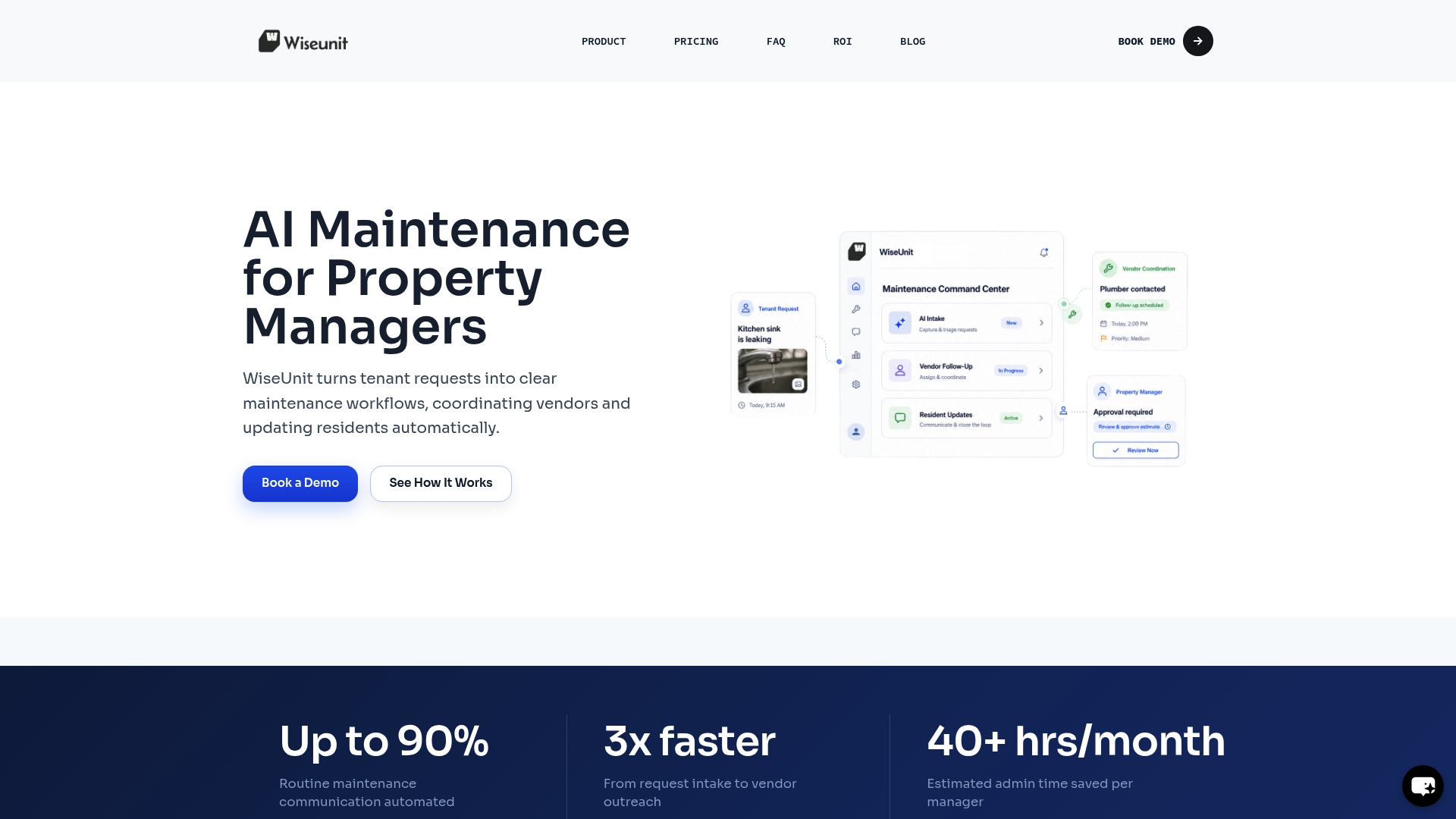
The principles in this guide only create results when they're actually executed. Maintenance coordination is one of the highest-volume, most time-consuming operational areas in any property management company, and it's where manual processes break down fastest as you scale.
Wiseunit is an AI maintenance execution platform built specifically for property management companies. It handles tenant intake through calls, SMS, or online forms, automatically triages requests, coordinates vendor scheduling, and syncs status updates directly into AppFolio, Buildium, or Yardi. Your team stays informed without managing every step manually.
If you're managing 80 or more doors and maintenance coordination is consuming hours your team doesn't have, see what AI maintenance coordination can do for your operation. You can also use the ROI calculator to estimate exactly what automated maintenance execution would return at your current portfolio size.
FAQ
What are property management company growth systems?
Property management company growth systems are documented workflows, technology configurations, and hiring structures that allow a company to add doors without proportionally adding overhead or losing operational consistency.
When should I start building formal systems?
Start before you feel like you need them. Most owners wait until they're overwhelmed at 80 to 100 doors, but the right time is around 30 to 50 doors when patterns are clear and stakes are lower.
What is the most important first hire for scaling?
A maintenance coordinator at around 80 doors is the highest-leverage first hire, freeing 15 to 20 hours of owner time per week at a cost of $35,000 to $45,000 per year.
How do I measure whether my growth systems are working?
Track six KPIs monthly: renewal rate, vacancy days, rent collection rate, maintenance cost ratio, average response time, and owner churn. Improvement across these metrics confirms your systems are holding under growth pressure.
How does automation support property management scalability?
Automation handles repeatable, high-volume tasks like maintenance intake and vendor coordination without adding headcount, which protects margins and lets your team focus on work that requires judgment.
Recommended
- Property Management Maintenance Operations: How to Scale Without Hiring (Toronto, Dallas, Phoenix)
- Property Management Maintenance Workflow: Step-by-Step Process to Reduce Workload (Toronto, Dallas, Phoenix)
- WiseUnit AI Blog | Maintenance Operations Insights
- Property Management Software vs AI Execution: Why Software Alone Is No Longer Enough