

Property management reporting dashboards are specialized tools that consolidate occupancy, rent collection, maintenance, and tenant experience data into a single visual interface to support faster, more accurate operational decisions. The industry now recognizes eight distinct dashboard categories covering everything from portfolio-level financials to ESG utility tracking. Knowing which types of property management reporting dashboards exist, and what each one measures, is the first step toward choosing the right reporting setup for your portfolio. This article covers all eight categories, explains how they integrate with platforms like Yardi, AppFolio, and Buildium, and helps you match the right dashboard type to your team's actual needs.
1. Types of property management reporting dashboards: the full list
The eight dashboard types used across the industry in 2026 each serve a distinct operational or financial function. Understanding the full list before selecting any single tool prevents the common mistake of buying a financial dashboard when your biggest gap is maintenance visibility.
- Portfolio performance dashboard: Tracks net operating income (NOI), asset-level returns, and occupancy trends across your entire portfolio. This is the primary tool for owners and senior managers reviewing overall health.
- Leasing and occupancy dashboard: Monitors lease status, upcoming expirations, move-ins, move-outs, and renewal pipelines. It answers the question: "What is happening to my occupied units right now?"
- Rent roll and delinquency dashboard: Displays rent billed versus rent collected, accounts receivable aging, and delinquency rates by unit or property. This is the most frequently used dashboard by on-site teams.
- Maintenance and work order dashboard: Tracks open work orders, resolution times, vendor assignments, and costs. The most useful version of this dashboard measures MTTR and first-time-fix rates, not just ticket counts.
- Turnover and make-ready dashboard: Focuses on unit readiness timelines, bottlenecks in the turn process, and days vacant between tenancies. Reducing turn time by even two days per unit has a measurable impact on annual revenue.
- Financial and budget-vs-actual dashboard: Compares planned expenses against actuals across categories like repairs, utilities, and management fees. This is the primary reporting tool for owner statements and investor reviews.
- Tenant experience and renewal dashboard: Aggregates satisfaction scores, renewal likelihood, and tenant lifecycle events. Teams using this dashboard proactively address friction before a tenant decides not to renew.
- ESG and utilities intensity dashboard: Tracks energy consumption, water usage, and sustainability metrics by building or unit. This category is growing in relevance as institutional investors and municipalities add ESG reporting requirements.
2. How dashboards integrate data and automate reporting
Modern property management dashboards pull data from multiple systems simultaneously, including property management software, accounting platforms, and maintenance tools. Integration with Yardi, AppFolio, and Buildium allows automated data pipelines that eliminate the manual export-and-consolidate workflow that still consumes hours of staff time each month.
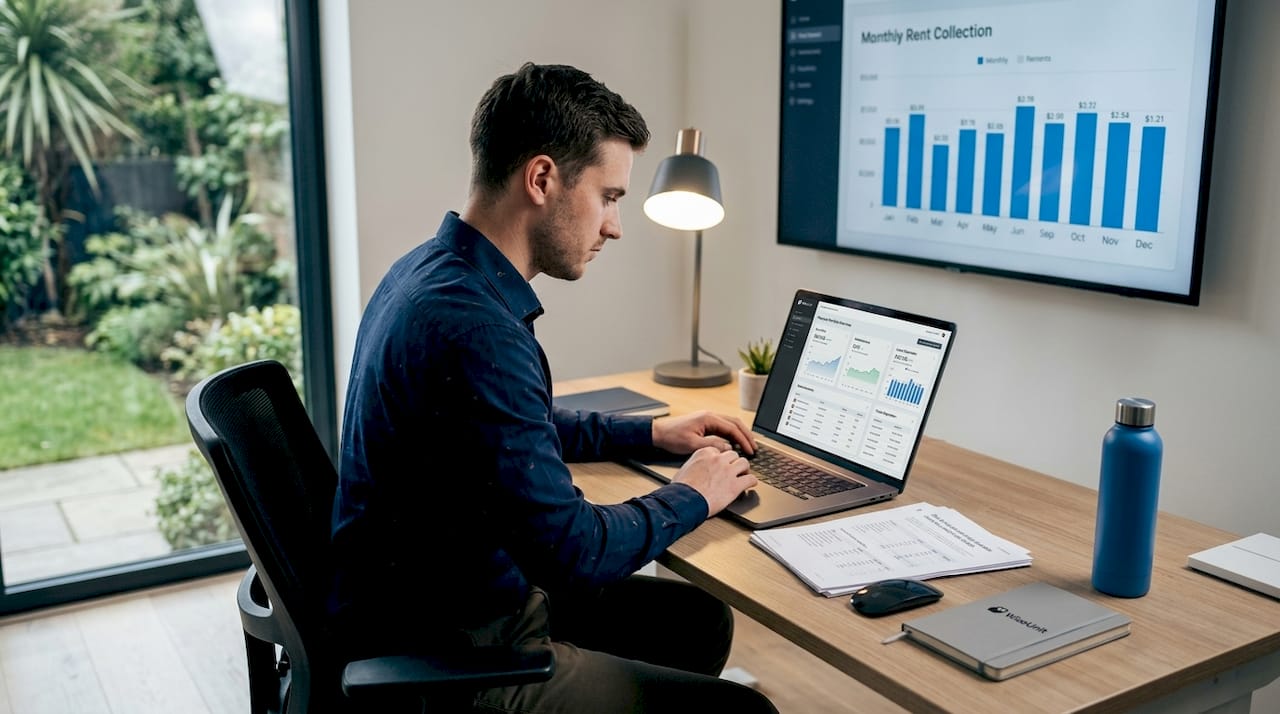
The practical result is that rent collection figures, open work orders, and lease expiration counts update in near real time without anyone touching a spreadsheet. Automated workflows also reduce the risk of transcription errors that distort owner reports. A property manager overseeing 300 units in Dallas or Phoenix, for example, can see the full financial and operational picture each morning without waiting for an end-of-month data pull.
No-code AI tools designed for property management can build dashboards that aggregate multiple data sources into one view with smart visualizations and narrative summaries. These tools are particularly cost-effective for teams managing 500 to 2,000 units, with pricing typically ranging from $50 to $300 per month. The shift from manual spreadsheet reporting to AI-powered dashboards reduces reporting time significantly and increases the accuracy of the insights delivered to owners and investors.
Pro Tip: When connecting your property management system to a dashboard tool, always verify that your data sources share consistent property and tenant IDs. Mismatched identifiers across your PMS, accounting software, and maintenance system are the leading cause of conflicting reports that erode owner trust.
3. What features make a dashboard effective for operations and tenant communication
The difference between a useful dashboard and a static report comes down to whether the data drives action. Actionable dashboards for operations teams track leading indicators, not just historical summaries.
The most effective property dashboard features include:
- Conditional alerts: Automatic notifications when rent is overdue beyond a set threshold, a work order exceeds its target resolution time, or a lease is within 60 days of expiration.
- Drilldown capability: The ability to click from a portfolio-level occupancy figure down to the specific unit, tenant, or work order causing the variance.
- Forward-looking metrics: Cash flow projections, lease renewal likelihood scores, and upcoming maintenance schedules that help owners anticipate expenses rather than react to them.
- Narrative generation: Automated text explanations that accompany financial figures, such as noting that a repair cost spike was caused by an aging HVAC unit with a replacement recommendation attached.
- Tenant lifecycle tracking: Visibility into move-in dates, lease terms, renewal conversations, and satisfaction survey results on a single screen.
"Including context and forward-looking information in owner reports, such as maintenance explanations and upcoming lease expirations, reduces owner anxiety and improves confidence in property management." — Owner Reporting Automation for Property Management
Owner-facing dashboards that only show backward-looking financial statements are less effective than those embedding forward-looking schedules alongside actuals. This distinction matters most when managing properties for third-party owners who are not involved in day-to-day operations and rely entirely on your reports to assess performance.
4. Comparing dashboard types by portfolio size and use case
Not every dashboard type fits every team. The right choice depends on your portfolio size, staffing structure, and whether you are reporting primarily to internal operators or external investors.
| Dashboard type | Best for | Complexity | Estimated cost range |
|---|---|---|---|
| Rent roll and delinquency | All portfolio sizes | Low | Included in most PMS platforms |
| Leasing and occupancy | Teams with active lease-up activity | Low to medium | Included in AppFolio, Buildium, Yardi |
| Maintenance and work order | Teams with high maintenance volume | Medium | $50–$150/month for standalone tools |
| Financial and budget-vs-actual | Owner reporting, investor portfolios | Medium to high | $100–$300/month for integrated tools |
| Portfolio performance | Large portfolios, 200+ units | High | $200–$500/month for BI platforms |
| Tenant experience and renewal | Multifamily operators focused on retention | Medium | Add-on to CRM or survey tools |
| ESG and utilities intensity | Institutional owners, regulated markets | High | $300+/month or custom build |
| Turnover and make-ready | High-turnover single-family or student housing | Medium | Often custom-built or spreadsheet-based |
Landlords managing fewer than 50 units typically get sufficient coverage from the rent roll, leasing, and maintenance dashboards built into their existing PMS. Property management companies overseeing 500 or more units across multifamily and HOA portfolios generally need a dedicated financial dashboard and at least one operational dashboard running in parallel. The key distinction to keep in mind: property management dashboards focus on business outcomes like leasing, revenue, and retention, while facility management dashboards focus on building systems performance. Confusing these two lenses leads to irrelevant KPIs and reports that do not serve either audience well.
5. How to choose and implement the right dashboard for your portfolio
Selecting the right reporting dashboard starts with an honest audit of your current data sources and the gaps in your existing reporting. The following steps give you a practical path from assessment to deployment.
- Map your data sources. List every system your team uses: your PMS (AppFolio, Buildium, or Yardi), your accounting software, your maintenance ticketing tool, and any tenant communication platforms. Identify which systems can export data via API or direct integration.
- Define your top three reporting needs. Choose the dashboard types that address your most pressing operational gaps. If delinquency is your primary concern, start with a rent roll dashboard. If maintenance response times are driving tenant complaints, prioritize the work order dashboard.
- Start with five to seven KPIs. Resist the urge to track everything at once. A dashboard with 30 metrics is harder to act on than one with seven well-chosen indicators. Add complexity after your team is comfortable with the core view.
- Choose the right tool tier. Teams managing under 200 units can often use the built-in reporting inside their PMS. Teams managing 500 to 2,000 units benefit from no-code AI dashboard tools in the $50 to $300 per month range. Larger portfolios may require embedded analytics or a standalone BI platform.
- Align the dashboard with your workflow. A dashboard that lives outside your daily workflow gets ignored. Embed it in your morning standup, your weekly owner call, or your monthly review process so the data drives actual decisions.
- Train your team on interpretation, not just navigation. Knowing how to read a delinquency aging report is different from knowing how to click through the software. Spend time explaining what each metric means and what action it should trigger.
Pro Tip: When automating maintenance reporting, connect your work order data to your financial dashboard so repair costs appear alongside budget-vs-actual figures. This single integration eliminates one of the most common gaps in owner reporting.
Key takeaways
The most effective property management dashboards combine operational leading indicators with forward-looking financial metrics, integrated directly from your PMS and maintenance systems, to give both operators and owners a complete and current picture of portfolio performance.
| Point | Details |
|---|---|
| Eight distinct dashboard types | Each category serves a specific operational or financial function; using the wrong type produces irrelevant KPIs. |
| Integration is the foundation | Dashboards connected to Yardi, AppFolio, or Buildium via API eliminate manual data consolidation and reduce reporting errors. |
| Leading indicators over snapshots | Metrics like MTTR and first-time-fix rates predict tenant satisfaction issues before they become visible problems. |
| Forward-looking features build owner trust | Embedding lease expiration schedules and maintenance projections alongside actuals reduces owner anxiety and improves retention of management contracts. |
| Match dashboard complexity to portfolio size | Teams under 200 units can rely on PMS built-ins; teams over 500 units benefit from dedicated AI-powered or BI dashboard tools. |
Why dashboard alignment matters more than dashboard count
I have reviewed reporting setups for property management teams ranging from 40-unit independent landlords to companies managing 3,000 units across multiple states. The most consistent mistake I see is not a lack of dashboards. It is a mismatch between the dashboard type and the stakeholder reading it.
A maintenance coordinator does not need a portfolio NOI view. An owner reviewing a monthly statement does not need a work order aging report. When teams build one dashboard and share it with everyone, the result is a report that is technically complete and practically useless for most of the people receiving it.
The shift toward AI-powered owner reporting is addressing this problem by generating stakeholder-specific views from a single data source. That is the right direction. But the technology only works if the underlying data is clean and consistently keyed across systems. I have seen dashboards built on mismatched property IDs produce occupancy figures that were off by 15%, which destroyed the owner's confidence in the entire reporting process.
My practical advice: before you invest in any new dashboard tool, spend two hours auditing whether your PMS, accounting software, and maintenance system share the same property and unit identifiers. That audit will save you more time than any feature comparison. You can also review client reporting best practices to understand what owners actually expect from a well-structured report before you build one.
— Laur
How Wiseunit supports maintenance visibility inside your dashboards
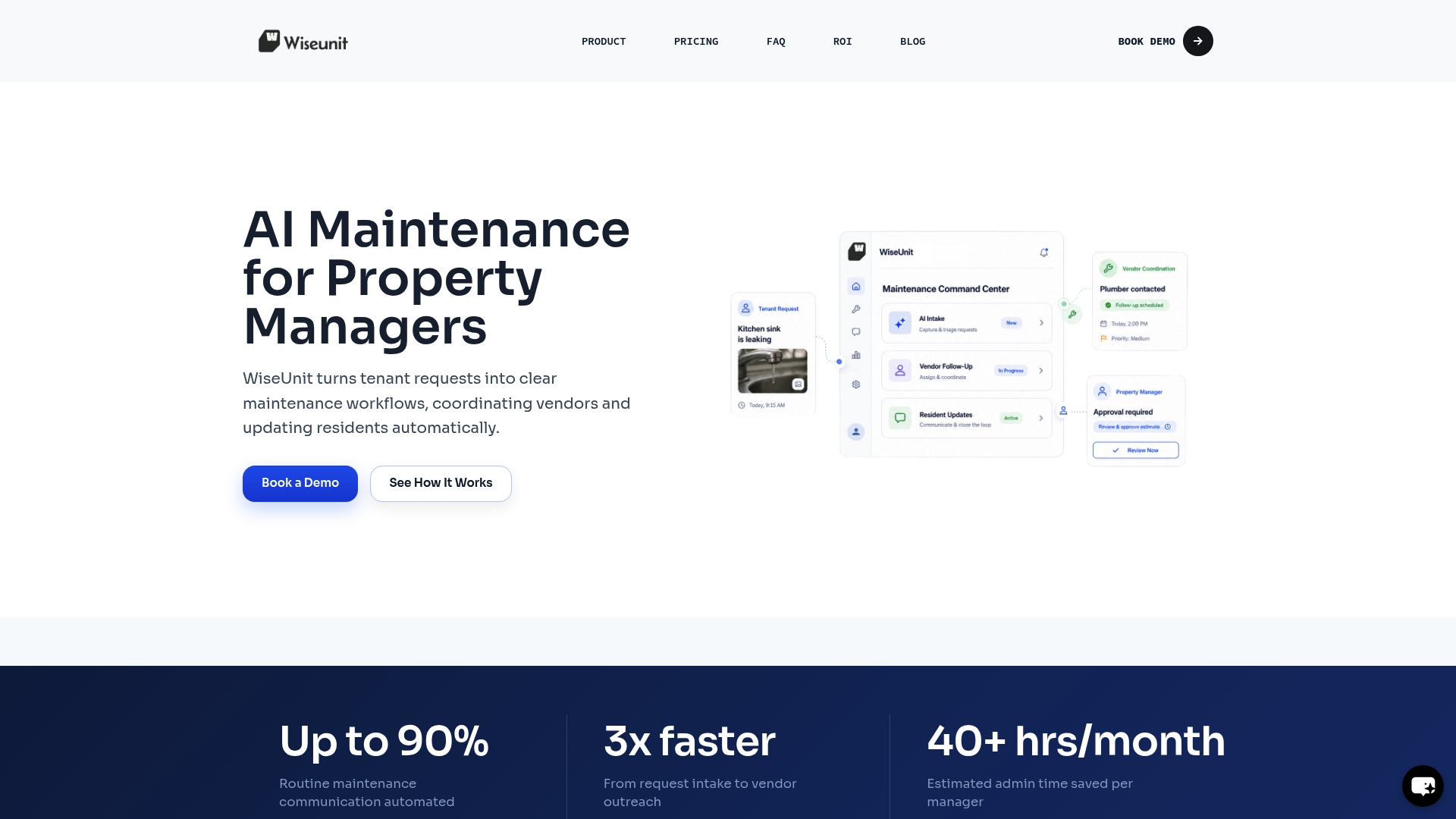
Wiseunit is a maintenance execution platform built for property management companies managing multifamily, single-family, and HOA portfolios. It connects directly with AppFolio, Buildium, and Yardi to handle tenant intake, issue triage, vendor coordination, and scheduling without requiring your team to manually manage each step. Every work order Wiseunit processes feeds structured data back into your reporting environment, so your maintenance dashboard always reflects current resolution times, vendor performance, and open ticket counts. If your team is ready to reduce manual coordination and improve the accuracy of your maintenance reporting, explore what Wiseunit can do for your portfolio. You can also use the ROI calculator to estimate the time and cost savings for your specific unit count.
FAQ
What are the main types of property management dashboards?
The eight main types are portfolio performance, leasing and occupancy, rent roll and delinquency, maintenance and work orders, turnover and make-ready, financial and budget-vs-actual, tenant experience and renewal, and ESG and utilities intensity. Each type tracks a distinct set of KPIs aligned with a specific operational or financial function.
How do I choose the right property management dashboard?
Start by identifying your top three reporting gaps, then select the dashboard type that addresses those gaps directly. Teams under 200 units typically need only rent roll and maintenance dashboards, while larger portfolios benefit from adding financial and portfolio performance views.
What KPIs should a maintenance dashboard track?
The most useful maintenance dashboard KPIs are mean time to resolve (MTTR), first-time-fix rate, work order backlog by age, and cost per work order. These leading indicators predict tenant satisfaction issues and hidden labor costs before they appear in financial statements.
Can property management dashboards integrate with AppFolio or Yardi?
Yes. Most modern dashboard tools connect to AppFolio, Yardi, and Buildium via API to pull rent, maintenance, and occupancy data automatically. Consistent property and tenant IDs across all connected systems are required to avoid conflicting data outputs.
What is the difference between a property management and a facility management dashboard?
Property management dashboards focus on business outcomes like NOI, leasing, and tenant retention. Facility management dashboards focus on building systems performance such as HVAC uptime and inspection schedules. Using the wrong lens produces KPIs that do not align with your actual reporting goals.