

Property management company overhead is defined as the internal operating costs a management company incurs to run its business, costs that never appear as line items on your invoice but directly reduce the profitability of your investment. These expenses include labor, compliance, and revenue leakage from manual processes. Hidden overhead costs range from the equivalent of $4,000 to $9,500 per property annually, according to 2026 data from Chekin. Understanding what is property management company overhead gives you the leverage to evaluate management fees accurately and choose operators who protect your returns.
What are the main components of property management company overhead?
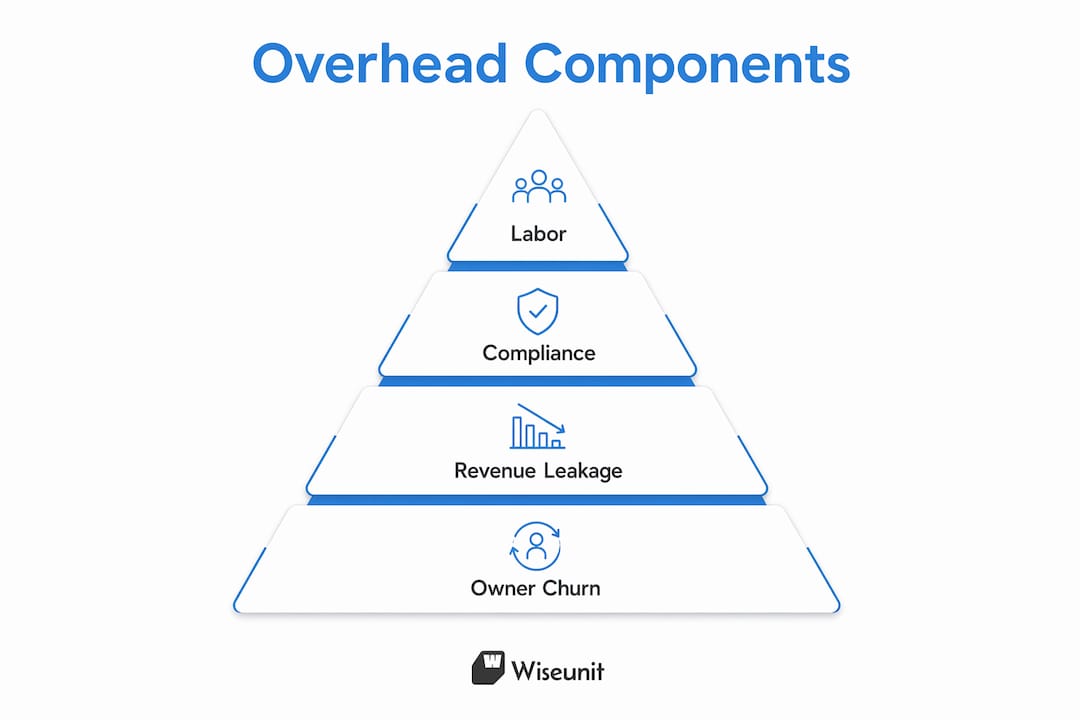
Property management overhead falls into four distinct categories, and most property owners never see any of them on a statement. The industry term for these costs is company operating expenses, which is distinct from pass-through property expenses like repairs or landscaping that appear directly on your owner statement.
Labor and Administration
Labor is the largest overhead driver. Administrative staff handle lease renewals, owner reporting, compliance documentation, and tenant communication. These are real costs the management company absorbs into its fee structure. A mid-sized operator running 200 units can easily carry $15,000 or more per month in staff salaries before a single maintenance call is made.

Compliance Costs
Regulatory compliance is a growing overhead line. Fair housing rules, local licensing requirements, habitability standards, and data privacy regulations all require dedicated staff time or third-party legal support. Fixed compliance overhead for a mid-sized operator can reach $1,500 per month. Companies that do not invest in compliance management systems face penalty exposure that compounds overhead further.
Revenue Leakage from Manual Pricing
Static pricing is a silent profit killer. When a management company fails to update rental rates in response to market conditions, occupancy drops and average rent falls below market. Revenue leakage from static pricing can represent tens of thousands of dollars annually across a 20-property portfolio. This is overhead in the form of lost income, not a direct expense.
Owner Churn Costs
Losing an owner client is expensive. Recruiting, onboarding, and re-staffing for a new portfolio relationship costs time and money. NARPM 2025 data identifies "feeling uninformed about my property" as the top reason owners terminate contracts. Poor communication is a labor overhead problem in disguise.
Pro Tip: Ask any property manager to separate their company operating budget from the property-level budget they manage on your behalf. If they cannot produce both documents, their overhead is likely uncontrolled.
The critical distinction here is between overhead and pass-through expenses. Pass-through costs like plumbing repairs or HOA fees flow directly to your owner statement. Overhead costs live inside the management company's P&L and shape the quality and efficiency of every service you receive.
How does overhead affect the fees you pay and your property profitability?
The management fee percentage is often the least important number to scrutinize. Ancillary fees typically add 30–50% to total property management expenses beyond the base rate. That means a company advertising 8% management fees may cost you the equivalent of 11–12% once leasing fees, renewal fees, and maintenance markups are included.
Here is how the fee structure typically breaks down:
- Base management fee: 8–12% of collected monthly rent, with minimums often between $100 and $200 per month for residential properties.
- Leasing fee: Typically one half to one full month's rent charged when a new tenant is placed.
- Renewal fee: A flat fee or percentage charged each time a lease renews, often $150–$300 per unit.
- Maintenance markup: Many companies add 10–20% to vendor invoices as a coordination fee.
- Vacancy fee: Some operators charge a reduced monthly fee even when the unit sits empty.
Now consider how overhead shapes these numbers. A company running high manual labor overhead passes that cost into its fee structure or cuts corners on service quality to protect margins. A company that has automated its maintenance workflows can deliver faster response times at lower marginal cost, which means better service without inflated fees.
| Factor | High Overhead (Manual) | Low Overhead (Automated) |
|---|---|---|
| Staff per 100 units | 3–4 coordinators | 1–2 coordinators |
| Average response time | 24–48 hours | Under 4 hours |
| Revenue leakage risk | High (static pricing) | Low (dynamic updates) |
| Owner churn risk | High (poor communication) | Low (automated updates) |
| Compliance penalty exposure | Elevated | Reduced |
A concrete example clarifies the impact. Suppose you own a 10-unit building generating $15,000 in monthly rent. At 10% management fee, you pay $1,500 per month. Add a leasing fee of one month's rent on two turnovers per year ($3,000), two renewal fees at $250 each ($500), and a 15% maintenance markup on $4,000 in annual repairs ($600). Your actual annual cost is $24,100, not the $18,000 the base fee implies. High overhead on the management company's side pushes these numbers higher through slower vacancy fills and more frequent owner disputes.
Proper budgeting practices that separate company operating budgets from property-level budgets improve cash flow visibility for both the operator and the owner. Companies that skip this discipline often cannot explain why their fees are structured the way they are.
What strategies do property management companies use to reduce overhead?
The most effective overhead reduction strategy is replacing manual processes with automated systems. Automation of property management tasks reduces labor and compliance overhead, improves pricing accuracy, and cuts revenue leakage. Small companies generating $50,000 to $500,000 annually can scale their portfolios without proportional staff increases when they adopt the right tools.
Here are the primary strategies operators use:
- Maintenance workflow automation: Platforms like Wiseunit handle tenant intake, issue triage, vendor coordination, and follow-ups inside systems like AppFolio, Buildium, or Yardi. This removes the need for a dedicated maintenance coordinator for every 75–100 units.
- Dynamic pricing tools: Software that monitors local rental market data and adjusts listing prices automatically closes the revenue leakage gap caused by static pricing.
- Compliance automation: Digital tools that track lease expiration dates, inspection schedules, and regulatory deadlines reduce the staff hours required for compliance management and lower penalty risk.
- Outsourced support functions: Non-core tasks like mailroom management can be outsourced to specialists such as Postal Solutions, freeing internal staff for higher-value work.
- Staff optimization through AI: AI-powered coordination tools allow one staff member to manage the workload previously handled by three, which directly reduces the labor line in overhead.
Pro Tip: When evaluating a property management company, ask specifically which tasks are handled by software versus human staff. A company that cannot name specific platforms for maintenance coordination, compliance tracking, and pricing is running on manual processes and carrying the overhead costs that come with them.
The impact on maintenance costs is measurable. Companies that automate maintenance coordination report faster vendor dispatch, fewer missed follow-ups, and higher tenant satisfaction scores, all of which reduce the indirect overhead of owner churn and vacancy.
How can property owners evaluate property management overhead before hiring?
Evaluating overhead before signing a management agreement requires asking the right questions and knowing which answers signal risk. Most owners focus on the fee percentage and miss the operational signals that predict true cost.
Use this evaluation checklist:
- Request a sample owner statement. A well-structured statement separates management fees, pass-through expenses, and ancillary charges clearly. Vague or bundled line items suggest poor overhead tracking.
- Ask about their technology stack. Which platforms do they use for maintenance coordination, tenant communication, and compliance tracking? Operators using AppFolio, Buildium, or Yardi with integrated automation tools carry lower overhead than those relying on spreadsheets and phone calls.
- Ask about staff-to-unit ratios. A ratio above one coordinator per 75 units suggests manual processes are driving labor overhead. Automated operators often manage 150 or more units per coordinator.
- Ask how they handle maintenance requests after hours. Manual operators route calls to on-call staff, which is expensive. Automated operators use AI intake systems that triage requests and dispatch vendors without human intervention.
- Request references from owners with similar portfolio sizes. Ask those owners specifically about communication frequency and response times. Slow communication is the visible symptom of high overhead.
Red flags include vague answers about technology, inability to produce a company operating budget, and fee structures that include many small charges without clear justification. A transparent operator can explain exactly where every dollar goes and why their overhead structure benefits you as an owner.
Operational efficiency guides consistently show that owners who vet technology adoption before signing contracts experience fewer disputes, faster maintenance resolution, and better long-term returns.
Key takeaways
Property management company overhead is the single most underestimated cost factor in evaluating a management relationship, and automation is the most direct path to controlling it.
| Point | Details |
|---|---|
| Overhead is invisible on invoices | Internal operating costs like labor and compliance never appear on owner statements but reduce your net returns. |
| Ancillary fees compound base costs | Leasing, renewal, and maintenance markup fees add 30–50% to the stated management fee percentage. |
| Manual operations carry hidden costs | Static pricing and slow maintenance response create revenue leakage that compounds annually across a portfolio. |
| Automation reduces overhead directly | AI-powered maintenance coordination cuts labor costs and allows operators to scale without proportional staff increases. |
| Evaluation requires asking the right questions | Request technology stack details, staff-to-unit ratios, and sample statements before signing any management agreement. |
Overhead transparency is the new competitive standard
From where I sit, most property owners are evaluating management companies the wrong way. They compare fee percentages and call it due diligence. The fee percentage is almost irrelevant if the operator is running on manual processes that inflate every other cost category.
What I have observed consistently is that the gap between a 9% and an 11% management fee is far smaller than the gap between a company that automates maintenance coordination and one that does not. A manual operator with a 9% fee can cost you more in aggregate through slow vacancy fills, missed maintenance follow-ups, and owner churn than an automated operator charging 11%.
The 2026 shift toward AI-powered operations is not a trend. It is a structural change in how property management overhead gets distributed. Companies that have not adopted execution-layer tools are carrying labor costs that will only grow as regulatory complexity increases. As an owner, your job is to identify which side of that divide your manager sits on. The questions in this article give you the framework to find out.
How Wiseunit reduces maintenance overhead for property managers
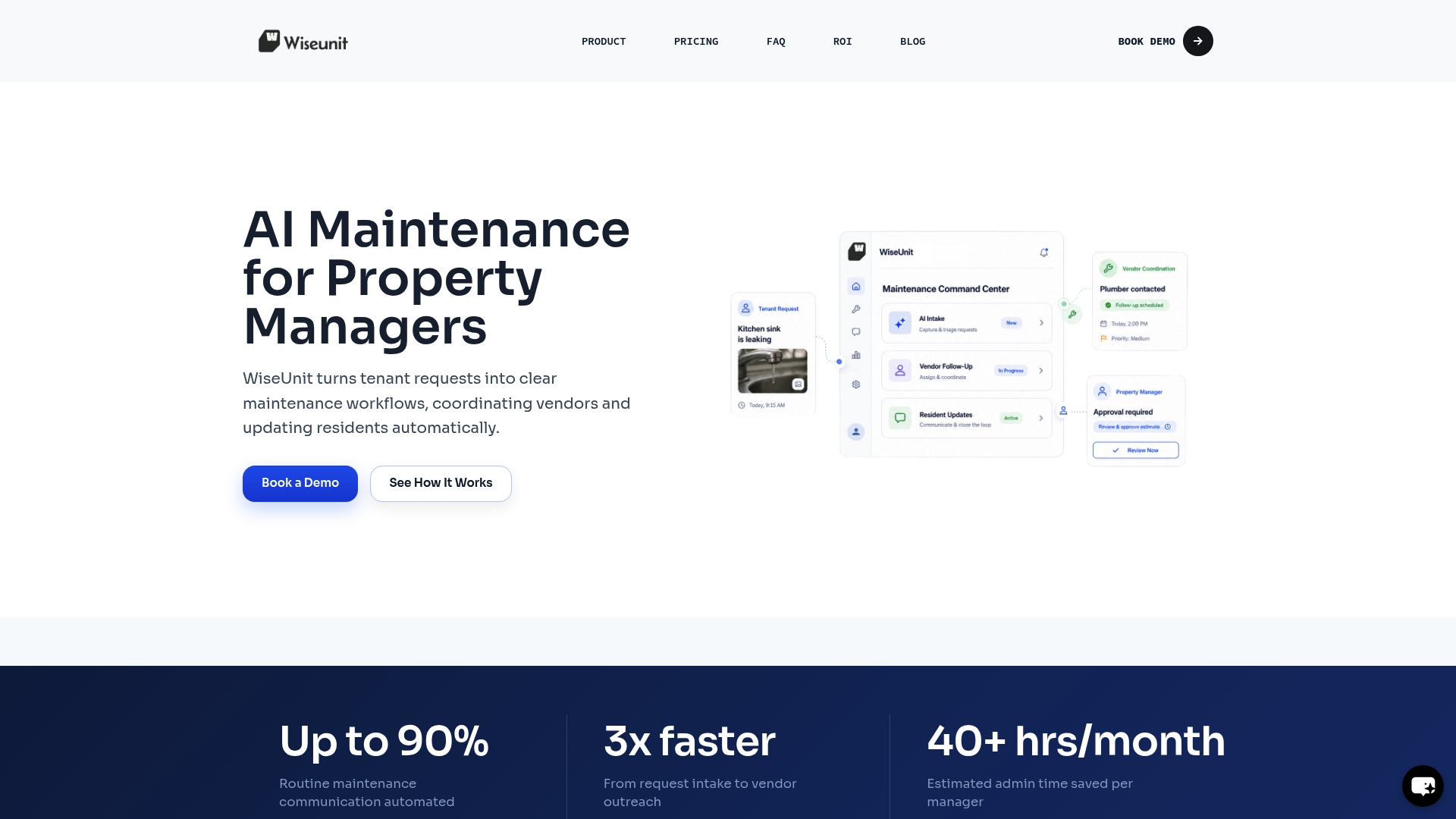
Maintenance coordination is one of the largest labor overhead drivers in property management. Wiseunit is an AI-powered maintenance execution platform built specifically for property management companies managing multifamily, single-family, and HOA portfolios. Wiseunit handles the full maintenance workflow from tenant intake through vendor dispatch, scheduling, follow-ups, and status updates inside AppFolio, Buildium, or Yardi. This removes the manual coordination burden that drives up overhead costs without adding headcount. Use the Wiseunit ROI calculator to see exactly how much your team could save by replacing manual maintenance coordination with an AI execution layer.
FAQ
What is property management company overhead?
Property management company overhead refers to the internal operating expenses a management company incurs to run its business, including labor, compliance, and administrative costs. These costs do not appear on owner invoices but directly affect service quality and profitability.
How much does property management overhead cost per property?
Hidden overhead costs range from approximately $4,000 to $9,500 per property annually when accounting for labor, compliance, and revenue leakage from manual processes, according to 2026 data from Chekin.
How do overhead costs affect property management fees?
High overhead pushes operators to increase ancillary fees or reduce service quality to protect margins. Ancillary fees like leasing, renewals, and maintenance markups typically add 30–50% to the base management fee percentage.
What is the difference between overhead and pass-through expenses?
Overhead costs are internal to the management company, such as staff salaries and compliance software. Pass-through expenses are property-level costs like repairs or utilities that flow directly to the owner's statement.
How can i tell if a property manager has high overhead?
Ask about their technology stack, staff-to-unit ratios, and how they handle after-hours maintenance requests. Operators relying on manual processes and unable to name specific platforms for coordination and compliance tracking are carrying higher overhead costs.
Recommended
- Property Management Company Liability for Landlords
- Property Management Maintenance Operations: How to Scale Without Hiring (Toronto, Dallas, Phoenix)
- Maintenance Backlog in Property Management: Causes, Costs & How to Fix It (2026)
- How Top Property Managers Reduce Maintenance Costs Without Hiring More Staff (2026)