

Maintenance as a service (MaaS) in property management is defined as an outsourced model where a provider delivers both preventive and corrective maintenance under a structured contract with measurable performance standards. The industry term for the broader practice is "managed maintenance services," and it replaces ad-hoc repair calls with coordinated workflows, documented processes, and clear accountability. For property owners and real estate investors, this model directly improves building functionality, reduces emergency repair costs, and raises tenant satisfaction. Platforms like Wiseunit, AppFolio, and Buildium now support this model by automating the coordination layer that most teams handle manually.
What is maintenance as a service in property management?
Maintenance as a service is the practice of contracting a single provider or platform to manage the full cycle of property upkeep, from scheduled inspections to emergency repairs, under one program. Rather than calling a different vendor every time something breaks, you work within a defined scope where tasks are prioritized, scheduled, and tracked. The result is a property that runs on a maintenance calendar instead of a crisis list.
Commercial property maintenance covers coordination of building systems and shared spaces, including preventive maintenance, corrective repairs, inspections, janitorial services, exterior upkeep, and tenant requests. This scope applies equally to multifamily residential portfolios, single-family rental collections, and HOA communities. Each of these property types generates a high volume of recurring tasks that are difficult to manage without a structured program.
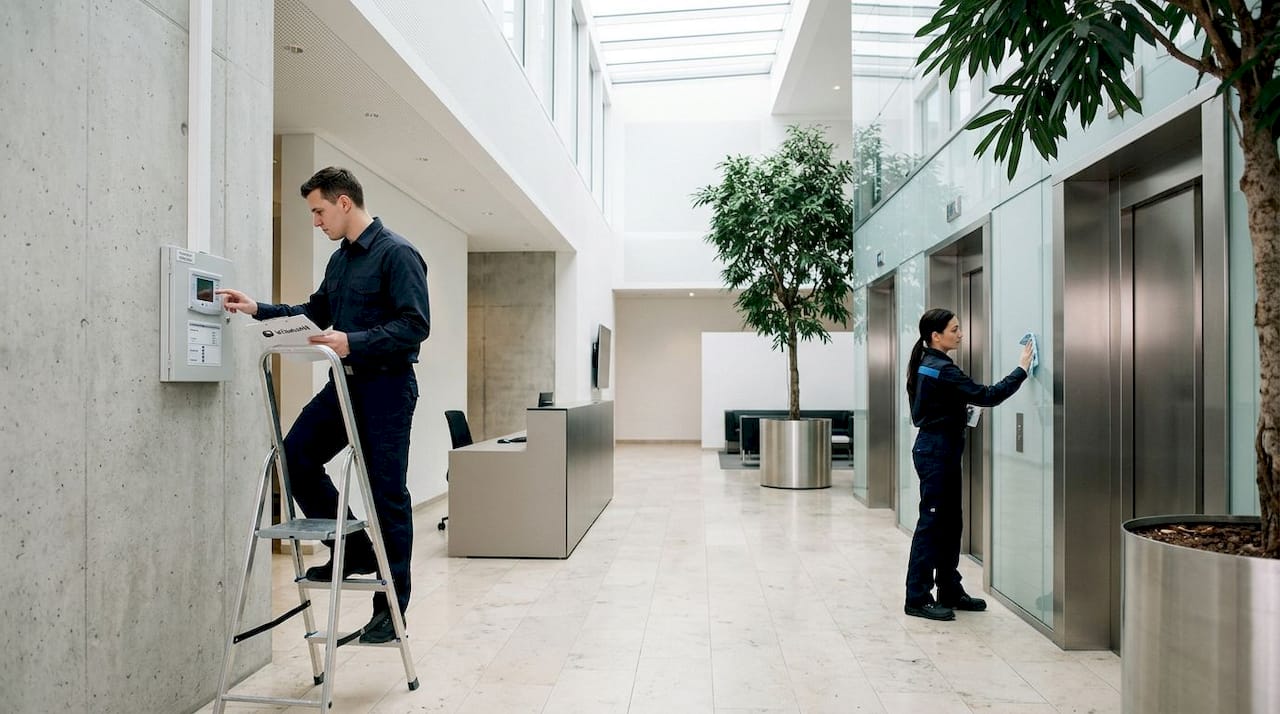
The core distinction in this model is the shift from reactive to managed. Preventive maintenance reduces failure likelihood through scheduled servicing, while reactive maintenance responds after issues occur. Managed maintenance services package both under one program, reducing disruptions and improving consistency across your portfolio.
What services are typically included
A well-scoped managed maintenance program covers the following areas:
- HVAC systems: Seasonal inspections, filter replacements, and mechanical servicing
- Plumbing: Routine checks, leak detection, and corrective repairs
- Life-safety systems: Fire alarm testing, extinguisher inspections, and emergency lighting checks
- Exterior and grounds: Landscaping, parking lot upkeep, and building envelope inspections
- Janitorial and common areas: Cleaning schedules for lobbies, hallways, and shared amenities
- Tenant service requests: Intake, triage, vendor dispatch, and status updates for unit-level issues
Pro Tip: When reviewing a managed maintenance proposal, ask the provider to separate preventive tasks from tenant service requests in the scope document. Mixing them creates billing confusion and makes it harder to track performance by category.
How do SLAs define performance in maintenance contracts?
A service level agreement (SLA) is the contractual document that transforms vague maintenance promises into measurable obligations. SLAs set responsibilities, response times, quality thresholds, and consequences, and they are agreed upon before services start to reduce ambiguity. For property owners, an SLA is the primary tool for holding a maintenance provider accountable without micromanaging daily operations.
Understanding what is maintenance SLA for property companies requires looking at four core elements: response time commitments (how fast a provider acknowledges and dispatches for a given issue category), resolution time targets (how long a repair should take), quality standards (what "done" looks like for recurring tasks), and remedies (what happens when targets are missed). Without all four, you have a service description, not an SLA.
SLAs are legal obligations with remedies, not just guidelines. This distinction matters because it shifts risk from you to the provider when performance falls short. A property owner managing 50 units without SLA-backed contracts is absorbing all the operational risk of delayed repairs, missed inspections, and tenant complaints.
Here is how a structured SLA improves property operations in practice:
- Emergency response: Provider commits to a 2-hour acknowledgment and 4-hour dispatch for life-safety or habitability issues.
- Routine repairs: Non-urgent tenant requests are resolved within 3 to 5 business days, with status updates at each stage.
- Preventive tasks: Scheduled inspections are completed on a defined calendar with documented sign-off.
- Reporting: Monthly performance reports show completion rates, open tickets, and any SLA breaches.
- Remedies: Missed targets trigger a credit, re-service, or escalation process defined in the contract.
"SLA-backed tracked workflows enable real-time performance monitoring and backlog management, preventing tenant dissatisfaction due to delayed repairs." — Property Facility Tenant SLA Dashboard
Without this structure, issues surface only after a tenant has already been affected. With it, you can spot a growing backlog before it becomes a complaint or a lease non-renewal.
Benefits of maintenance as a service vs. traditional ad-hoc repairs
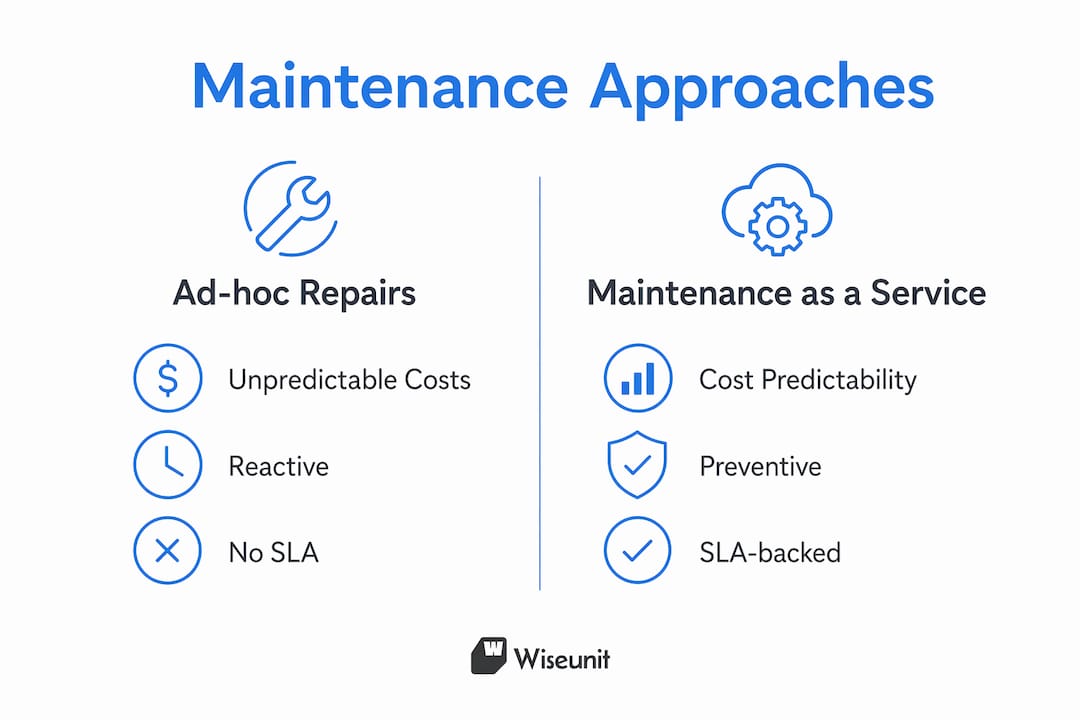
The operational case for managed maintenance services over ad-hoc repairs is straightforward: structured programs support better coordination and maintenance alignment across your portfolio. Ad-hoc repair models create unpredictable costs, inconsistent vendor quality, and no institutional memory of what was serviced and when.
The table below compares the two approaches across the dimensions that matter most to property owners and investors:
| Factor | Ad-hoc repairs | Maintenance as a service |
|---|---|---|
| Cost predictability | Variable, often higher per incident | Fixed or capped monthly fees |
| Vendor consistency | Different contractors each time | Single accountable provider |
| Preventive coverage | Rarely included | Built into the program |
| Tenant communication | Manual, often delayed | Tracked and documented |
| Performance visibility | None | SLA reports and dashboards |
| Emergency frequency | Higher due to deferred maintenance | Lower with scheduled servicing |
Provider continuity, prioritization, scheduling, and documentation deliver the real value in this model, not just dispatching contractors. A provider who manages your maintenance calendar knows your building's history, tracks aging equipment, and flags issues before they escalate. That institutional knowledge is impossible to replicate with one-off vendor calls.
The tenant experience benefit is equally concrete. Tenants who submit a request and receive a status update within hours are far less likely to escalate to a complaint or leave at lease renewal. Maintenance as a service programs that include tenant-facing communication workflows directly reduce turnover risk.
Pro Tip: Track your emergency repair ratio. If more than 30% of your monthly maintenance spend goes to unplanned repairs, your preventive program is underperforming. A well-run managed maintenance program should push that ratio below 15% within 12 months.
How to select and implement a maintenance service provider
Choosing the right managed maintenance partner requires more than comparing hourly rates. The provider's ability to document, coordinate, and report on work is what separates a genuine maintenance as a service relationship from a glorified handyman contract.
Use these criteria when vetting providers:
- Scope clarity: Can they provide a written breakdown separating preventive maintenance, tenant service requests, and capital project work? Misclassifying scope affects funding, permitting, and responsibility. Clarity here prevents the most common contract failures.
- Technology use: Do they use a work order system, or do they track jobs in a spreadsheet? Providers using platforms that integrate with AppFolio, Buildium, or Yardi give you real-time visibility without manual data entry.
- SLA documentation: Do they offer a formal SLA with defined response times and remedies, or just verbal commitments?
- Vendor network: For tasks outside their direct staff, do they have vetted subcontractors, or do they call whoever is available?
- Reporting cadence: Will you receive monthly performance summaries, or do you have to ask for updates?
Facility management integrates people, place, process, and technology to keep properties safe and efficient. The best maintenance providers operate with this same integrated mindset rather than treating each work order as an isolated transaction.
Once you select a provider, define the scope in writing before the contract starts. Specify which property systems are covered, how tenant requests are submitted and tracked, and what falls outside the agreement (capital replacements, code-required upgrades, and major renovations typically sit outside standard maintenance contracts). Review performance against SLA targets at 30, 60, and 90 days, and adjust the scope or remedies based on what the data shows.
For teams managing high volumes of requests across multifamily or HOA portfolios, integrating your maintenance provider's workflow with your property management system is the single highest-leverage implementation step. It eliminates duplicate data entry, keeps all parties updated, and creates an audit trail that protects you in disputes.
Key takeaways
Maintenance as a service in property management delivers consistent, SLA-backed upkeep that reduces emergency costs, improves tenant satisfaction, and gives owners measurable performance data instead of reactive repair bills.
| Point | Details |
|---|---|
| Managed vs. ad-hoc | Maintenance as a service replaces unpredictable repair calls with a structured, contracted program. |
| SLA as the foundation | A formal SLA with response times, quality standards, and remedies is what makes a provider accountable. |
| Preventive coverage matters | Scheduled servicing reduces emergency repairs and extends asset life across HVAC, plumbing, and life-safety systems. |
| Scope definition prevents failures | Separating preventive tasks, tenant requests, and capital projects in writing prevents the most common contract disputes. |
| Technology integration multiplies value | Connecting your maintenance provider to AppFolio, Buildium, or Yardi gives real-time visibility without manual coordination. |
Why the SLA is the part most owners skip
Property owners who adopt managed maintenance services often focus on the service list and the monthly fee. The SLA gets skimmed or skipped entirely. That is the single most expensive mistake I see in this space.
A maintenance contract without a formal SLA is a relationship built on goodwill. Goodwill works until a vendor is overloaded, a key technician leaves, or a tenant escalates a complaint. At that point, you have no contractual lever to pull. The provider can point to the work they did complete, and you have no documented standard to measure against.
The counterintuitive reality is that providers who push back on formal SLAs are often the ones with the most inconsistent performance. A confident, well-run maintenance operation welcomes measurable commitments because they know they can meet them. Treat SLA resistance as a red flag during vendor selection, not a negotiating point.
The second thing most owners underestimate is the value of institutional knowledge. When you rotate vendors on every repair, you lose the history of what was serviced, when, and what was found. A managed maintenance provider who has been on your property for 18 months knows which HVAC unit is aging, which tenant submits requests frequently, and which building systems need capital planning. That knowledge does not show up on an invoice, but it prevents the $15,000 emergency replacement that a scheduled inspection would have caught.
Technology is reshaping how this institutional knowledge gets captured and used. Platforms like Wiseunit act as the execution layer between your tenants, vendors, and property management system, keeping every work order documented and every stakeholder updated without adding headcount. The maintenance backlog problem that plagues growing portfolios is largely a coordination problem, and that is exactly what the right technology solves.
— Laur
How Wiseunit helps you execute maintenance as a service
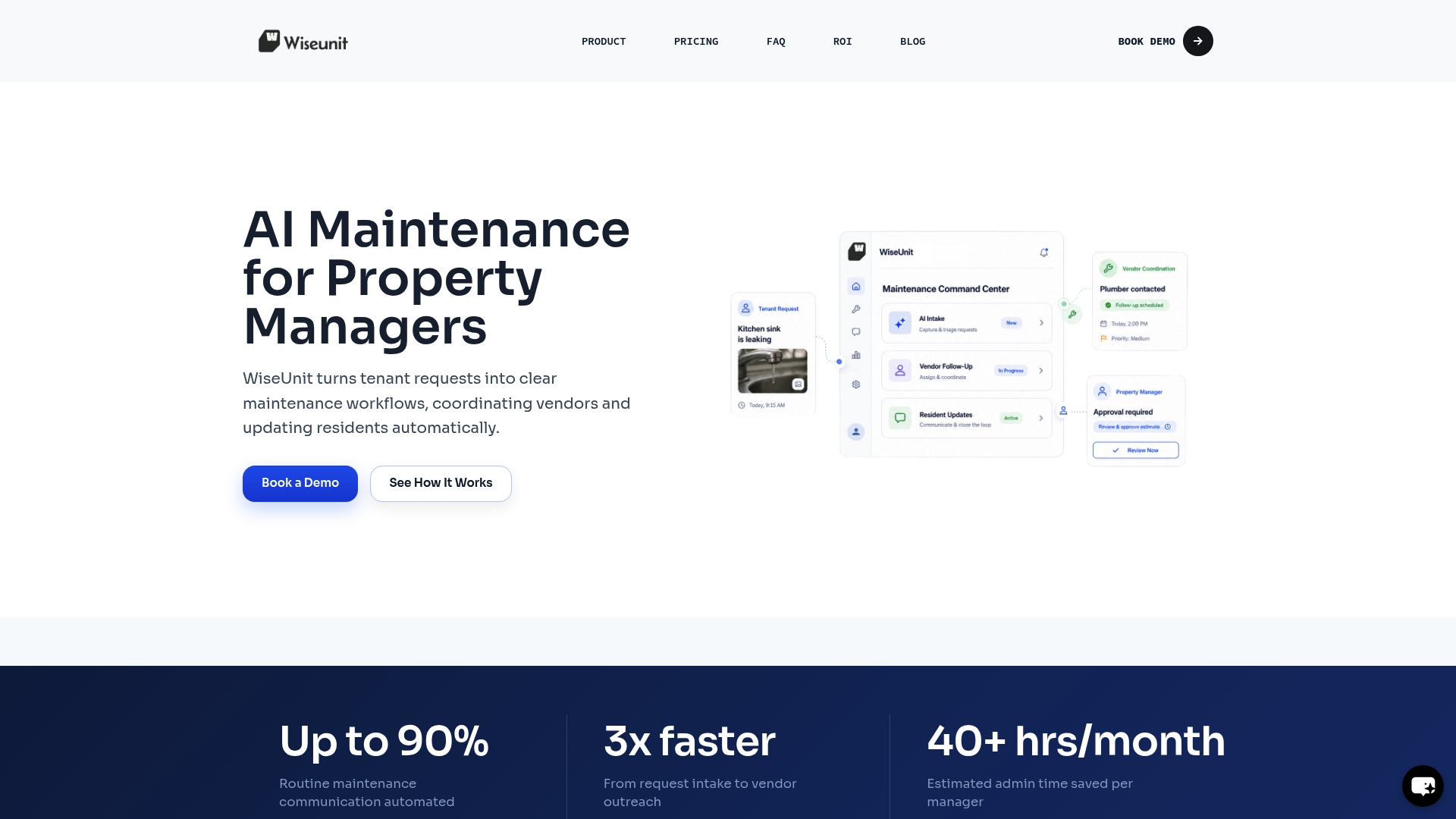
Wiseunit is an AI-powered maintenance coordination platform built specifically for property management teams in the US and Canada. It handles the full workflow from tenant intake through vendor dispatch, scheduling, follow-ups, and status updates inside AppFolio, Buildium, or Yardi. Instead of tracking tickets, Wiseunit executes the actual maintenance workflow so your team spends less time coordinating and more time managing. Tenants submit requests by call, SMS, or online form, and Wiseunit routes, triages, and updates all parties automatically. Use the ROI calculator to see how much coordination time your team can recover, or explore Wiseunit's platform to see how it fits your portfolio.
FAQ
What is maintenance as a service in property management?
Maintenance as a service is an outsourced model where a provider delivers both preventive and corrective property upkeep under a structured contract with defined performance standards. It replaces ad-hoc vendor calls with a coordinated program covering HVAC, plumbing, life-safety systems, and tenant service requests.
What is a maintenance SLA for property companies?
A maintenance SLA is a contractual document that defines response times, quality standards, and remedies for a property maintenance provider. It transforms service commitments into measurable legal obligations that protect owners when performance falls short.
What is the difference between preventive and reactive maintenance?
Preventive maintenance involves scheduled inspections and servicing designed to reduce failure likelihood, while reactive maintenance responds to issues after they occur. A managed maintenance program packages both under one contract to reduce disruptions and control costs.
How does maintenance as a service work for multifamily properties?
A managed maintenance provider handles tenant request intake, triage, vendor coordination, and status updates across all units under a single contract. Apartment maintenance programs for multifamily properties typically include unit-level repairs, common area upkeep, and scheduled system inspections.
What should be excluded from a maintenance as a service contract?
Capital replacements, code-required upgrades, and major renovations typically fall outside standard managed maintenance contracts. Defining these scope boundaries in writing before the contract starts prevents billing disputes and misaligned expectations.