

Property management software integration is the automated exchange of data between the tools that run your properties, including your property management system (PMS), CRM, leasing platforms, housekeeping software, and smart access controls. Without it, your team becomes the middleware, manually copying data between systems that should be talking to each other. The role of property management software integration goes beyond convenience. It is the operational backbone that determines whether your workflows scale or collapse under volume. This guide breaks down integration levels, real benefits, hidden risks, and how to build a tech stack that actually holds together.
What are the different types of property management software integrations?
Integration depth is the single most misrepresented concept in property management software sales. Integration levels range from Level 1, which is a logo on a partner page, all the way to Level 5, which is deep bidirectional real-time sync. Most marketed integrations land at Level 2 or 3, meaning they push data in one direction or require manual triggers. That gap creates hidden workloads your team absorbs without realizing it.
Here is how the levels break down in practice:
| Integration level | What it actually means |
|---|---|
| Level 1: Logo listing | Vendor claims partnership; no technical connection exists |
| Level 2: CSV/file export | Data moves via scheduled file uploads; manual or semi-automated |
| Level 3: One-way API push | One system sends data to another; no confirmation or write-back |
| Level 4: Two-way API sync | Both systems read and write; conflicts possible without governance |
| Level 5: Real-time bidirectional sync | Instant, confirmed data exchange with error handling and monitoring |
The industry standard term for what most property managers want is systems integration, specifically bidirectional API integration with defined data ownership. When a vendor says "we integrate with AppFolio, Buildium, or Yardi," that phrase alone tells you nothing about depth. A Level 3 integration with your PMS means maintenance status updates, lease changes, or applicant data may never flow back automatically.
Pro Tip: Ask vendors three specific questions before signing: Which API endpoints do you access? Can your system write back to our PMS, or only read? What happens when a sync fails? Vendors who cannot answer clearly are selling you a logo, not a connection.
Understanding the property management software ecosystem helps you map which tools need which level of integration before you evaluate vendors.
How does software integration improve efficiency and tenant experience?
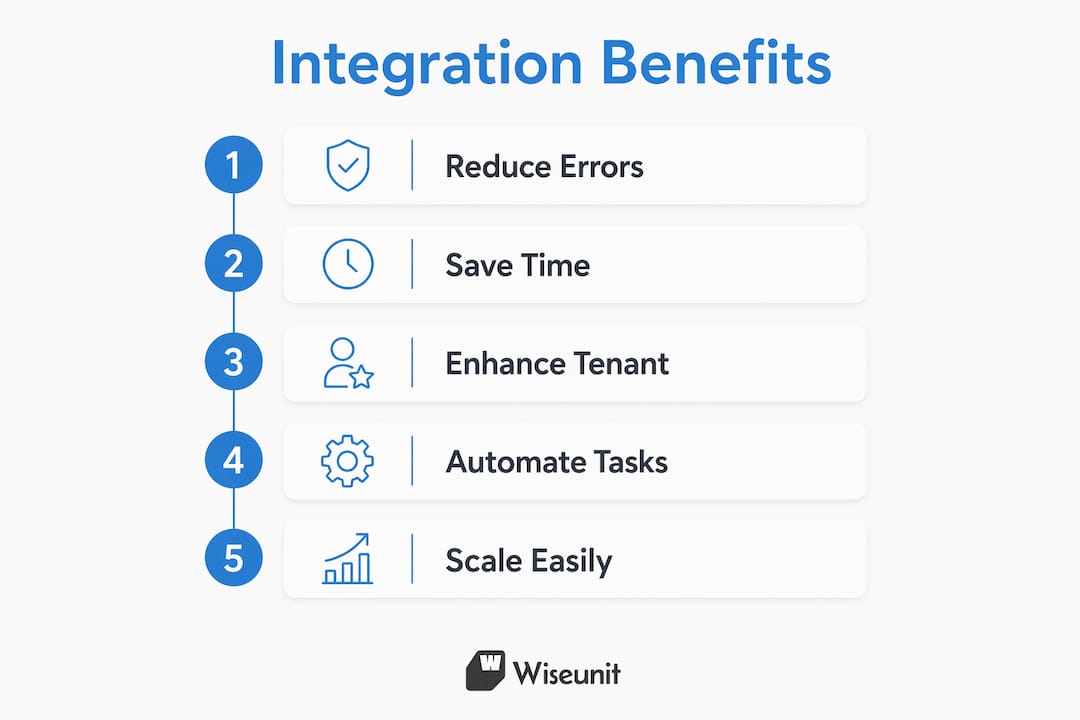
Integrated systems eliminate the manual data entry that consumes coordinator time and introduces errors. When your PMS, leasing platform, and access control system share a live data layer, entire workflows execute without staff involvement. A new lease signed in your leasing platform can trigger a smart lock code, a welcome message, and a move-in inspection task simultaneously.
The two-way sync between Rentvine and Tenant Turner is a concrete example: listings, leads, and applicant data stay current across both platforms automatically, removing the need for staff to manage file uploads or reconcile records. That kind of integration lets leasing teams focus on closing, not data hygiene.
Key operational improvements driven by deep integration include:
- Automated guest and tenant screening triggered by application submission, with results written back to the PMS without manual review steps
- Access credential generation tied to lease start dates, eliminating the coordinator step of emailing lock codes
- Maintenance request routing that assigns vendors, logs status updates, and notifies tenants without staff touching the ticket
- Housekeeping and turnover scheduling synced to checkout data in real time, reducing gaps between vacancy and readiness
- Financial data consolidation across multiple properties, giving owners accurate reporting without manual reconciliation
Property management automation at this level also produces measurable tenant experience gains. Tenants receive faster responses, accurate status updates, and consistent communication because the system handles it, not an overloaded coordinator. Proper integration enables predictive maintenance and tenant service enhancement that fragmented stacks simply cannot deliver. That means fewer complaints, better retention, and lower turnover costs.
What are the operational risks of property management systems integration?

Integration is not a set-and-forget decision. Integration maintenance is costly and fragile, and vendors frequently fail to provide clear SLAs, monitoring, or defined ownership when syncs break. When an API update on one platform silently changes a field name, your integration can fail without any alert, and your team may not notice until data is already out of sync across multiple systems.
The most common operational risks follow a predictable pattern:
- Silent data drift. Two systems diverge over time because conflict resolution rules were never defined. You end up with lease records in your PMS that contradict what your leasing platform shows.
- Partial write access. Your integration can read data from the PMS but cannot write back. Status updates made in a third-party tool never appear in your system of record.
- Sync latency mismatches. A batch sync that runs every four hours is fine for financial summaries but unacceptable for move-in access credentials. Using the wrong sync mode for the wrong workflow creates real tenant-facing failures.
- No monitoring or alerting. Most integrations have no built-in alerting. When the connection breaks, the first signal is often a tenant complaint or a missed vendor dispatch.
- Unclear support ownership. When something breaks, both vendors point at each other. Without a defined escalation path in your contract, resolution time stretches from hours to days.
Defining system-of-record ownership for every data entity, such as leases, maintenance status, and tenant contact records, is the governance step most teams skip. Without it, silent overwrites and inconsistent records undermine every efficiency gain the integration was supposed to deliver.
Pro Tip: Build a simple integration log: for each connected tool, document which system owns which data field, the sync direction, the sync frequency, and who gets alerted when it fails. Review it quarterly. Most integration failures are discovered in this review before they become operational crises.
How to select and implement property management software integrations
Selecting an integration is an evaluation process, not a checkbox exercise. The goal is to match integration depth to operational need, then implement in stages rather than connecting every tool at once.
Start with this evaluation checklist before committing to any integration:
- API access level: Does the vendor offer a full REST API, or only webhooks for specific events?
- Write capability: Can the integration push data back to your PMS, or only pull?
- Sync mode: Is it real-time event-driven, scheduled batch, or manual trigger?
- Error handling: Does the integration retry failed writes, log errors, and alert your team?
- Vendor SLA: Is there a documented response time for integration outages?
- Data ownership policy: Which system is the source of truth for each entity type?
Operational teams separate real-time workflows where delays matter, such as move-ins and access credentials, from batch syncs for low-risk data like monthly financial summaries. This separation is a best practice that improves tenant experience while reducing unnecessary load on your integration layer.
For implementation, a stepwise approach consistently outperforms a big-bang rollout. Connect your PMS to one tool, validate data accuracy over two to four weeks, define conflict resolution rules, then add the next integration. Each connection you add increases the complexity of your data governance requirements. Teams that connect six tools simultaneously rarely have clean data within the first quarter.
AI middleware and unified data layers are emerging as practical tools for managing integration resilience, particularly for teams running AppFolio, Buildium, or Yardi alongside multiple third-party tools. These layers absorb API changes from individual vendors without breaking your entire workflow stack.
How integration drives automation and the future of property management
Integration is the prerequisite for every meaningful automation in property management. Without a live, bidirectional data layer connecting your tools, AI and IoT systems have nothing reliable to act on. Integration platforms form the digital backbone of smart buildings, connecting PMS, IoT sensors, tenant services, and financial systems to enable automation and data transparency at scale.
The direction the industry is moving is toward what some analysts call autonomous property management, where routine decisions like vendor assignment, rent escalation triggers, and maintenance prioritization execute without human review. That future depends entirely on integration quality. A fragmented stack without a unified layer produces what practitioners call "integration spaghetti," a web of fragile point-to-point connections that breaks under real operational pressure.
"Open data access and robust two-way API sync let property managers focus on high-value tasks instead of managing workflows and data." — Tenant Turner and Rentvine integration announcement
API standardization across the PropTech sector is accelerating. Platforms that commit to open, documented APIs with write access will attract the best third-party tools and AI execution layers. Property managers who evaluate vendors on integration depth today are positioning their operations for the automation gains that will separate efficient teams from overwhelmed ones over the next three years.
Key takeaways
Deep, bidirectional integration is the operational foundation that separates property management teams that scale from those that add headcount every time volume increases.
| Point | Details |
|---|---|
| Integration depth varies widely | Most marketed integrations are Level 2 or 3; demand evidence of write-back capability before committing. |
| Data ownership prevents drift | Define which system owns each data entity to avoid silent overwrites and reconciliation overhead. |
| Sync mode must match workflow urgency | Use real-time sync for access credentials and move-ins; batch sync is acceptable for financial summaries. |
| Implementation should be stepwise | Connect one tool at a time, validate data accuracy, then expand to avoid integration spaghetti. |
| Integration enables AI execution | Autonomous maintenance routing, screening, and vendor coordination all depend on a reliable data layer. |
Why integration depth is the question most teams forget to ask
I have reviewed tech stacks for property management teams managing anywhere from 200 to 2,000 units, and the pattern is consistent. The integrations that cause the most operational pain are not the ones that failed to connect. They are the ones that connected at Level 2 or 3 and were assumed to be working.
The uncomfortable reality is that most vendors will not volunteer information about integration depth. They will show you a partner logo grid and let you assume the rest. I have seen teams spend months troubleshooting data inconsistencies that traced back to a one-way sync that was never designed to write back to the PMS. The fix was not technical. It was a conversation that should have happened before the contract was signed.
What I consistently recommend is treating integration evaluation the same way you treat lease review. Read the technical documentation, not just the marketing page. Ask for a sandbox environment to test write-back behavior before go-live. And build your team efficiency practices around the assumption that integrations will break, because they will. The teams that recover fastest are the ones who built monitoring and ownership into their process from day one, not as an afterthought.
Integration is not a one-time setup. It is an ongoing operational relationship between your tools, your vendors, and your data governance policies. Treat it that way, and it becomes a genuine force multiplier. Treat it as a checkbox, and it becomes a liability.
— Laur
How Wiseunit handles the integration layer for maintenance workflows
Property management teams that manage high volumes of maintenance requests know that the gap between a ticket being logged and a vendor being dispatched is where most time and tenant goodwill gets lost. Wiseunit is built to close that gap by acting as the execution layer on top of your existing PMS.
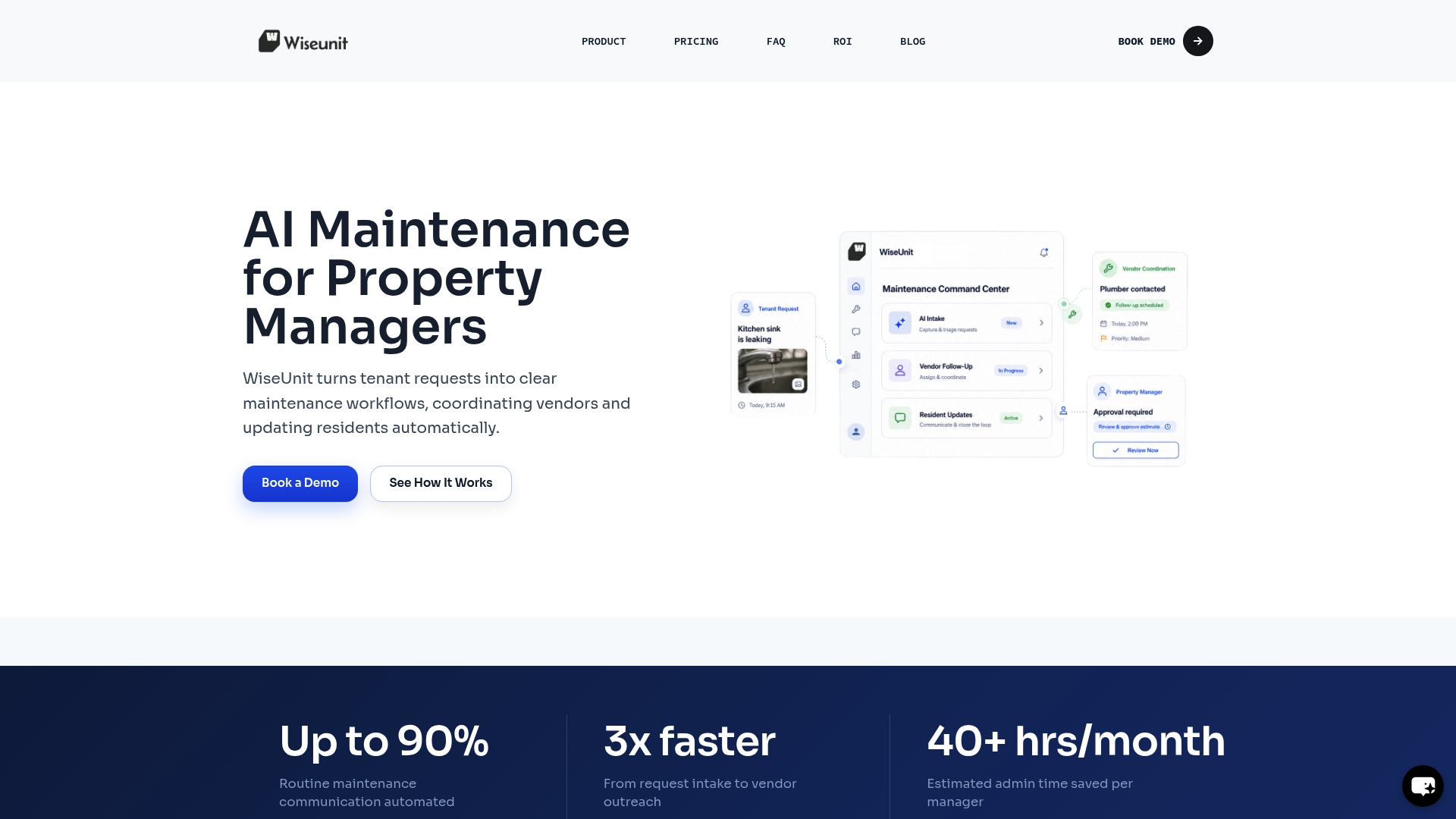
Wiseunit connects directly with AppFolio, Buildium, and Yardi to handle the full maintenance workflow: tenant intake via call, SMS, or online form; issue triage; vendor coordination; scheduling; and status updates written back into your PMS automatically. You do not need to replace your current system. Wiseunit works inside it. If you want to see what AI maintenance coordination looks like in practice for your portfolio, the platform is available to explore now.
FAQ
What is property management software integration?
Property management software integration is the automated data exchange between tools like your PMS, leasing platform, CRM, and smart access systems. It eliminates manual data entry by keeping records synchronized across platforms in real time or on a defined schedule.
Why do property management companies need integration?
Without integration, staff manually transfer data between systems, which introduces errors and delays. Deep integration automates workflows like tenant screening, maintenance routing, and access credential generation, reducing coordinator workload and improving tenant response times.
What types of property management software integrations exist?
Integrations range from file-based CSV exports at the shallow end to real-time bidirectional API sync at the deep end. The most operationally reliable integrations offer two-way API access with write-back capability, error handling, and defined data ownership policies.
How do I evaluate integration quality before buying?
Ask vendors specifically whether their integration can write data back to your PMS, what sync mode it uses (real-time vs. batch), and what monitoring or alerting exists when the sync fails. Vendors who cannot answer these questions clearly are offering a shallow connection.
What is the biggest risk of property management systems integration?
The most common risk is silent data drift, where two systems diverge because no conflict resolution rules were defined. Establishing clear system-of-record ownership for each data entity before go-live prevents the reconciliation overhead that undermines integration benefits.