

Most property managers aren't losing time to one big problem. They're losing it to dozens of small ones: a tenant call that interrupts a vendor negotiation, a maintenance ticket that stalls because nobody followed up, a work order that slips through because your inbox and your platform don't talk to each other. The result is that property managers lose 12 hours weekly to manual tasks that well-designed property manager time saving systems could handle automatically. This guide breaks down exactly which systems, tools, and practices close that gap.
Table of Contents
- Key Takeaways
- Building your technology foundation first
- How to automate your maintenance request workflow
- Using AI to handle tenant communication at scale
- Time management strategies that complement your systems
- My take on what actually moves the needle
- How Wiseunit handles this for property managers
- FAQ
Key Takeaways
| Point | Details |
|---|---|
| Automation cuts admin time dramatically | Switching from manual processes to automated workflows reduces monthly admin hours from 86 to 15.5. |
| Treat requests as state machines | Defining clear stages for every maintenance ticket prevents lost requests and enables automatic escalation. |
| AI handles routine communication | AI tools manage after-hours tenant queries, draft email replies, and triage issues before a human ever gets involved. |
| Hiring is not the answer | Scaling by adding staff to manage manual work costs more over time than investing in automated systems. |
| Track KPIs to sustain gains | Measuring response times, closure rates, and tenant satisfaction keeps your systems improving after initial setup. |
Building your technology foundation first
Before you automate anything, you need the right base. Property manager time saving strategies only work if the underlying systems are connected. A property management platform like AppFolio, Buildium, or Yardi acts as your system of record, but what sits on top of it determines how much manual work you still carry.
The most common mistake teams make is using disconnected tools. A maintenance request comes in through email, gets logged manually in the platform, gets communicated to the vendor by phone, and then someone has to chase the update. Each handoff is a potential failure point. Fragmented communication between issue identification and repair execution is the root cause of most operational inefficiency, not staff shortages.
Here is what your foundational tech stack needs before you layer in automation:
- Property management platform: AppFolio, Buildium, or Yardi as your central data hub
- Tenant-facing intake channel: An online portal, SMS line, or phone intake that feeds directly into the platform
- Vendor communication tool: A system that notifies vendors and logs responses without manual forwarding
- Document and invoice management: Digital storage that connects to your approval workflows
- Reliable connectivity and access: Your team needs consistent access across devices to avoid workarounds
| Tool Category | Example Platforms | Core Function |
|---|---|---|
| Property management software | AppFolio, Buildium, Yardi | Central record, ticketing, reporting |
| Maintenance execution AI | Wiseunit | Intake, triage, vendor coordination, updates |
| Inspection and field tools | HappyCo, Snapfix | On-site inspection triggers and work orders |
| Document management | Google Drive, SharePoint | Invoice storage, vendor contracts |
| Tenant communication | SMS portals, online forms | Intake and real-time status updates |
Pro Tip: Before buying any new tool, audit where your team currently spends the most time. Map a single maintenance request from submission to closed ticket and count every manual step. That map tells you exactly where automation pays off first.
How to automate your maintenance request workflow
The biggest time drain in property management is not a single task. It is the entire maintenance lifecycle, repeated hundreds of times per month, with manual intervention at every stage. The fix is to treat each request as a state machine with defined, automatic transitions.
Here is what that looks like in practice:
- Tenant submits a request via call, SMS, or online form. The system captures the issue type, unit, urgency level, and contact info without a human doing data entry.
- Automated triage assigns a category such as plumbing, HVAC, or electrical, and routes it to the right vendor based on pre-set rules for location, specialty, and availability.
- Vendor receives a notification with job details and confirms availability. No phone tag. No back-and-forth email chains.
- Scheduling confirmation goes to the tenant automatically, along with a contact for the assigned vendor and an estimated arrival window.
- Work is completed and the vendor closes the ticket, triggering an invoice submission and a tenant satisfaction message.
- If any stage stalls, the system escalates. Stalled states auto-escalate after 48 hours, which prevents requests from going silent and keeps managers informed without manual monitoring.
This structure is exactly how teams that automate maintenance with AppFolio, Buildium, and Yardi eliminate the follow-up burden that typically consumes a coordinator's day. The key is that the system does not just track status. It executes the next step.
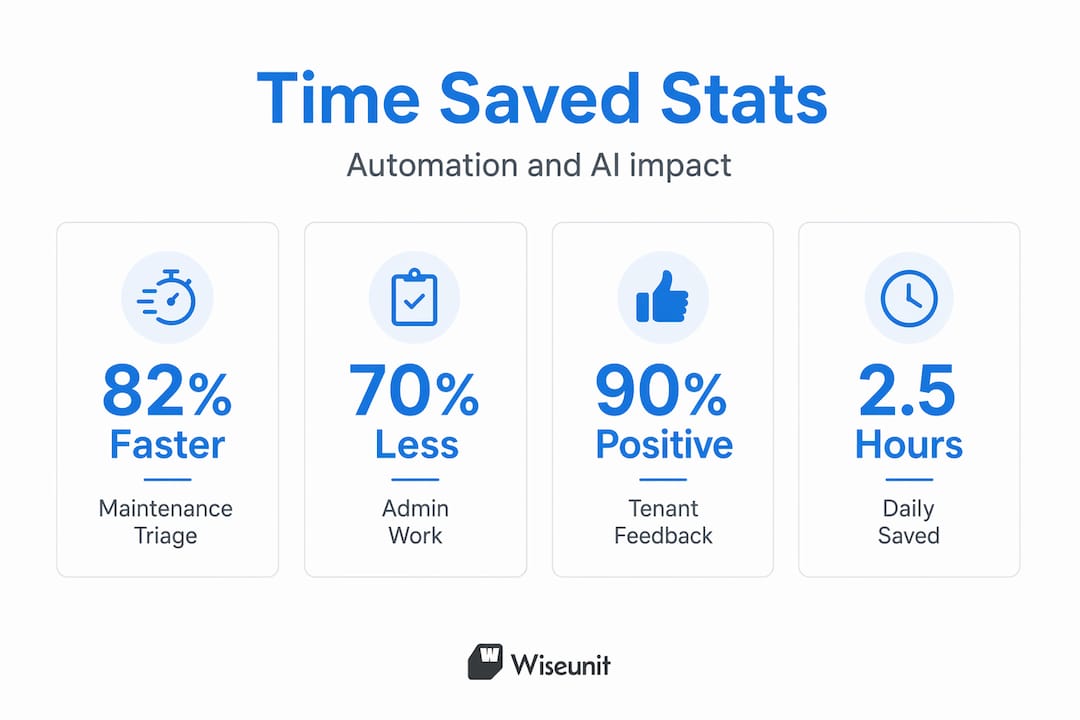
The efficiency gains are measurable. Maintenance triage time drops by 82% when workflows are automated, cutting monthly hours from 86 down to 15.5 across your entire admin operation. That frees your team to handle the work that actually requires judgment.
Pro Tip: Set your escalation thresholds based on issue category, not just time. An unresolved water leak should escalate in four hours. A cosmetic repair can wait 72 hours. Flat escalation rules cause noise. Category-based rules protect against real risk.
Using AI to handle tenant communication at scale
Tenant communication is one of the highest-volume, lowest-complexity tasks in property management. Most of it is repetitive: status updates, maintenance confirmations, lease reminders, compliance notices. AI tools handle this category well.
The current generation of property management efficiency tools covers several specific communication use cases:
- After-hours intake: An AI handles tenant calls and texts when your office is closed, captures request details, and queues them for morning processing or dispatches urgent issues immediately.
- Email drafting and thread summarization: AI reads incoming tenant emails, drafts appropriate replies for your review, and summarizes long threads so you process them in seconds, not minutes.
- Automated status updates: As a work order moves through stages, the tenant receives automatic messages. They never have to call to ask "what's happening with my request."
- Compliance reminders: Lease renewal notices, inspection scheduling, and move-out checklists go out automatically based on calendar triggers, not manual tracking.
The most effective implementation of these tools does not require replacing your existing platform. Integrated AI tools that reduce context switching stay within familiar workflows. They surface inside your existing inbox or platform rather than asking your team to log into yet another system.
AI in property management works best as background support infrastructure, handling the repetitive admin while human managers focus on relationship-heavy or judgment-intensive work. That framing matters when you are evaluating what to automate and what to keep manual. Not every interaction should be handed off to AI. Lease disputes, escalated complaints, and vendor qualification decisions benefit from a human touch. But "when is my repair scheduled?" does not.
For a thorough comparison of what these tools can do, the AI tools comparison for 2026 covers the leading platforms with feature-level breakdowns.
Pro Tip: Before deploying AI for tenant communication, write out your 20 most common tenant questions and the correct response to each. Use those as training inputs. AI configured with your actual answer library performs significantly better than one running on generic prompts.
Time management strategies that complement your systems
Technology alone does not close the productivity gap. How your team operates around that technology determines whether the gains hold. The most effective property manager time saving strategies combine good tooling with deliberate work habits.
Time blocking specific parts of the day for focused tasks reduces interruptions and improves the quality of work output. A property manager who checks communications twice daily in defined windows processes the same volume faster than one who responds reactively throughout the day. Batch processing is more efficient than constant context-switching.
A few practices that make a real difference:
- Set communication windows: Define when tenants and vendors can expect responses. Post this in your tenant portal and signature line. It reduces the expectation of instant replies and lets you batch responses without guilt.
- Build KPI dashboards: Track average maintenance closure time, first-response time, and tenant satisfaction scores weekly. Without measurement, you cannot tell whether your systems are actually saving time or just rearranging the work.
- Avoid the staffing trap: Hiring additional staff to solve scaling issues that automation could handle leads to recurring payroll costs with diminishing returns. A coordinator hired to chase vendor updates costs you every month. An automated escalation rule costs you once.
- Audit your workflows quarterly: Systems drift. Vendors change. Platforms get updated. Schedule a quarterly review to check that your automation rules still reflect current operations and catch bottlenecks before they grow.
The teams that sustain the highest efficiency gains are not the ones who implemented the best software. They are the ones who built the discipline to keep their systems current and their processes well-defined.
My take on what actually moves the needle
I've spent time studying how property management teams implement automation, and the pattern I keep seeing is this: the teams that struggle are not failing because of bad software. They're failing because they layered new tools onto broken processes.
What I've learned is that visibility comes before automation. If you cannot see where a maintenance request sits in your workflow right now, adding AI on top of that chaos just accelerates the confusion. The teams that get real results from property management software vs. AI execution invest in mapping their process first, then automate the stages that are already working.
The thing I find most misunderstood is the hiring instinct. When volume goes up, the first response is to hire another maintenance coordinator. I get it. But in my experience, that coordinator spends 70% of their time on tasks that a well-configured system would handle automatically. You're paying full salary for 30% of the value.
The future direction I see is AI operating as a true execution layer, not just a reporting tool. That means AI that does not just tell you a ticket is stalled but actually sends the follow-up, contacts the vendor, and updates the tenant. That shift from tracking to executing is where the real time savings live. And it is already possible today.
— Laur
How Wiseunit handles this for property managers
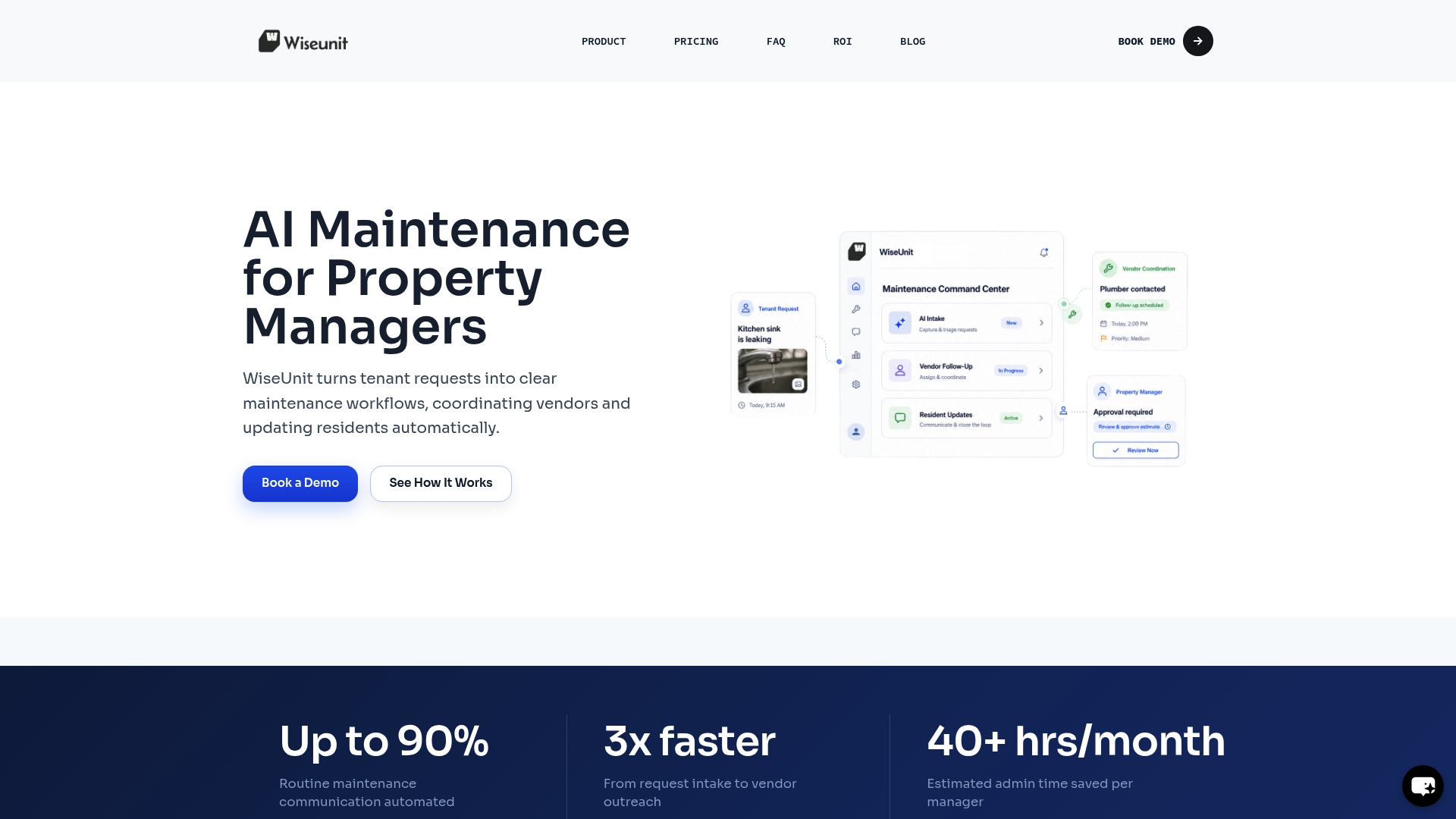
If the workflow described in this article sounds like where you want to be, Wiseunit is built to get you there. Wiseunit is a multi-agent AI platform that executes the full maintenance coordination workflow, from tenant intake through vendor dispatch, scheduling, follow-ups, and platform updates inside AppFolio, Buildium, or Yardi. Your team stops chasing tickets and starts managing by exception.
Wiseunit works as the execution layer on top of your existing platform, not a replacement for it. Tenants submit requests via call, SMS, or online form. Wiseunit handles the rest and keeps everyone updated automatically. Use the Wiseunit ROI calculator to see what that would mean for your portfolio in real numbers.
FAQ
What are the biggest time wasters for property managers?
Manual maintenance coordination, reactive tenant communication, and chasing vendor updates account for the majority of wasted time. Automation reduces total monthly admin hours from 86 to 15.5 when applied systematically.
How does AI improve maintenance workflows for landlords?
AI handles intake, triage, vendor routing, and tenant updates automatically, so your team intervenes only when human judgment is required. This reduces cycle times and eliminates most of the follow-up work that fills a coordinator's day.
What software do property managers use to save time?
The most effective setups combine a property management platform like AppFolio, Buildium, or Yardi with an AI execution layer that handles maintenance workflows end to end. Best software for property managers in 2026 prioritizes integration with existing systems over standalone capability.
Should I hire more staff or invest in automation?
Automation is the better investment for repeatable, high-volume tasks. Hiring to solve a scaling problem that automation could handle adds permanent payroll cost for work that a system would do consistently at a fraction of the expense.
How do I measure whether my time-saving systems are working?
Track average maintenance closure time, first-response time, and the percentage of tickets requiring manual intervention. These three KPIs tell you whether your systems are performing or drifting over time.