
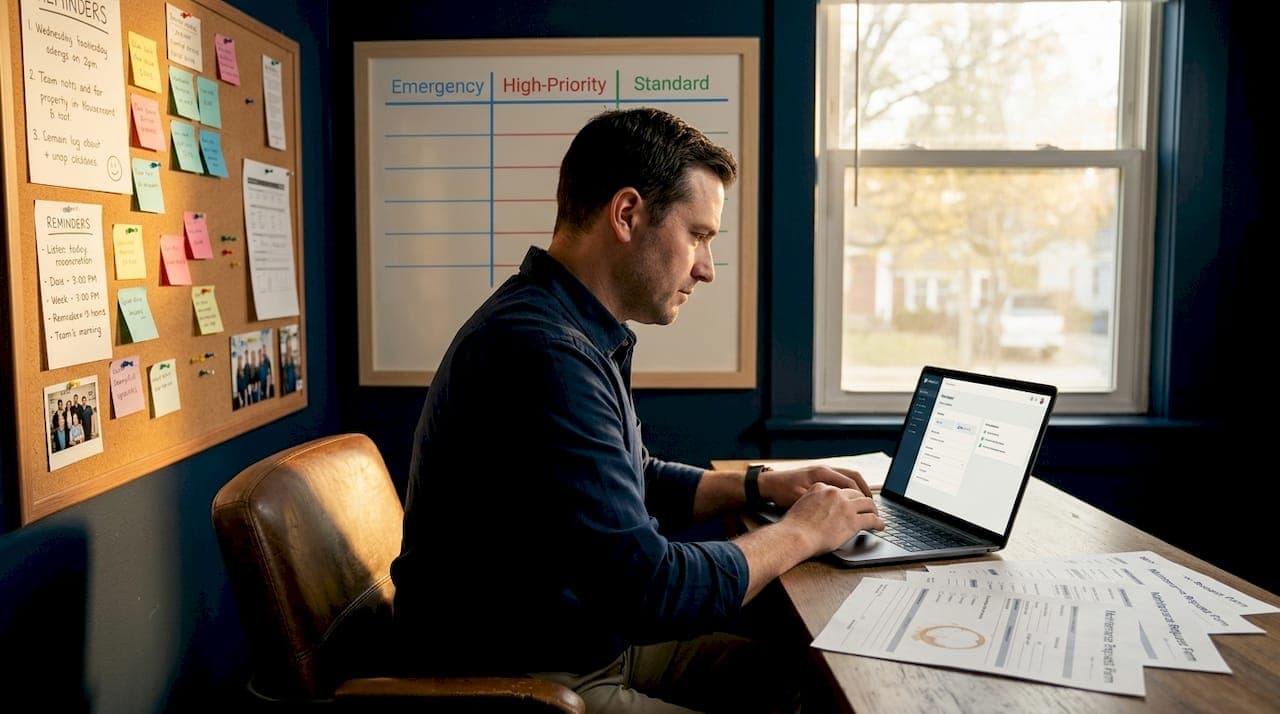
Not all maintenance request types in multifamily properties carry the same weight, cost, or urgency. Yet many property management teams treat them the same way, which is exactly why emergencies get delayed, tenants get frustrated, and repair costs spike. Understanding how to classify and respond to each category of multifamily maintenance requests, from critical safety issues to minor cosmetic fixes, is one of the most practical ways to protect both your bottom line and your tenant relationships. This guide breaks down each type so you can build a tighter workflow around them.
Table of Contents
- Key takeaways
- 1. Emergency maintenance requests in multifamily properties
- 2. High-priority requests affecting tenant comfort
- 3. Standard and routine maintenance requests
- 4. Comparing maintenance request categories side by side
- 5. Strategies for classifying and responding to requests effectively
- My take on why classification is more than an admin task
- How Wiseunit handles maintenance request coordination for you
- FAQ
Key takeaways
| Point | Details |
|---|---|
| Three core categories exist | Emergency, high-priority, and standard requests each require distinct response times and workflows. |
| Response time targets matter legally | Safety-critical issues should be resolved within 24 hours; comfort issues within 3 to 5 days. |
| Intake quality drives speed | Capturing photos, access info, and tenant availability upfront cuts repeat site visits and delays. |
| Categorization controls costs | Accurate classification reduces emergency call volume and keeps labor costs predictable. |
| Digital workflows produce measurable results | Operators using digital systems have cut resolution times and reduced maintenance costs significantly. |
1. Emergency maintenance requests in multifamily properties
Emergency requests, also called P1 or critical work orders in facility management, represent the highest-stakes category in any multifamily maintenance guide. These are safety issues that create immediate risk of injury, structural damage, or legal liability if not addressed within hours.
Common examples include:
- Active gas leaks or suspected carbon monoxide exposure
- Electrical hazards such as sparking outlets or panel failures
- Flooding from a burst pipe or sewer backup
- Non-functional fire suppression systems or triggered alarms
- Complete loss of heat in winter months (which carries legal obligations in most U.S. jurisdictions)
- Broken exterior doors or locks that compromise unit security
The industry standard for emergency SLA response is approximately 15 minutes for initial contact and 4 hours for resolution. Many state and local housing codes also require landlords to address habitability-related emergencies within 24 hours, meaning the legal clock starts the moment a tenant submits a request.
From an operations standpoint, emergency requests disrupt your entire team's day. They pull technicians off scheduled work and often require after-hours vendor dispatch at premium rates. This is why reducing emergency volume is a core maintenance cost control objective for any multifamily operator.
Pro Tip: Set up a dedicated emergency line or after-hours answering protocol that automatically logs the request type, unit number, and reported issue. The faster you capture that intake information, the faster dispatch can happen, and the more defensible your response time is if a tenant escalates the issue.
2. High-priority requests affecting tenant comfort
High-priority requests, sometimes labeled P2 or P3 depending on the system, sit one tier below emergencies. They do not pose immediate safety risks, but they significantly affect a tenant's ability to live comfortably in their unit. Left unresolved, they tend to escalate into formal complaints, lease non-renewals, or negative reviews.
Typical high-priority maintenance issues in apartments include:
- HVAC failures that leave units without heating or cooling
- Plumbing problems that restrict water access (such as a failed water heater)
- Refrigerator or range malfunctions in occupied units
- Active water intrusion that risks mold or structural damage
- Pest infestations that have spread beyond a single unit
The standard response target for these high-priority work orders is a 4-hour acknowledgment with a resolution window of 24 to 48 hours. If resolution requires a specialty vendor or parts procurement, tenant communication becomes especially important during that waiting period.
What makes this category operationally tricky is the balancing act. You cannot treat every HVAC call with the same urgency as a gas leak, but a tenant who has been without air conditioning for three days in July feels otherwise. Setting clear internal service level agreements (SLAs) for this tier and communicating expected timelines proactively is what separates average property management teams from high-performing ones.
The tenant retention angle is real here. Tenants who experience a fast, transparent response to a comfort issue are significantly more likely to renew their lease. The inverse is equally true, and lease turnover is expensive.
3. Standard and routine maintenance requests
Standard requests, also called P4 or low-priority work orders, cover the cosmetic repairs and minor functional issues that affect quality of life but do not disrupt habitability. These are the most common maintenance issues in apartments by volume, and they are also the easiest category to lose control of if your queue management is poor.
Common examples include:
- Paint touch-ups and drywall scuffs
- Slow-draining sink or tub (not fully clogged)
- Loose cabinet hinges or door hardware
- Minor appliance quirks (ice maker not working, dishwasher takes longer than normal)
- Window screen tears or damaged blinds
- Small grout cracks or tile chips
Response time targets for standard requests fall in the 7 to 10 business day range. That window gives you flexibility to batch these by building or unit cluster, which reduces technician travel time and keeps labor costs in check.
The operational key with routine requests is scheduling. Batching low-priority work by floor, building wing, or contractor type is a legitimate and smart workflow decision. It reduces the number of separate vendor visits, which is one of the most underappreciated drivers of maintenance spend.
Pro Tip: Ask tenants to submit photos with every standard request, even for something as simple as a loose door handle. Technicians who arrive with photos already reviewed can bring the right part on the first visit, cutting repeat trips by a significant margin. Structured intake forms that require photos and access instructions reduce follow-up calls by up to 70%.
4. Comparing maintenance request categories side by side
Understanding each category in isolation is useful. Comparing them together is where the operational clarity comes from. Here is a side-by-side view of the three main property maintenance categories:
| Category | Examples | Response Target | Resolution Target | Cost Profile | Tenant Impact |
|---|---|---|---|---|---|
| Emergency (P1) | Gas leak, flooding, electrical hazard | 15 minutes | 4 hours | Very high (after-hours, premium rates) | Habitability risk, legal exposure |
| High-priority (P2/P3) | HVAC failure, water heater, pest issue | 4 hours | 24 to 48 hours | Moderate to high | Comfort disruption, retention risk |
| Standard (P4) | Cosmetic repairs, minor appliance issues | 1 to 2 business days | 7 to 10 business days | Low to moderate | Quality of life, satisfaction signal |
The cost profile column is worth paying attention to. Emergency repairs almost always carry a premium, whether that is an after-hours vendor call or expedited parts sourcing. A single burst pipe response can easily cost three to five times what the same repair would cost as a scheduled fix. This is the financial argument for investing in preventive work. When you reduce the conditions that generate emergency calls, you directly control your maintenance spend.
Property managers who track request-to-resolution time and emergency call volume as KPIs consistently find that better classification upstream leads to lower costs downstream.
5. Strategies for classifying and responding to requests effectively
A solid framework for handling types of maintenance requests does not have to be complicated. What it does need is consistency. Here is a practical set of steps that high-performing multifamily teams use:
-
Define your tiers formally. Write out your P1, P2, and P3 definitions with specific examples for your portfolio. A team that shares a common definition of "emergency" makes fewer judgment errors at intake.
-
Build classification logic into your intake process. Whether you use a digital form, an AI intake agent, or a phone script, the intake step should always collect issue type, location, severity indicators, photos, and access availability. Accurate urgency classification at intake is the single most impactful triage lever you have.
-
Set SLA clocks automatically. Once a request is classified, the response clock should start without manual intervention. Automated SLA escalation prevents high-priority work orders from sitting unnoticed during peak volume periods.
-
Separate preventive from corrective work. Preventive maintenance is scheduled proactively based on inspection cycles or asset data, not triggered by a tenant complaint. Building a formal preventive schedule for HVAC filters, water heater flushing, and roof inspections reduces the conditions that generate urgent requests. One 500-unit operator reduced emergency repairs by 52% after shifting to a predictive digital maintenance model.
-
Use batching for standard requests. Group P4 work orders by unit cluster or trade type and assign them in weekly batches. This is a low-effort scheduling change with a direct impact on technician efficiency and reduced maintenance costs.
-
Communicate proactively at every tier. Tenants do not expect instant resolution. They expect to be told what is happening and when. Automated status updates tied to work order stages dramatically reduce inbound "where is my technician?" calls.
-
Review your emergency call rate monthly. A high volume of P1 requests is a signal that something in your preventive maintenance or intake triage is failing. Tracking this metric consistently gives you the data to justify process changes and work order system improvements.
My take on why classification is more than an admin task
I've spent a lot of time looking at how property management teams handle maintenance intake, and the pattern I keep seeing is this: teams with the worst tenant satisfaction scores are rarely behind on repairs. They're behind on triage. The work gets done eventually, but it gets done in the wrong order, at the wrong cost, with the wrong communication.
What I've found is that most emergency volume is not random. It is the predictable result of deferred low-priority requests. A slow drain that sits in the standard queue for three weeks eventually becomes a flooded bathroom. A cosmetic crack ignored long enough becomes a moisture intrusion call at 11 PM on a Friday. Treating the categorization process as an administrative checkbox rather than an operational lever is where the real cost accumulates.
The other thing I've learned is that the tenant experience at the intake moment sets the tone for everything that follows. A tenant who submits a request and immediately receives a clear confirmation with an expected timeline is already less frustrated, even before the repair happens. One operator managing 450 units cut resolution time from 3.8 days to 8 hours after digitizing their intake and routing workflows. That is not just a speed improvement. That is a tenant retention improvement.
Digital systems do not fix a broken prioritization philosophy. But they do give you the structure to enforce one consistently, even when your team is managing hundreds of requests across multiple properties. The teams that get this right treat maintenance classification as a revenue-protective discipline, not a back-office chore.
— Laur
How Wiseunit handles maintenance request coordination for you
Managing multiple categories of maintenance requests across dozens or hundreds of units gets operationally chaotic without the right system underneath it. Wiseunit is built specifically to act as the execution layer between your tenants, your vendors, and your property management platform.
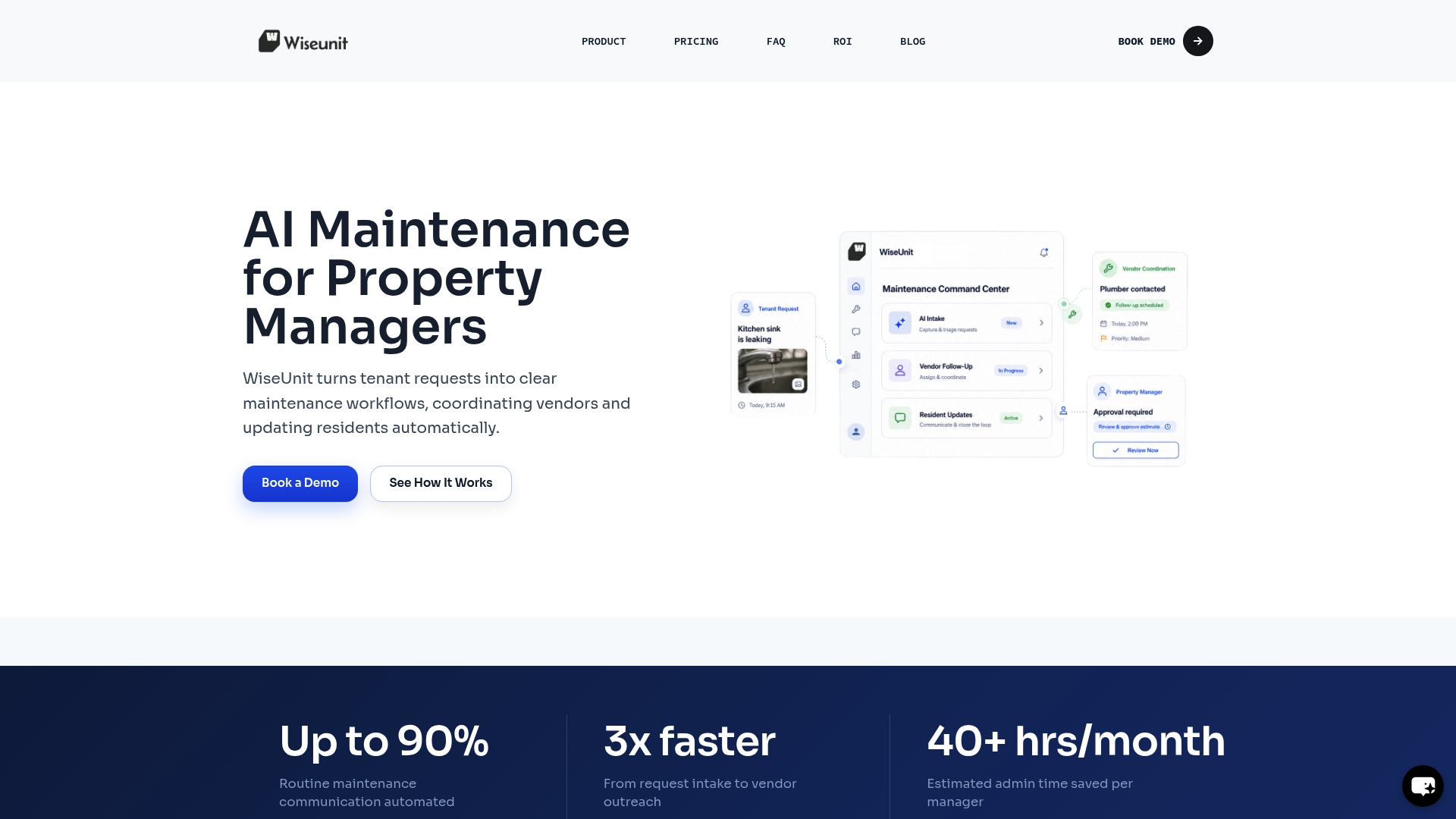
When a tenant submits a request by phone, SMS, or an online form, Wiseunit's AI automatically captures the issue details, classifies the urgency, and coordinates the next steps, including vendor assignment, scheduling, and status updates inside AppFolio, Buildium, or Yardi. You get faster response times without adding headcount, and your tenants get clear communication at every stage. See how the maintenance workflow automation works, try it free with no upfront commitment, or run your numbers through the ROI calculator to see what faster resolution is worth to your portfolio.
FAQ
What are the main maintenance request types in multifamily?
The three main categories are emergency (P1), high-priority (P2/P3), and standard (P4) requests, each defined by safety risk, tenant impact, and response time requirements.
How quickly should emergency maintenance requests be resolved?
Emergency requests should receive an initial response within 15 minutes and reach resolution within 4 hours, with most state housing codes requiring habitability issues to be addressed within 24 hours.
How do you reduce emergency maintenance volume in a multifamily property?
Shifting to a preventive maintenance schedule and improving intake triage accuracy are the two most direct levers. One apartment complex reduced emergency repairs by 52% after moving from a reactive to a predictive digital maintenance model.
Why do routine maintenance requests get delayed so often?
Delays in routine requests typically stem from missing tenant context at intake, such as access instructions, availability, and photos, rather than from a lack of technician capacity.
What is the difference between preventive and corrective maintenance?
Corrective maintenance is triggered by a reported failure or inspection finding. Preventive maintenance is scheduled proactively based on asset cycles or condition data, before a tenant ever needs to submit a request.
Recommended
- AI Maintenance Coordination Software for Property Managers | WiseUnit AI
- Multifamily Maintenance Operations: A Property Manager's Guide
- Property Management Maintenance Workflow: Step-by-Step Process to Reduce Workload (Toronto, Dallas, Phoenix)
- How Property Managers Automate Maintenance with AppFolio, Buildium, and Yardi