

An AI Maintenance Coordinator for Property Managers is a software layer that handles the full maintenance workflow automatically, from the moment a tenant submits a request to the moment a vendor closes the job. Unlike traditional ticketing tools that simply log issues, these systems execute each step: triage, vendor selection, scheduling, follow-ups, and status updates inside platforms like AppFolio, Buildium, and Yardi. The industry term for this category is maintenance execution software, and understanding the distinction matters. Tools like Property Bots, SnapInspect, and SINGU AI each take this approach, and predictive maintenance features can cut reactive repair costs by up to 40%. For teams managing high volumes of requests across multifamily or HOA portfolios, that is not a marginal gain.
How does an AI maintenance coordinator automate your workflow?
The full automation cycle in a virtual maintenance coordinator starts at tenant intake and ends with a closed work order, with no manual handoffs required in between. That end-to-end coverage is what separates execution software from basic ticketing.
Here is how the process works in practice:
- Tenant submits a request. The tenant calls, texts, or fills out an online form. The AI captures the issue, asks clarifying questions, and requests photos if needed.
- Triage and categorization. The system classifies the issue by urgency and type. Property Bots' Tenant Triage AI confirms the request instantly via SMS, collects photos, and automatically books service calls, cutting delays at the first touchpoint.
- Vendor selection and scheduling. The AI matches the job to the right vendor based on trade, availability, and past performance. It sends the work order, confirms the appointment, and notifies the tenant.
- Status updates throughout. Both the tenant and the property manager receive automatic updates at each stage. No one needs to call the office to find out what is happening.
- Completion and reporting. SnapInspect delivers photo-backed instant reports with timestamped documentation immediately after inspections, creating a clear audit trail without manual data entry.
The result is a workflow where your maintenance coordinator spends time on exceptions, not on routine coordination. Some AI property management systems save over 20 hours of manual work every week. That time compounds quickly across a portfolio of 200 or 500 units.
Pro Tip: Set up your AI system to send tenants a confirmation SMS within two minutes of submission. That single touchpoint reduces follow-up calls to your office by a significant margin, because tenants know their request was received.
How does predictive maintenance cut costs and improve efficiency?
Predictive maintenance is the practice of scheduling repairs based on actual equipment condition and historical failure patterns, rather than fixed calendar intervals. The difference in cost outcomes is substantial.
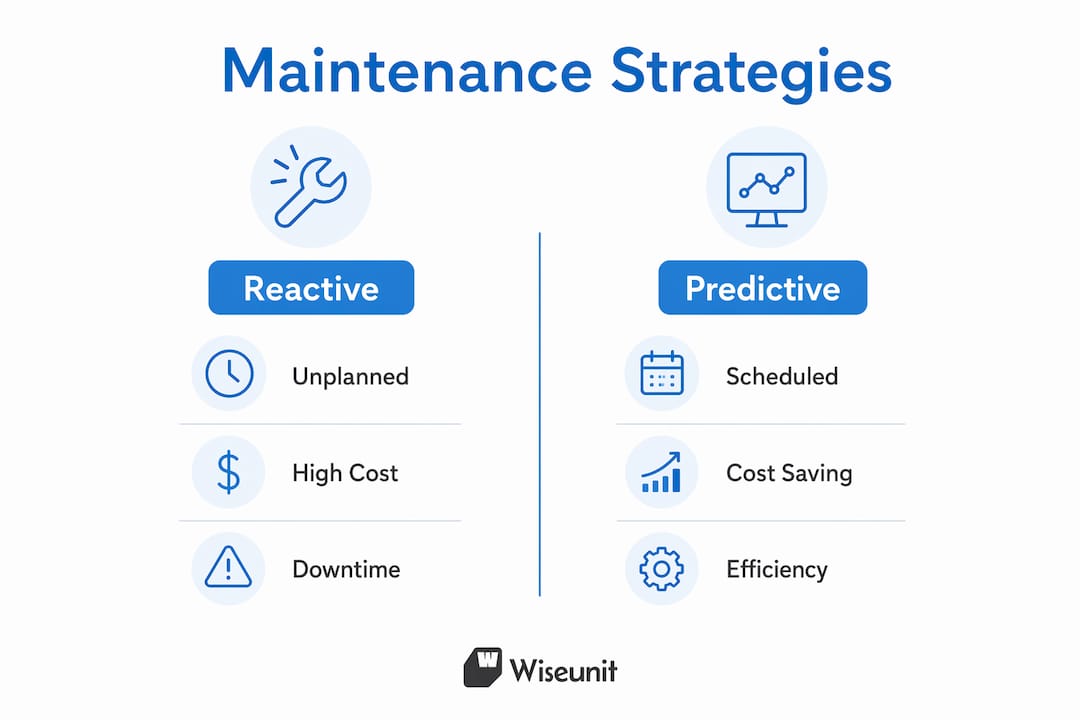
Calendar-based maintenance treats every HVAC unit the same regardless of age, usage, or environment. Condition-based maintenance, powered by AI analysis of historical work orders and sensor data, flags the units most likely to fail before they do. Reactive repair costs drop by up to 40% when teams make this shift. That reduction reflects fewer emergency callouts, less tenant disruption, and lower per-repair costs when work is planned rather than urgent.
Key benefits of AI-driven predictive maintenance include:
- Pattern recognition across properties. AI identifies which asset types fail most often in specific conditions, such as water heaters in older buildings during winter months.
- Budget forecasting accuracy. When the system predicts upcoming failures, your capital expenditure planning becomes data-driven rather than guesswork.
- Vendor pre-positioning. Knowing a repair is likely in the next 30 days lets you schedule preferred vendors in advance, avoiding premium rates for emergency availability.
- Reduced tenant turnover risk. Tenants who experience fewer unplanned outages are more likely to renew. Maintenance quality is consistently cited as a top factor in lease renewal decisions.
The shift from reactive to predictive is not just a cost story. It is an operational maturity story. Teams that adopt condition-based cycles spend less time in crisis mode and more time managing their portfolio strategically.
What should you know before adopting AI maintenance tools?
AI maintenance coordination does not go live at full capacity on day one. Understanding the setup requirements upfront prevents frustration and sets realistic expectations for your team.
The most important preparation steps are:
- Plan for a calibration period. AI systems require a 2–4 week training phase to learn your standard operating procedures, vendor preferences, and repair protocols before operating autonomously. Budget that time into your rollout plan.
- Audit your historical data first. The first month of AI adoption often involves cleaning and standardizing past work orders and vendor records. Without clean input, the system cannot accurately predict failure rates or route jobs correctly.
- Standardize your records before go-live. Inconsistent vendor names, duplicate work order categories, and missing cost data will degrade AI recommendations. A data cleanup sprint before launch pays dividends immediately.
- Involve your maintenance coordinators early. The staff who know your vendor relationships and property quirks are the best trainers for your AI system. Their input during setup directly improves output quality.
Without clean and consistent historical data, AI systems risk routing tasks incorrectly or generating inaccurate predictive alerts. That is not a technology failure. It is a data hygiene failure, and it is entirely preventable.
Pro Tip: Before your AI goes live, export your last 12 months of work orders and run a simple audit: check for duplicate vendor entries, missing cost fields, and uncategorized issue types. Fixing those three things alone will meaningfully improve your AI's first-month accuracy.
Which AI tools lead the market for property maintenance coordination?
The market for AI-driven maintenance software has matured quickly. Several platforms now offer distinct capabilities worth comparing before you commit to a solution.
SINGU AI integrates directly into existing tickets, inspection forms, and dashboards your team already uses, which reduces adoption friction for maintenance staff. Property Bots focuses on tenant-facing automation, with its Tenant Triage AI handling SMS confirmations, photo collection, and automated scheduling. SnapInspect leads on inspection documentation, generating timestamped, photo-backed reports immediately after site visits. Rentalize Core bundles predictive maintenance into a full housing management system, making it a strong option for teams that want a single platform.
For teams already running AppFolio, Buildium, or Yardi, integration compatibility is a non-negotiable filter. Wiseunit connects directly with these platforms, executing maintenance workflows inside the systems you already use rather than requiring a parallel tool.
| Platform | Core Strength | Tenant Communication | Predictive Maintenance | Integration |
|---|---|---|---|---|
| Property Bots | Tenant triage automation | SMS, photo collection | Limited | Moderate |
| SnapInspect | Inspection reporting | Post-inspection reports | Moderate | Strong |
| SINGU AI | Workflow integration | Dashboard-based | Moderate | Strong |
| Rentalize Core | Full housing management | Built-in tenant portal | Strong | Moderate |
| Wiseunit | End-to-end execution | SMS, calls, online forms | Strong | AppFolio, Buildium, Yardi |
The right choice depends on where your biggest bottleneck sits. If tenant intake is the problem, Property Bots or Wiseunit address that directly. If inspection documentation is the gap, SnapInspect is purpose-built for it. If you need predictive cost control, Rentalize Core or Wiseunit offer the deeper analytics. For a broader comparison of AI property management tools across categories, the full breakdown is worth reviewing before you finalize a vendor.
Key takeaways
AI maintenance execution software delivers measurable cost and time savings when deployed with clean data, a realistic calibration timeline, and the right platform for your portfolio's specific bottlenecks.
| Point | Details |
|---|---|
| Full workflow automation | AI handles intake, triage, vendor scheduling, and reporting without manual handoffs. |
| Predictive maintenance savings | Condition-based scheduling reduces reactive repair costs by up to 40%. |
| Calibration takes 2–4 weeks | Plan for a training phase before expecting autonomous AI operation. |
| Data quality drives accuracy | Clean, standardized historical records are required for reliable AI recommendations. |
| Integration compatibility matters | Choose platforms that work inside AppFolio, Buildium, or Yardi to avoid workflow fragmentation. |
What i've learned about getting AI maintenance tools to actually work
Most property managers I talk to expect AI to perform on day one. That expectation leads to early disappointment, and sometimes to abandoning a tool that would have delivered real value with a bit more patience.
The calibration period is real. Two to four weeks feels long when you are managing a backlog of requests, but the AI is learning your vendor network, your property types, and your escalation thresholds during that time. Teams that treat the setup phase as an investment rather than a delay get dramatically better results by month two.
The other thing I have seen consistently: the managers who get the most out of these systems are the ones who keep improving their data. They review AI routing decisions weekly, correct errors, and update vendor records when a contractor changes their service area or pricing. Effective AI deployment requires continuous refinement of SOPs and vendor criteria based on performance metrics. That is not a one-time task.
My honest view is that the property managers who treat AI as a tool to augment their coordinators, rather than replace them, see the best outcomes. The AI handles volume and consistency. Your team handles judgment calls and relationships. That division of labor is where the real efficiency gains live. For multifamily teams specifically, the 2026 guide to AI maintenance coordination covers how to scale this approach across larger portfolios.
— Laur
See how Wiseunit handles maintenance from start to finish
If your team is spending hours each week on manual follow-ups, vendor calls, and status updates, Wiseunit is built to take that work off your plate.
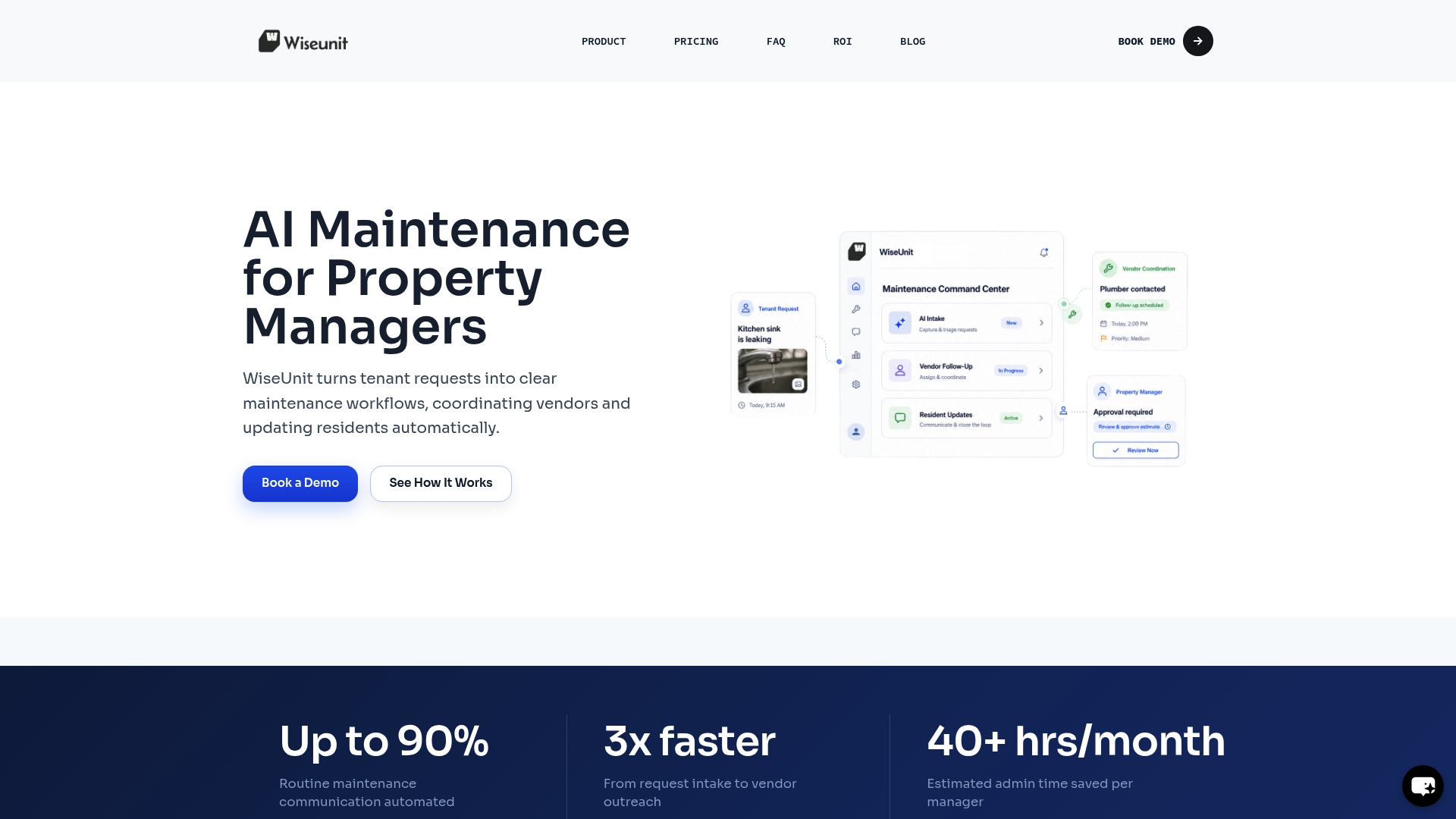
Wiseunit is a maintenance execution platform for property management companies managing multifamily, single-family rental, and HOA portfolios. Tenants submit requests by call, SMS, or online form. Wiseunit triages the issue, coordinates the vendor, schedules the job, and updates your records in AppFolio, Buildium, or Yardi automatically. Your team stays in control without doing the manual coordination. If you are ready to see how it works for your portfolio, request a demo directly from the Wiseunit website.
FAQ
What is an AI maintenance coordinator for property managers?
An AI Maintenance Coordinator is software that automates the full maintenance workflow, from tenant request intake through vendor scheduling and job completion, without requiring manual coordination at each step.
How long does it take to set up an AI maintenance system?
Most platforms require a 2–4 week calibration period to learn your SOPs, vendor preferences, and repair protocols before operating at full capacity.
Can AI maintenance tools integrate with AppFolio, buildium, or yardi?
Yes. Platforms like Wiseunit integrate with major property management software, executing workflows directly inside the systems your team already uses.
How much can predictive maintenance actually save?
Predictive maintenance features reduce reactive repair costs by up to 40% by shifting from fixed calendar schedules to condition-based maintenance cycles.
What happens if my historical maintenance data is incomplete?
Incomplete or inconsistent data causes AI systems to route tasks incorrectly and generate unreliable predictive alerts. Auditing and standardizing your past work orders before go-live is the most important preparation step.